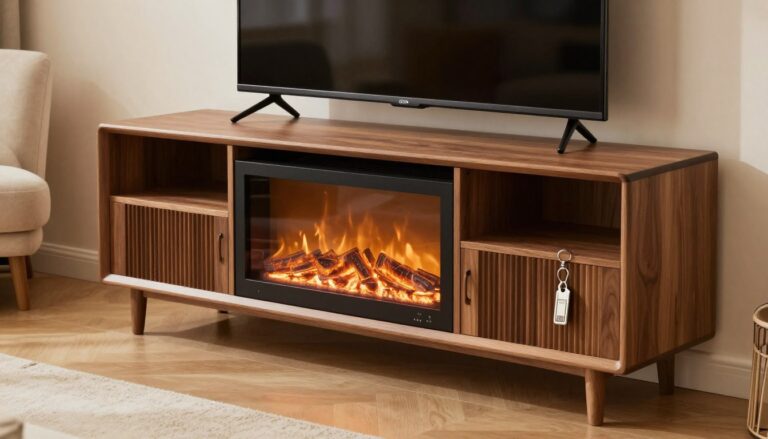
Do Fireplace TV Stands Take Up a Lot of Electricity?
Affiliate links — we may earn a commission
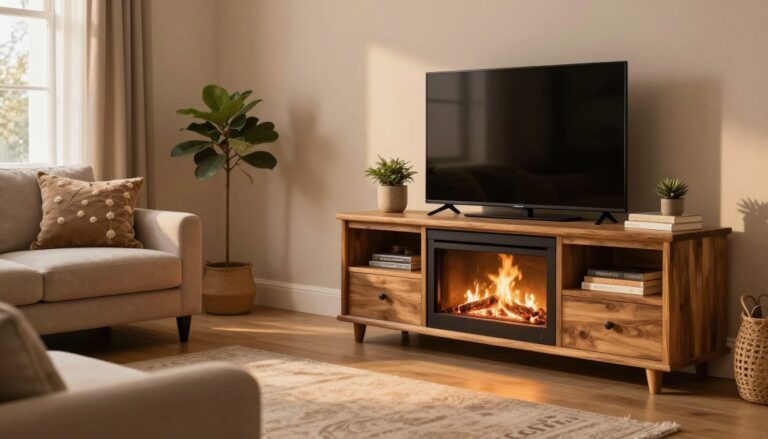
I brought home my first electric fireplace TV stand from Walker Edison one night. My wife thought I was crazy. “It’ll raise our electric bill,” she said. But I plugged it in, and our living room lit up. Our energy bill didn’t change much after three months.
I worried a lot about the electricity use before buying. I read online, watched videos, and even talked to an electrician. But it turned out, my worries were unfounded.
These stands use a standard outlet. No need for special wiring or an electrician. Most people spend less than $20 a month on them. That’s less than my Starbucks coffee budget.
The energy use depends on how you use it. If you just want the flame, it uses little electricity. But if you turn on the heater, it uses more. Yet, it’s usually okay for most homes.
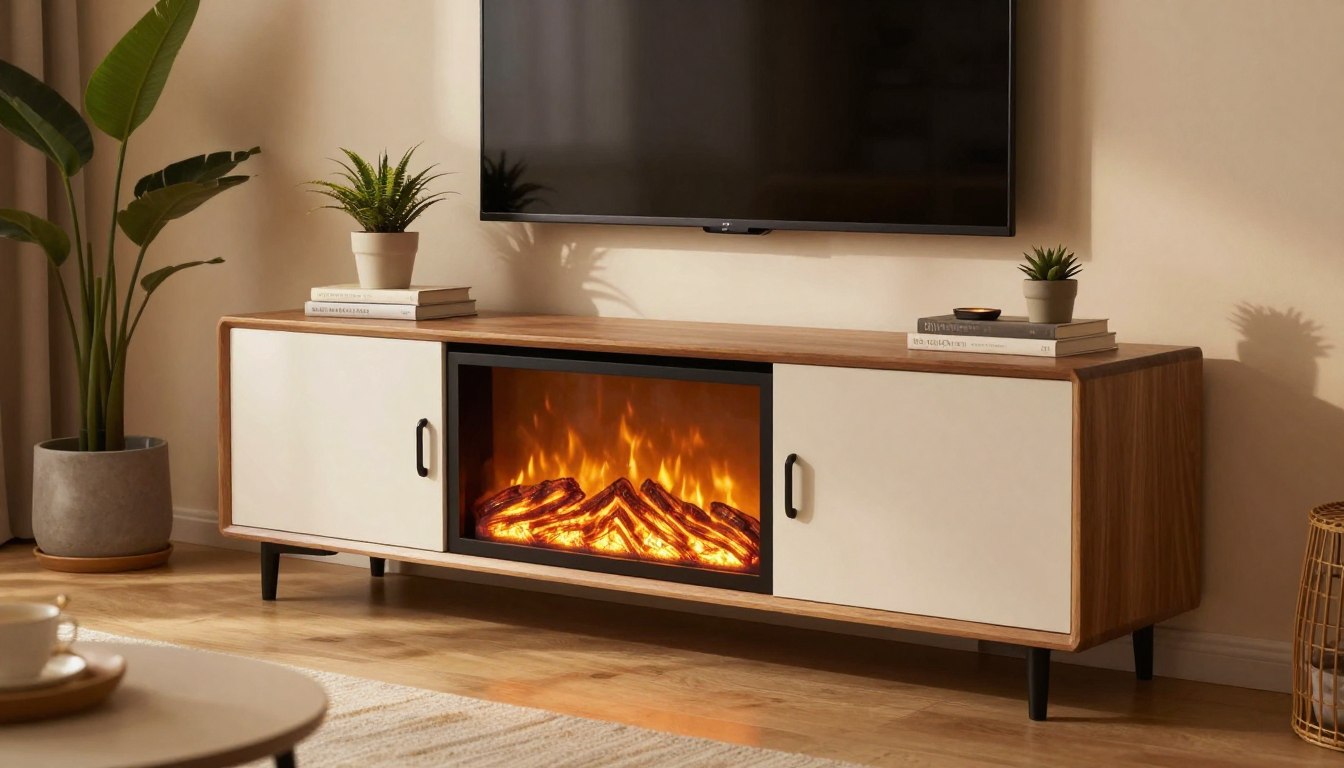
What really sold me was its dual function. It holds my 65-inch Samsung, my PlayStation 5, and warms our living room. It’s like having three pieces of furniture in one.
Key Takeaways
- Electric fireplace TV stands plug into standard outlets and don’t require special wiring or installation.
- Monthly operating costs typically fall between $15 and $25 with normal usage habits.
- The flame-only mode uses very little electricity compared to the heating function.
- Most units draw between 750 and 1,500 watts when the heater is running.
- Electric fireplace TV stand energy consumption is far lower than traditional HVAC systems or gas fireplaces.
- Built-in features like thermostats and timers help keep your electric bill in check.
Understanding Electric Fireplace TV Stand Power Consumption
Before I worry about my electric bill, I want to know the facts. Let’s break down the power usage of fireplace TV consoles. These units have two parts: the visual flame effect and the heater. Each part uses electricity at different rates.
How Wattage Works in Electric Fireplace Units
Wattage shows how fast a device uses energy. When I ask how much electricity a fireplace TV stand uses, the answer changes based on its function. If it’s just showing flames, it uses almost no energy. But, if the heater is on, it uses more.
I think of it like a car. Cruise control is like the flames, and flooring the gas pedal is like the heater.
Comparing LED Flame Effects vs Heating Functions
The difference between LED flame effects and the heater is huge. LED flames use only 2 to 10 watts per hour. That’s less than a lamp on my nightstand. Running flames for hours each day costs less than $1–$2 a month.
The heater, on the other hand, is a different story.
| Function | Wattage | Daily Cost (3 hrs at $0.12/kWh) | Monthly Cost |
|---|---|---|---|
| LED Flame Effects Only | 2–10 watts | Less than $0.01 | Under $1 |
| Low Heat Setting | 750 watts | $0.27 | ~$8 |
| High Heat Setting | 1,500 watts | $0.54 | ~$16 |
Typical Power Draw: 750-1500 Watts Explained
Most electric fireplace TV stands have two heat settings: 750W and 1,500W. At $0.12 per kWh, the high setting for three hours daily adds about $16 to my bill. The low setting cuts that in half.
“The best heating appliance is the one you only run when you actually need it.”
Understanding the power usage of fireplace TV consoles helps me make better choices. Knowing how much electricity they use makes the numbers less scary. Next, I’ll look at what this means for my monthly energy costs.
Do Fireplace TV Stands Take Up a Lot of Electricity?
I get this question all the time, and I love giving the answer. These units won’t wreck your electric bill. Once you understand TV stand with electric fireplace wattage and how it translates to real dollars, you’ll breathe a sigh of relief.
Breaking Down Monthly Energy Costs
Let me crunch some numbers. A standard 1,500-watt fireplace TV stand running 3 hours per day costs about $0.54 daily at average U.S. electricity rates (roughly $0.16 per kWh, per the EIA). That adds up to around $16 per month. Drop it to the low 750-watt setting, and you’re looking at just $0.27 per day — or about $8 monthly.
| Setting | Wattage | Daily Cost (3 hrs) | Monthly Cost |
|---|---|---|---|
| Low Heat | 750W | $0.27 | ~$8 |
| High Heat | 1,500W | $0.54 | ~$16 |
| Flame Only | ~10W | Less than $0.01 | ~$0.50 |
Real-World Usage: $15-$25 Monthly Average
Most people I’ve spoken with report electric fireplace media center energy costs landing between $15 and $25 per month. This is much less than gas fireplaces at $40–$60 monthly or wood-burning setups exceeding $50 once you factor in logs and upkeep. That’s a pretty sweet deal.
Factors That Affect Your Electric Bill
Your actual costs depend on a few key variables:
- Heater setting: Low mode draws half the power of high mode
- Thermostat cycling: A built-in thermostat turns the heater on and off, reducing total run time
- Room size: Smaller rooms reach target temperature faster
- Daily usage patterns: Running it 4 hours versus 2 hours doubles your cost
- Local electricity rates: Prices vary widely across states
Understanding TV stand with electric fireplace wattage helps you predict these expenses with confidence. In the next section, I’ll walk through the energy-saving features that can push your electric fireplace media center energy costs even lower.
Energy Efficiency Features That Save You Money
Saving money is great, and energy efficient fireplace TV stands make it easy. They come with smart features that lower your bills. These tools can cut your costs by 30–50% compared to using a full heater all day.
Thermostats and Automatic Temperature Control
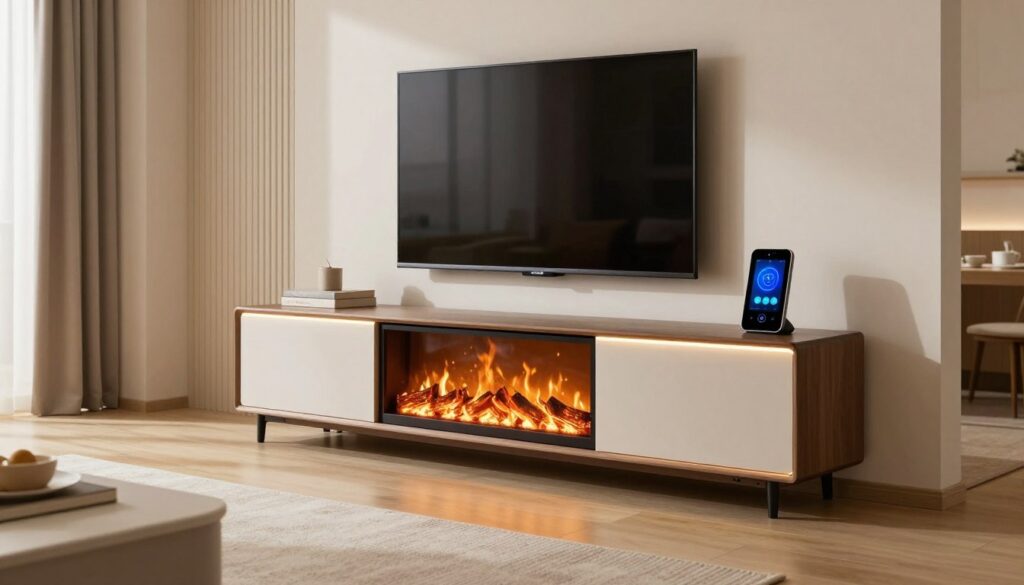
Built-in thermostats are a big help. They turn the heater on and off to keep your room at the right temperature. When it’s just right, the heater stops using full power. This saves you money and keeps your electricity bill down.
Look for models with ETL or CSA safety certifications. These confirm the unit is safe and energy efficient.
Timer Functions and Smart Shutoff Systems
Timers are a lifesaver. They turn off your fireplace when you’re not using it. This stops you from wasting electricity while you sleep.
Flame-Only Mode: Ambiance Without the Heat
Flame-only mode is my favorite feature. It uses just 2–10 watts to show off the LED visuals. This is less power than a nightlight. You get the cozy look without the heat, saving you money in warm months.
Zone Heating Benefits
Zone heating is simple and smart. It warms the room you’re in and lowers your main thermostat. This can completely offset the cost of your electric fireplace.
| Feature | Energy Savings | Power Draw |
|---|---|---|
| Built-in Thermostat | Up to 33% | Cycles between 0–1500W |
| Timer/Auto Shutoff | Up to 25% | Eliminates idle usage |
| Flame-Only Mode | Up to 99% | 2–10W |
| Zone Heating Strategy | Up to 50% | 750–1500W (occupied room only) |
With these features, energy efficient fireplace TV stands are a smart choice. Next, I’ll compare them to other heating methods to show their value.
Comparing Fireplace TV Stands to Other Heating Methods
Do fireplace TV stands use a lot of electricity compared to other heating methods? I looked into it, and the answer might surprise you. Electric fireplaces turn nearly 100% of electricity into heat. They don’t lose energy through chimneys or flues. This is a big advantage over others.
Gas fireplaces are 70–90% efficient. Wood-burning ones are only 50–80% efficient. This means half your wood might just heat the sky, not your room. Adding chimney cleaning, venting, and fuel costs, electric fireplaces seem like a smart choice.
| Heating Method | Efficiency | Monthly Cost | Installation Needed | Emissions |
|---|---|---|---|---|
| Electric Fireplace TV Stand | ~100% | $15–$25 | None (plug-in) | Zero |
| Gas Fireplace | 70–90% | $40–$60 | Venting + gas line | CO₂, water vapor |
| Wood-Burning Fireplace | 50–80% | $50+ | Chimney + hearth | Smoke, particulates |
| Portable Space Heater | ~100% | $20–$30 | None (plug-in) | Zero |
What I love about electric fireplace TV stands is that they’re two products in one. A space heater sits on the floor but looks dull. A fireplace TV stand holds your TV, media, and heats your room all in one piece.
“The cheapest energy is the energy you don’t waste.” — Amory Lovins, Rocky Mountain Institute
Gas might be cheaper in some areas. But for extra heat, electric fireplaces are hard to beat. They offer:
- Instant on/off with zero warm-up time
- No smoke, fumes, or harmful emissions
- Zero maintenance costs for chimneys or gas lines
- Simple plug-and-play setup right out of the box
These units save energy, keeping costs low. And as we’ll see next, how big your room is affects how well your fireplace TV stand works.
Room Size Impact on Electric Fireplace Efficiency
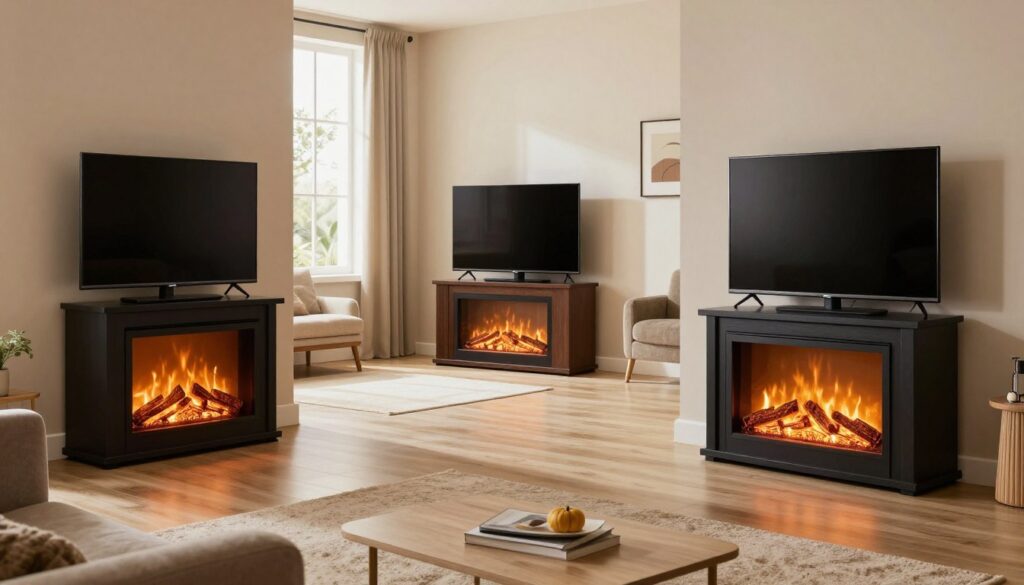
I’ve found that the power use of a fireplace TV stand greatly depends on your room size. A small unit can be efficient in a cozy den but not in a large living area. Here’s a guide by square footage to help you understand the impact.
Small Rooms (Up to 400 sq. ft.): Optimal Performance
In small rooms, a 1,500W electric fireplace works best. It heats the room quickly and efficiently. Once it reaches the desired temperature, it turns off, saving energy.
Keeping doors closed helps keep the warmth inside. This makes the fireplace even more energy-efficient.
Medium Rooms (400-600 sq. ft.): Moderate Energy Use
In medium rooms, the heater turns on and off more often. It’s effective in warming the space, working well with central heating. The energy use is similar to a central unit for one room.
Factors like ceiling height and insulation affect its performance.
Large Spaces: Supplemental Heating Considerations
For rooms over 600 square feet, the electric fireplace is a supplemental heat source. It’s best used with central heating. It helps warm seating areas but can’t heat the whole space.
| Room Size | Heating Role | Heater Cycling | Estimated Monthly Cost |
|---|---|---|---|
| Up to 400 sq. ft. | Primary heat source | Less frequent | $15–$20 |
| 400–600 sq. ft. | Zone heating | Moderate | $20–$25 |
| 600+ sq. ft. | Supplemental only | Near constant | $25–$35 |
Poor insulation can increase energy costs, regardless of room size. Before focusing on the fireplace’s power use, check your insulation. That’s where you can save the most.
Smart Usage Tips to Minimize Electricity Consumption
I see my electric fireplace like my car. It’s not the machine that costs a lot, it’s how I use it. A few smart habits can cut your electric fireplace energy costs by 30–50%. That means more money in your pocket every month.
- Drop to 750W mode when your room is almost warm enough. This cuts the TV stand with electric fireplace wattage in half right away.
- Switch to flame-only mode for cozy nights. It uses only 2–10 watts, less than a standard LED bulb. This gives you warmth without using a lot of energy.
- Use built-in timers to turn off the unit when you sleep or leave. You don’t need a warm living room at 3 a.m.
- Close doors to the room you’re heating. This makes spaces warm faster and keeps the heat in longer.
- Lower your central thermostat by 3–5 degrees when zone heating. This helps offset the costs of your electric fireplace against your main HVAC system.
- Run your unit during off-peak hours if your utility offers cheaper rates. Rates can be 20–40% lower during these times.
The cheapest kilowatt-hour is the one you never use.
I put my unit in the main living area where my family spends most of their time. Heating an unused guest bedroom? That’s just wasting money. The TV stand with electric fireplace wattage stays the same, but the value you get from each watt changes a lot based on where you place it.
Small changes can make a big difference. Going from a $12 monthly bill to a $30 one is all about making smart choices.
Different TV Stand Sizes and Their Power Requirements
Here’s a fun secret I love sharing: the size of your fireplace TV stand has zero impact on your electricity usage. Whether you pick a sleek 55-inch model or a jaw-dropping 75-inch unit, the heating element inside stays the same. Your fireplace TV stand monthly electricity bill won’t budge just because you went bigger.
All sizes run on the same 750W or 1500W heating elements. The extra inches give you more storage, style, and screen real estate — not a bigger power bill.
55-Inch Models: Same Wattage, Compact Design
I find 55-inch models perfect for apartments and cozy bedrooms. They pack full 750W/1500W heating power into a compact frame. You get the same warmth and flame ambiance without eating up floor space. Energy efficient fireplace TV stands in this size prove that small doesn’t mean weak.
65-Inch Units: Storage Without Extra Energy Cost
Stepping up to a 65-inch unit gives you extra shelving and cabinet space. Your daily operating cost stays at roughly $0.27 to $0.54 for three hours of use. Brands like Povison offer stunning options — their Modern Light Luxury Fireplace TV Stand features a polished stone finish that looks expensive but runs cheap.
75-Inch Stands: Maximum Style, Standard Power Draw
The 75-inch stands are showstoppers. Povison’s 78.74″ Modern Fireplace TV Stand with bold geometry and their 78.74″ Modern TV Stand with LED Flame Effects both maintain standard power draw. Your fireplace TV stand monthly electricity bill remains the same $15–$25 monthly average I covered earlier.
| Stand Size | Wattage Options | Daily Cost (3 hrs) | Monthly Cost Estimate | Best For |
|---|---|---|---|---|
| 55-Inch | 750W / 1500W | $0.27 – $0.54 | $8 – $16 | Apartments, bedrooms |
| 65-Inch | 750W / 1500W | $0.27 – $0.54 | $8 – $16 | Living rooms, dens |
| 75-Inch | 750W / 1500W | $0.27 – $0.54 | $8 – $16 | Great rooms, entertainment spaces |
Picking energy efficient fireplace TV stands comes down to room size and style — not worrying about wattage differences. Go big with confidence.
Environmental and Cost Benefits of Electric Fireplace TV Stands
I love finding deals, and electric fireplace TV stands are a great find. They’re good for the planet and your wallet. So, do fireplace tv stands use a lot of electricity? Not really, when you think about all the money you save.
No Emissions or Venting Requirements
Electric fireplaces don’t produce smoke or harmful gases. This means no worries about air quality or carbon monoxide. You don’t need a chimney or gas line, saving you thousands of dollars.
Nearly 100% Energy Efficiency Rating
Electric fireplaces are super efficient. They turn almost all electricity into heat. Traditional fireplaces lose a lot of heat through the chimney. Brands like RealCozy and Povison are certified to be very efficient.
Lower Maintenance Costs Than Traditional Fireplaces
Old fireplaces needed yearly cleanings and chimney sweeps. Electric units don’t. They’re safe and easy to maintain. The LED flames last a long time with little upkeep.
| Cost Category | Electric Fireplace TV Stand | Wood-Burning Fireplace | Gas Fireplace |
|---|---|---|---|
| Annual Maintenance | $0–$20 | $200–$400 | $150–$300 |
| Installation Cost | $0 (plug-in) | $2,000–$5,000 | $1,500–$3,500 |
| Annual Fuel/Energy Cost | $180–$300 | $400–$800 | $300–$600 |
| Emissions Produced | None | Smoke and particulates | Carbon dioxide |
The savings over time make electric fireplace TV stands a smart choice. They’re a great investment for your home.
Conclusion
So, do fireplace TV stands take up a lot of electricity? No, they don’t. They cost about $15 to $25 a month, even with four hours of use each day. This is less than what I spend on coffee weekly.
These units offer warmth, ambiance, and a spot for my TV. They’re a great deal for the price.
Electric fireplace TV stands use the same amount of power, whether they’re small or large. They have 750 to 1500W wattage. This means you can control how much energy you use with thermostats, timers, and flame-only modes.
Zone heating lets you warm just the room you’re in. This saves energy and keeps your home cozy.
These stands are nearly 100% energy efficient and don’t produce emissions. They also need almost no maintenance. Compared to traditional fireplaces, they’re a better choice in every way.
For me, the small increase in my electric bill is worth it. I get cozy evenings, a beautiful flame display, and a modern entertainment center. It’s a great value.
FAQ
Do fireplace TV stands take up a lot of electricity?
FAQ
Do fireplace TV stands take up a lot of electricity?
No, they really don’t — and I say that with genuine enthusiasm. Most electric fireplace TV stands cost between and per month to operate with average daily use of about 4 hours. If you’re only running the LED flame effects without the heater, you’re looking at a mere 2-10 watts, which adds less than
FAQ
Do fireplace TV stands take up a lot of electricity?
No, they really don’t — and I say that with genuine enthusiasm. Most electric fireplace TV stands cost between $15 and $25 per month to operate with average daily use of about 4 hours. If you’re only running the LED flame effects without the heater, you’re looking at a mere 2-10 watts, which adds less than $1-2 to your monthly bill. The heating function draws more at 750-1500 watts, but even at full power for 3 hours daily, that’s roughly $16 per month at the national average electricity rate of $0.12/kWh. So unless you’re leaving it blasting on high 24/7, your wallet can relax.
How much electricity does a fireplace TV stand use compared to a space heater?
Here’s where it gets interesting — the electric fireplace TV stand energy consumption is virtually identical to a standard space heater because they use the same 750W/1500W heating elements. Both cost roughly $12-$25 monthly depending on usage. The difference? My fireplace TV stand also holds my 65-inch television, stores my media gear, and looks like a legitimate piece of furniture instead of a sad plastic box sitting in the corner. I’d call that a win on the value front.
What does the fireplace TV stand monthly electricity bill look like on low versus high settings?
I love this question because the math is wonderfully straightforward. Running a unit on the low setting (750W) for 3 hours daily costs approximately $0.27 per day, totaling around $8 monthly. Crank it to the high setting (1500W) for the same duration, and you’re looking at about $0.54 daily or roughly $16 per month. The fireplace TV console power usage is entirely in your hands — literally, as most come with remote controls.
Are electric fireplace TV stands more energy efficient than gas or wood-burning fireplaces?
Dramatically so, and I’m not exaggerating. Electric fireplace TV stands achieve nearly 100% efficiency because every watt of electricity converts directly to heat — no energy escapes through a chimney or flue. Gas fireplaces operate at 70-90% efficiency and cost $40-$60 monthly, while wood-burning options hover at 50-80% efficiency and run $50+ monthly when you factor in wood and upkeep. The electric fireplace entertainment center operating costs make the competition look downright extravagant.
Does a larger TV stand with electric fireplace use more wattage than a smaller one?
This is one of my favorite myths to bust. Whether you choose a compact 55-inch model or a sprawling 75-inch stand like the Povison 78.74″ Modern Fireplace TV Stand, the TV stand with electric fireplace wattage remains the same standard 750W/1500W. The size difference affects storage capacity and aesthetic presence, not your electricity meter. My 75-inch unit costs exactly the same to operate as a 55-inch model — roughly $0.27 to $0.54 daily for 3 hours of heated use.
What are the most energy efficient fireplace TV stands features I should look for?
I’d prioritize four features that can reduce your electric fireplace media center energy costs by 30-50%. First, a built-in thermostat that cycles the heater on and off to maintain your desired temperature instead of running continuously. Second, timer functions that automatically shut the unit off when you’re asleep or away. Third, a flame-only mode that delivers gorgeous ambiance at just 2-10 watts. Fourth, look for ETL and CSA safety certifications, which confirm the unit has been tested for both electrical safety and energy performance. Brands like RealCozy and Povison incorporate all of these intelligently.
Can zone heating with a fireplace TV stand actually save me money overall?
Absolutely, and this is the strategy I personally swear by. The zone heating concept means I warm only the room I’m actually using — my living room — while lowering my central thermostat by a few degrees. This can potentially offset the electric fireplace operating costs entirely through savings on my main heating bill. Instead of heating 2,000 square feet of house to 72°F, I heat my living room with the fireplace TV stand and keep the rest at 66°F. The math works beautifully, even in smaller rooms up to 400 square feet where the 1500W unit reaches target temperature quickly and cycles less frequently.
How does room size affect how much electricity my fireplace TV stand consumes?
Room size is honestly the unsung hero of this entire conversation. In a small room up to 400 square feet, a 1500W unit reaches comfortable temperature quickly and then cycles down, using less electricity overall. In medium rooms of 400-600 square feet, the heater cycles more frequently but performs comparably to zoned central heating. For large spaces over 600 square feet, I’d recommend treating the unit as supplemental heat alongside your central system. Pro tip: closing doors to the heated room dramatically improves efficiency by containing warm air.
Do electric fireplace TV stands require venting or produce any emissions?
Zero emissions, zero venting, zero guilt — that’s my kind of appliance. Electric fireplace TV stands produce no smoke, fumes, or harmful byproducts, which means no chimney installation, no gas line hookup, and no indoor air quality concerns. They plug into a standard wall outlet and that’s genuinely the entire installation process. There’s no fuel storage to worry about either, eliminating the safety hazards associated with wood piles or propane tanks. The LED flame technology in the visual effects ensures long-lasting performance with minimal replacement needs, and maintenance costs stay refreshingly close to nothing — no chimney sweeps, no ash cleanup, no annual gas line inspections.
What are the best smart usage tips to keep my fireplace TV stand electricity costs minimal?
I’ve refined my approach over time, and these habits genuinely make the difference between economical operation and unnecessary expense. Start by using the low heat setting (750W) once your room approaches target temperature — that immediately cuts power consumption in half. Use flame-only mode during evenings when you want the cozy look without the heat, consuming just 2-10 watts. Set timers so the unit doesn’t run while you’re sleeping or away. Close doors to trap heat effectively. If your utility offers time-of-use rates, run the heater during off-peak hours for lower costs. And lower your central thermostat by a few degrees when zone heating. Combined, these adjustments can slash your electric fireplace TV stand energy consumption by 30-50% compared to full-power continuous operation.
-2 to your monthly bill. The heating function draws more at 750-1500 watts, but even at full power for 3 hours daily, that’s roughly per month at the national average electricity rate of
FAQ
Do fireplace TV stands take up a lot of electricity?
No, they really don’t — and I say that with genuine enthusiasm. Most electric fireplace TV stands cost between $15 and $25 per month to operate with average daily use of about 4 hours. If you’re only running the LED flame effects without the heater, you’re looking at a mere 2-10 watts, which adds less than $1-2 to your monthly bill. The heating function draws more at 750-1500 watts, but even at full power for 3 hours daily, that’s roughly $16 per month at the national average electricity rate of $0.12/kWh. So unless you’re leaving it blasting on high 24/7, your wallet can relax.
How much electricity does a fireplace TV stand use compared to a space heater?
Here’s where it gets interesting — the electric fireplace TV stand energy consumption is virtually identical to a standard space heater because they use the same 750W/1500W heating elements. Both cost roughly $12-$25 monthly depending on usage. The difference? My fireplace TV stand also holds my 65-inch television, stores my media gear, and looks like a legitimate piece of furniture instead of a sad plastic box sitting in the corner. I’d call that a win on the value front.
What does the fireplace TV stand monthly electricity bill look like on low versus high settings?
I love this question because the math is wonderfully straightforward. Running a unit on the low setting (750W) for 3 hours daily costs approximately $0.27 per day, totaling around $8 monthly. Crank it to the high setting (1500W) for the same duration, and you’re looking at about $0.54 daily or roughly $16 per month. The fireplace TV console power usage is entirely in your hands — literally, as most come with remote controls.
Are electric fireplace TV stands more energy efficient than gas or wood-burning fireplaces?
Dramatically so, and I’m not exaggerating. Electric fireplace TV stands achieve nearly 100% efficiency because every watt of electricity converts directly to heat — no energy escapes through a chimney or flue. Gas fireplaces operate at 70-90% efficiency and cost $40-$60 monthly, while wood-burning options hover at 50-80% efficiency and run $50+ monthly when you factor in wood and upkeep. The electric fireplace entertainment center operating costs make the competition look downright extravagant.
Does a larger TV stand with electric fireplace use more wattage than a smaller one?
This is one of my favorite myths to bust. Whether you choose a compact 55-inch model or a sprawling 75-inch stand like the Povison 78.74″ Modern Fireplace TV Stand, the TV stand with electric fireplace wattage remains the same standard 750W/1500W. The size difference affects storage capacity and aesthetic presence, not your electricity meter. My 75-inch unit costs exactly the same to operate as a 55-inch model — roughly $0.27 to $0.54 daily for 3 hours of heated use.
What are the most energy efficient fireplace TV stands features I should look for?
I’d prioritize four features that can reduce your electric fireplace media center energy costs by 30-50%. First, a built-in thermostat that cycles the heater on and off to maintain your desired temperature instead of running continuously. Second, timer functions that automatically shut the unit off when you’re asleep or away. Third, a flame-only mode that delivers gorgeous ambiance at just 2-10 watts. Fourth, look for ETL and CSA safety certifications, which confirm the unit has been tested for both electrical safety and energy performance. Brands like RealCozy and Povison incorporate all of these intelligently.
Can zone heating with a fireplace TV stand actually save me money overall?
Absolutely, and this is the strategy I personally swear by. The zone heating concept means I warm only the room I’m actually using — my living room — while lowering my central thermostat by a few degrees. This can potentially offset the electric fireplace operating costs entirely through savings on my main heating bill. Instead of heating 2,000 square feet of house to 72°F, I heat my living room with the fireplace TV stand and keep the rest at 66°F. The math works beautifully, even in smaller rooms up to 400 square feet where the 1500W unit reaches target temperature quickly and cycles less frequently.
How does room size affect how much electricity my fireplace TV stand consumes?
Room size is honestly the unsung hero of this entire conversation. In a small room up to 400 square feet, a 1500W unit reaches comfortable temperature quickly and then cycles down, using less electricity overall. In medium rooms of 400-600 square feet, the heater cycles more frequently but performs comparably to zoned central heating. For large spaces over 600 square feet, I’d recommend treating the unit as supplemental heat alongside your central system. Pro tip: closing doors to the heated room dramatically improves efficiency by containing warm air.
Do electric fireplace TV stands require venting or produce any emissions?
Zero emissions, zero venting, zero guilt — that’s my kind of appliance. Electric fireplace TV stands produce no smoke, fumes, or harmful byproducts, which means no chimney installation, no gas line hookup, and no indoor air quality concerns. They plug into a standard wall outlet and that’s genuinely the entire installation process. There’s no fuel storage to worry about either, eliminating the safety hazards associated with wood piles or propane tanks. The LED flame technology in the visual effects ensures long-lasting performance with minimal replacement needs, and maintenance costs stay refreshingly close to nothing — no chimney sweeps, no ash cleanup, no annual gas line inspections.
What are the best smart usage tips to keep my fireplace TV stand electricity costs minimal?
I’ve refined my approach over time, and these habits genuinely make the difference between economical operation and unnecessary expense. Start by using the low heat setting (750W) once your room approaches target temperature — that immediately cuts power consumption in half. Use flame-only mode during evenings when you want the cozy look without the heat, consuming just 2-10 watts. Set timers so the unit doesn’t run while you’re sleeping or away. Close doors to trap heat effectively. If your utility offers time-of-use rates, run the heater during off-peak hours for lower costs. And lower your central thermostat by a few degrees when zone heating. Combined, these adjustments can slash your electric fireplace TV stand energy consumption by 30-50% compared to full-power continuous operation.
FAQ
Do fireplace TV stands take up a lot of electricity?
No, they really don’t — and I say that with genuine enthusiasm. Most electric fireplace TV stands cost between and per month to operate with average daily use of about 4 hours. If you’re only running the LED flame effects without the heater, you’re looking at a mere 2-10 watts, which adds less than
FAQ
Do fireplace TV stands take up a lot of electricity?
No, they really don’t — and I say that with genuine enthusiasm. Most electric fireplace TV stands cost between $15 and $25 per month to operate with average daily use of about 4 hours. If you’re only running the LED flame effects without the heater, you’re looking at a mere 2-10 watts, which adds less than $1-2 to your monthly bill. The heating function draws more at 750-1500 watts, but even at full power for 3 hours daily, that’s roughly $16 per month at the national average electricity rate of $0.12/kWh. So unless you’re leaving it blasting on high 24/7, your wallet can relax.
How much electricity does a fireplace TV stand use compared to a space heater?
Here’s where it gets interesting — the electric fireplace TV stand energy consumption is virtually identical to a standard space heater because they use the same 750W/1500W heating elements. Both cost roughly $12-$25 monthly depending on usage. The difference? My fireplace TV stand also holds my 65-inch television, stores my media gear, and looks like a legitimate piece of furniture instead of a sad plastic box sitting in the corner. I’d call that a win on the value front.
What does the fireplace TV stand monthly electricity bill look like on low versus high settings?
I love this question because the math is wonderfully straightforward. Running a unit on the low setting (750W) for 3 hours daily costs approximately $0.27 per day, totaling around $8 monthly. Crank it to the high setting (1500W) for the same duration, and you’re looking at about $0.54 daily or roughly $16 per month. The fireplace TV console power usage is entirely in your hands — literally, as most come with remote controls.
Are electric fireplace TV stands more energy efficient than gas or wood-burning fireplaces?
Dramatically so, and I’m not exaggerating. Electric fireplace TV stands achieve nearly 100% efficiency because every watt of electricity converts directly to heat — no energy escapes through a chimney or flue. Gas fireplaces operate at 70-90% efficiency and cost $40-$60 monthly, while wood-burning options hover at 50-80% efficiency and run $50+ monthly when you factor in wood and upkeep. The electric fireplace entertainment center operating costs make the competition look downright extravagant.
Does a larger TV stand with electric fireplace use more wattage than a smaller one?
This is one of my favorite myths to bust. Whether you choose a compact 55-inch model or a sprawling 75-inch stand like the Povison 78.74″ Modern Fireplace TV Stand, the TV stand with electric fireplace wattage remains the same standard 750W/1500W. The size difference affects storage capacity and aesthetic presence, not your electricity meter. My 75-inch unit costs exactly the same to operate as a 55-inch model — roughly $0.27 to $0.54 daily for 3 hours of heated use.
What are the most energy efficient fireplace TV stands features I should look for?
I’d prioritize four features that can reduce your electric fireplace media center energy costs by 30-50%. First, a built-in thermostat that cycles the heater on and off to maintain your desired temperature instead of running continuously. Second, timer functions that automatically shut the unit off when you’re asleep or away. Third, a flame-only mode that delivers gorgeous ambiance at just 2-10 watts. Fourth, look for ETL and CSA safety certifications, which confirm the unit has been tested for both electrical safety and energy performance. Brands like RealCozy and Povison incorporate all of these intelligently.
Can zone heating with a fireplace TV stand actually save me money overall?
Absolutely, and this is the strategy I personally swear by. The zone heating concept means I warm only the room I’m actually using — my living room — while lowering my central thermostat by a few degrees. This can potentially offset the electric fireplace operating costs entirely through savings on my main heating bill. Instead of heating 2,000 square feet of house to 72°F, I heat my living room with the fireplace TV stand and keep the rest at 66°F. The math works beautifully, even in smaller rooms up to 400 square feet where the 1500W unit reaches target temperature quickly and cycles less frequently.
How does room size affect how much electricity my fireplace TV stand consumes?
Room size is honestly the unsung hero of this entire conversation. In a small room up to 400 square feet, a 1500W unit reaches comfortable temperature quickly and then cycles down, using less electricity overall. In medium rooms of 400-600 square feet, the heater cycles more frequently but performs comparably to zoned central heating. For large spaces over 600 square feet, I’d recommend treating the unit as supplemental heat alongside your central system. Pro tip: closing doors to the heated room dramatically improves efficiency by containing warm air.
Do electric fireplace TV stands require venting or produce any emissions?
Zero emissions, zero venting, zero guilt — that’s my kind of appliance. Electric fireplace TV stands produce no smoke, fumes, or harmful byproducts, which means no chimney installation, no gas line hookup, and no indoor air quality concerns. They plug into a standard wall outlet and that’s genuinely the entire installation process. There’s no fuel storage to worry about either, eliminating the safety hazards associated with wood piles or propane tanks. The LED flame technology in the visual effects ensures long-lasting performance with minimal replacement needs, and maintenance costs stay refreshingly close to nothing — no chimney sweeps, no ash cleanup, no annual gas line inspections.
What are the best smart usage tips to keep my fireplace TV stand electricity costs minimal?
I’ve refined my approach over time, and these habits genuinely make the difference between economical operation and unnecessary expense. Start by using the low heat setting (750W) once your room approaches target temperature — that immediately cuts power consumption in half. Use flame-only mode during evenings when you want the cozy look without the heat, consuming just 2-10 watts. Set timers so the unit doesn’t run while you’re sleeping or away. Close doors to trap heat effectively. If your utility offers time-of-use rates, run the heater during off-peak hours for lower costs. And lower your central thermostat by a few degrees when zone heating. Combined, these adjustments can slash your electric fireplace TV stand energy consumption by 30-50% compared to full-power continuous operation.
-2 to your monthly bill. The heating function draws more at 750-1500 watts, but even at full power for 3 hours daily, that’s roughly per month at the national average electricity rate of
FAQ
Do fireplace TV stands take up a lot of electricity?
No, they really don’t — and I say that with genuine enthusiasm. Most electric fireplace TV stands cost between $15 and $25 per month to operate with average daily use of about 4 hours. If you’re only running the LED flame effects without the heater, you’re looking at a mere 2-10 watts, which adds less than $1-2 to your monthly bill. The heating function draws more at 750-1500 watts, but even at full power for 3 hours daily, that’s roughly $16 per month at the national average electricity rate of $0.12/kWh. So unless you’re leaving it blasting on high 24/7, your wallet can relax.
How much electricity does a fireplace TV stand use compared to a space heater?
Here’s where it gets interesting — the electric fireplace TV stand energy consumption is virtually identical to a standard space heater because they use the same 750W/1500W heating elements. Both cost roughly $12-$25 monthly depending on usage. The difference? My fireplace TV stand also holds my 65-inch television, stores my media gear, and looks like a legitimate piece of furniture instead of a sad plastic box sitting in the corner. I’d call that a win on the value front.
What does the fireplace TV stand monthly electricity bill look like on low versus high settings?
I love this question because the math is wonderfully straightforward. Running a unit on the low setting (750W) for 3 hours daily costs approximately $0.27 per day, totaling around $8 monthly. Crank it to the high setting (1500W) for the same duration, and you’re looking at about $0.54 daily or roughly $16 per month. The fireplace TV console power usage is entirely in your hands — literally, as most come with remote controls.
Are electric fireplace TV stands more energy efficient than gas or wood-burning fireplaces?
Dramatically so, and I’m not exaggerating. Electric fireplace TV stands achieve nearly 100% efficiency because every watt of electricity converts directly to heat — no energy escapes through a chimney or flue. Gas fireplaces operate at 70-90% efficiency and cost $40-$60 monthly, while wood-burning options hover at 50-80% efficiency and run $50+ monthly when you factor in wood and upkeep. The electric fireplace entertainment center operating costs make the competition look downright extravagant.
Does a larger TV stand with electric fireplace use more wattage than a smaller one?
This is one of my favorite myths to bust. Whether you choose a compact 55-inch model or a sprawling 75-inch stand like the Povison 78.74″ Modern Fireplace TV Stand, the TV stand with electric fireplace wattage remains the same standard 750W/1500W. The size difference affects storage capacity and aesthetic presence, not your electricity meter. My 75-inch unit costs exactly the same to operate as a 55-inch model — roughly $0.27 to $0.54 daily for 3 hours of heated use.
What are the most energy efficient fireplace TV stands features I should look for?
I’d prioritize four features that can reduce your electric fireplace media center energy costs by 30-50%. First, a built-in thermostat that cycles the heater on and off to maintain your desired temperature instead of running continuously. Second, timer functions that automatically shut the unit off when you’re asleep or away. Third, a flame-only mode that delivers gorgeous ambiance at just 2-10 watts. Fourth, look for ETL and CSA safety certifications, which confirm the unit has been tested for both electrical safety and energy performance. Brands like RealCozy and Povison incorporate all of these intelligently.
Can zone heating with a fireplace TV stand actually save me money overall?
Absolutely, and this is the strategy I personally swear by. The zone heating concept means I warm only the room I’m actually using — my living room — while lowering my central thermostat by a few degrees. This can potentially offset the electric fireplace operating costs entirely through savings on my main heating bill. Instead of heating 2,000 square feet of house to 72°F, I heat my living room with the fireplace TV stand and keep the rest at 66°F. The math works beautifully, even in smaller rooms up to 400 square feet where the 1500W unit reaches target temperature quickly and cycles less frequently.
How does room size affect how much electricity my fireplace TV stand consumes?
Room size is honestly the unsung hero of this entire conversation. In a small room up to 400 square feet, a 1500W unit reaches comfortable temperature quickly and then cycles down, using less electricity overall. In medium rooms of 400-600 square feet, the heater cycles more frequently but performs comparably to zoned central heating. For large spaces over 600 square feet, I’d recommend treating the unit as supplemental heat alongside your central system. Pro tip: closing doors to the heated room dramatically improves efficiency by containing warm air.
Do electric fireplace TV stands require venting or produce any emissions?
Zero emissions, zero venting, zero guilt — that’s my kind of appliance. Electric fireplace TV stands produce no smoke, fumes, or harmful byproducts, which means no chimney installation, no gas line hookup, and no indoor air quality concerns. They plug into a standard wall outlet and that’s genuinely the entire installation process. There’s no fuel storage to worry about either, eliminating the safety hazards associated with wood piles or propane tanks. The LED flame technology in the visual effects ensures long-lasting performance with minimal replacement needs, and maintenance costs stay refreshingly close to nothing — no chimney sweeps, no ash cleanup, no annual gas line inspections.
What are the best smart usage tips to keep my fireplace TV stand electricity costs minimal?
I’ve refined my approach over time, and these habits genuinely make the difference between economical operation and unnecessary expense. Start by using the low heat setting (750W) once your room approaches target temperature — that immediately cuts power consumption in half. Use flame-only mode during evenings when you want the cozy look without the heat, consuming just 2-10 watts. Set timers so the unit doesn’t run while you’re sleeping or away. Close doors to trap heat effectively. If your utility offers time-of-use rates, run the heater during off-peak hours for lower costs. And lower your central thermostat by a few degrees when zone heating. Combined, these adjustments can slash your electric fireplace TV stand energy consumption by 30-50% compared to full-power continuous operation.
FAQ
Do fireplace TV stands take up a lot of electricity?
No, they really don’t — and I say that with genuine enthusiasm. Most electric fireplace TV stands cost between and per month to operate with average daily use of about 4 hours. If you’re only running the LED flame effects without the heater, you’re looking at a mere 2-10 watts, which adds less than
FAQ
Do fireplace TV stands take up a lot of electricity?
No, they really don’t — and I say that with genuine enthusiasm. Most electric fireplace TV stands cost between $15 and $25 per month to operate with average daily use of about 4 hours. If you’re only running the LED flame effects without the heater, you’re looking at a mere 2-10 watts, which adds less than $1-2 to your monthly bill. The heating function draws more at 750-1500 watts, but even at full power for 3 hours daily, that’s roughly $16 per month at the national average electricity rate of $0.12/kWh. So unless you’re leaving it blasting on high 24/7, your wallet can relax.
How much electricity does a fireplace TV stand use compared to a space heater?
Here’s where it gets interesting — the electric fireplace TV stand energy consumption is virtually identical to a standard space heater because they use the same 750W/1500W heating elements. Both cost roughly $12-$25 monthly depending on usage. The difference? My fireplace TV stand also holds my 65-inch television, stores my media gear, and looks like a legitimate piece of furniture instead of a sad plastic box sitting in the corner. I’d call that a win on the value front.
What does the fireplace TV stand monthly electricity bill look like on low versus high settings?
I love this question because the math is wonderfully straightforward. Running a unit on the low setting (750W) for 3 hours daily costs approximately $0.27 per day, totaling around $8 monthly. Crank it to the high setting (1500W) for the same duration, and you’re looking at about $0.54 daily or roughly $16 per month. The fireplace TV console power usage is entirely in your hands — literally, as most come with remote controls.
Are electric fireplace TV stands more energy efficient than gas or wood-burning fireplaces?
Dramatically so, and I’m not exaggerating. Electric fireplace TV stands achieve nearly 100% efficiency because every watt of electricity converts directly to heat — no energy escapes through a chimney or flue. Gas fireplaces operate at 70-90% efficiency and cost $40-$60 monthly, while wood-burning options hover at 50-80% efficiency and run $50+ monthly when you factor in wood and upkeep. The electric fireplace entertainment center operating costs make the competition look downright extravagant.
Does a larger TV stand with electric fireplace use more wattage than a smaller one?
This is one of my favorite myths to bust. Whether you choose a compact 55-inch model or a sprawling 75-inch stand like the Povison 78.74″ Modern Fireplace TV Stand, the TV stand with electric fireplace wattage remains the same standard 750W/1500W. The size difference affects storage capacity and aesthetic presence, not your electricity meter. My 75-inch unit costs exactly the same to operate as a 55-inch model — roughly $0.27 to $0.54 daily for 3 hours of heated use.
What are the most energy efficient fireplace TV stands features I should look for?
I’d prioritize four features that can reduce your electric fireplace media center energy costs by 30-50%. First, a built-in thermostat that cycles the heater on and off to maintain your desired temperature instead of running continuously. Second, timer functions that automatically shut the unit off when you’re asleep or away. Third, a flame-only mode that delivers gorgeous ambiance at just 2-10 watts. Fourth, look for ETL and CSA safety certifications, which confirm the unit has been tested for both electrical safety and energy performance. Brands like RealCozy and Povison incorporate all of these intelligently.
Can zone heating with a fireplace TV stand actually save me money overall?
Absolutely, and this is the strategy I personally swear by. The zone heating concept means I warm only the room I’m actually using — my living room — while lowering my central thermostat by a few degrees. This can potentially offset the electric fireplace operating costs entirely through savings on my main heating bill. Instead of heating 2,000 square feet of house to 72°F, I heat my living room with the fireplace TV stand and keep the rest at 66°F. The math works beautifully, even in smaller rooms up to 400 square feet where the 1500W unit reaches target temperature quickly and cycles less frequently.
How does room size affect how much electricity my fireplace TV stand consumes?
Room size is honestly the unsung hero of this entire conversation. In a small room up to 400 square feet, a 1500W unit reaches comfortable temperature quickly and then cycles down, using less electricity overall. In medium rooms of 400-600 square feet, the heater cycles more frequently but performs comparably to zoned central heating. For large spaces over 600 square feet, I’d recommend treating the unit as supplemental heat alongside your central system. Pro tip: closing doors to the heated room dramatically improves efficiency by containing warm air.
Do electric fireplace TV stands require venting or produce any emissions?
Zero emissions, zero venting, zero guilt — that’s my kind of appliance. Electric fireplace TV stands produce no smoke, fumes, or harmful byproducts, which means no chimney installation, no gas line hookup, and no indoor air quality concerns. They plug into a standard wall outlet and that’s genuinely the entire installation process. There’s no fuel storage to worry about either, eliminating the safety hazards associated with wood piles or propane tanks. The LED flame technology in the visual effects ensures long-lasting performance with minimal replacement needs, and maintenance costs stay refreshingly close to nothing — no chimney sweeps, no ash cleanup, no annual gas line inspections.
What are the best smart usage tips to keep my fireplace TV stand electricity costs minimal?
I’ve refined my approach over time, and these habits genuinely make the difference between economical operation and unnecessary expense. Start by using the low heat setting (750W) once your room approaches target temperature — that immediately cuts power consumption in half. Use flame-only mode during evenings when you want the cozy look without the heat, consuming just 2-10 watts. Set timers so the unit doesn’t run while you’re sleeping or away. Close doors to trap heat effectively. If your utility offers time-of-use rates, run the heater during off-peak hours for lower costs. And lower your central thermostat by a few degrees when zone heating. Combined, these adjustments can slash your electric fireplace TV stand energy consumption by 30-50% compared to full-power continuous operation.
-2 to your monthly bill. The heating function draws more at 750-1500 watts, but even at full power for 3 hours daily, that’s roughly per month at the national average electricity rate of
FAQ
Do fireplace TV stands take up a lot of electricity?
No, they really don’t — and I say that with genuine enthusiasm. Most electric fireplace TV stands cost between $15 and $25 per month to operate with average daily use of about 4 hours. If you’re only running the LED flame effects without the heater, you’re looking at a mere 2-10 watts, which adds less than $1-2 to your monthly bill. The heating function draws more at 750-1500 watts, but even at full power for 3 hours daily, that’s roughly $16 per month at the national average electricity rate of $0.12/kWh. So unless you’re leaving it blasting on high 24/7, your wallet can relax.
How much electricity does a fireplace TV stand use compared to a space heater?
Here’s where it gets interesting — the electric fireplace TV stand energy consumption is virtually identical to a standard space heater because they use the same 750W/1500W heating elements. Both cost roughly $12-$25 monthly depending on usage. The difference? My fireplace TV stand also holds my 65-inch television, stores my media gear, and looks like a legitimate piece of furniture instead of a sad plastic box sitting in the corner. I’d call that a win on the value front.
What does the fireplace TV stand monthly electricity bill look like on low versus high settings?
I love this question because the math is wonderfully straightforward. Running a unit on the low setting (750W) for 3 hours daily costs approximately $0.27 per day, totaling around $8 monthly. Crank it to the high setting (1500W) for the same duration, and you’re looking at about $0.54 daily or roughly $16 per month. The fireplace TV console power usage is entirely in your hands — literally, as most come with remote controls.
Are electric fireplace TV stands more energy efficient than gas or wood-burning fireplaces?
Dramatically so, and I’m not exaggerating. Electric fireplace TV stands achieve nearly 100% efficiency because every watt of electricity converts directly to heat — no energy escapes through a chimney or flue. Gas fireplaces operate at 70-90% efficiency and cost $40-$60 monthly, while wood-burning options hover at 50-80% efficiency and run $50+ monthly when you factor in wood and upkeep. The electric fireplace entertainment center operating costs make the competition look downright extravagant.
Does a larger TV stand with electric fireplace use more wattage than a smaller one?
This is one of my favorite myths to bust. Whether you choose a compact 55-inch model or a sprawling 75-inch stand like the Povison 78.74″ Modern Fireplace TV Stand, the TV stand with electric fireplace wattage remains the same standard 750W/1500W. The size difference affects storage capacity and aesthetic presence, not your electricity meter. My 75-inch unit costs exactly the same to operate as a 55-inch model — roughly $0.27 to $0.54 daily for 3 hours of heated use.
What are the most energy efficient fireplace TV stands features I should look for?
I’d prioritize four features that can reduce your electric fireplace media center energy costs by 30-50%. First, a built-in thermostat that cycles the heater on and off to maintain your desired temperature instead of running continuously. Second, timer functions that automatically shut the unit off when you’re asleep or away. Third, a flame-only mode that delivers gorgeous ambiance at just 2-10 watts. Fourth, look for ETL and CSA safety certifications, which confirm the unit has been tested for both electrical safety and energy performance. Brands like RealCozy and Povison incorporate all of these intelligently.
Can zone heating with a fireplace TV stand actually save me money overall?
Absolutely, and this is the strategy I personally swear by. The zone heating concept means I warm only the room I’m actually using — my living room — while lowering my central thermostat by a few degrees. This can potentially offset the electric fireplace operating costs entirely through savings on my main heating bill. Instead of heating 2,000 square feet of house to 72°F, I heat my living room with the fireplace TV stand and keep the rest at 66°F. The math works beautifully, even in smaller rooms up to 400 square feet where the 1500W unit reaches target temperature quickly and cycles less frequently.
How does room size affect how much electricity my fireplace TV stand consumes?
Room size is honestly the unsung hero of this entire conversation. In a small room up to 400 square feet, a 1500W unit reaches comfortable temperature quickly and then cycles down, using less electricity overall. In medium rooms of 400-600 square feet, the heater cycles more frequently but performs comparably to zoned central heating. For large spaces over 600 square feet, I’d recommend treating the unit as supplemental heat alongside your central system. Pro tip: closing doors to the heated room dramatically improves efficiency by containing warm air.
Do electric fireplace TV stands require venting or produce any emissions?
Zero emissions, zero venting, zero guilt — that’s my kind of appliance. Electric fireplace TV stands produce no smoke, fumes, or harmful byproducts, which means no chimney installation, no gas line hookup, and no indoor air quality concerns. They plug into a standard wall outlet and that’s genuinely the entire installation process. There’s no fuel storage to worry about either, eliminating the safety hazards associated with wood piles or propane tanks. The LED flame technology in the visual effects ensures long-lasting performance with minimal replacement needs, and maintenance costs stay refreshingly close to nothing — no chimney sweeps, no ash cleanup, no annual gas line inspections.
What are the best smart usage tips to keep my fireplace TV stand electricity costs minimal?
I’ve refined my approach over time, and these habits genuinely make the difference between economical operation and unnecessary expense. Start by using the low heat setting (750W) once your room approaches target temperature — that immediately cuts power consumption in half. Use flame-only mode during evenings when you want the cozy look without the heat, consuming just 2-10 watts. Set timers so the unit doesn’t run while you’re sleeping or away. Close doors to trap heat effectively. If your utility offers time-of-use rates, run the heater during off-peak hours for lower costs. And lower your central thermostat by a few degrees when zone heating. Combined, these adjustments can slash your electric fireplace TV stand energy consumption by 30-50% compared to full-power continuous operation.
FAQ
Do fireplace TV stands take up a lot of electricity?
No, they really don’t — and I say that with genuine enthusiasm. Most electric fireplace TV stands cost between and per month to operate with average daily use of about 4 hours. If you’re only running the LED flame effects without the heater, you’re looking at a mere 2-10 watts, which adds less than
FAQ
Do fireplace TV stands take up a lot of electricity?
No, they really don’t — and I say that with genuine enthusiasm. Most electric fireplace TV stands cost between $15 and $25 per month to operate with average daily use of about 4 hours. If you’re only running the LED flame effects without the heater, you’re looking at a mere 2-10 watts, which adds less than $1-2 to your monthly bill. The heating function draws more at 750-1500 watts, but even at full power for 3 hours daily, that’s roughly $16 per month at the national average electricity rate of $0.12/kWh. So unless you’re leaving it blasting on high 24/7, your wallet can relax.
How much electricity does a fireplace TV stand use compared to a space heater?
Here’s where it gets interesting — the electric fireplace TV stand energy consumption is virtually identical to a standard space heater because they use the same 750W/1500W heating elements. Both cost roughly $12-$25 monthly depending on usage. The difference? My fireplace TV stand also holds my 65-inch television, stores my media gear, and looks like a legitimate piece of furniture instead of a sad plastic box sitting in the corner. I’d call that a win on the value front.
What does the fireplace TV stand monthly electricity bill look like on low versus high settings?
I love this question because the math is wonderfully straightforward. Running a unit on the low setting (750W) for 3 hours daily costs approximately $0.27 per day, totaling around $8 monthly. Crank it to the high setting (1500W) for the same duration, and you’re looking at about $0.54 daily or roughly $16 per month. The fireplace TV console power usage is entirely in your hands — literally, as most come with remote controls.
Are electric fireplace TV stands more energy efficient than gas or wood-burning fireplaces?
Dramatically so, and I’m not exaggerating. Electric fireplace TV stands achieve nearly 100% efficiency because every watt of electricity converts directly to heat — no energy escapes through a chimney or flue. Gas fireplaces operate at 70-90% efficiency and cost $40-$60 monthly, while wood-burning options hover at 50-80% efficiency and run $50+ monthly when you factor in wood and upkeep. The electric fireplace entertainment center operating costs make the competition look downright extravagant.
Does a larger TV stand with electric fireplace use more wattage than a smaller one?
This is one of my favorite myths to bust. Whether you choose a compact 55-inch model or a sprawling 75-inch stand like the Povison 78.74″ Modern Fireplace TV Stand, the TV stand with electric fireplace wattage remains the same standard 750W/1500W. The size difference affects storage capacity and aesthetic presence, not your electricity meter. My 75-inch unit costs exactly the same to operate as a 55-inch model — roughly $0.27 to $0.54 daily for 3 hours of heated use.
What are the most energy efficient fireplace TV stands features I should look for?
I’d prioritize four features that can reduce your electric fireplace media center energy costs by 30-50%. First, a built-in thermostat that cycles the heater on and off to maintain your desired temperature instead of running continuously. Second, timer functions that automatically shut the unit off when you’re asleep or away. Third, a flame-only mode that delivers gorgeous ambiance at just 2-10 watts. Fourth, look for ETL and CSA safety certifications, which confirm the unit has been tested for both electrical safety and energy performance. Brands like RealCozy and Povison incorporate all of these intelligently.
Can zone heating with a fireplace TV stand actually save me money overall?
Absolutely, and this is the strategy I personally swear by. The zone heating concept means I warm only the room I’m actually using — my living room — while lowering my central thermostat by a few degrees. This can potentially offset the electric fireplace operating costs entirely through savings on my main heating bill. Instead of heating 2,000 square feet of house to 72°F, I heat my living room with the fireplace TV stand and keep the rest at 66°F. The math works beautifully, even in smaller rooms up to 400 square feet where the 1500W unit reaches target temperature quickly and cycles less frequently.
How does room size affect how much electricity my fireplace TV stand consumes?
Room size is honestly the unsung hero of this entire conversation. In a small room up to 400 square feet, a 1500W unit reaches comfortable temperature quickly and then cycles down, using less electricity overall. In medium rooms of 400-600 square feet, the heater cycles more frequently but performs comparably to zoned central heating. For large spaces over 600 square feet, I’d recommend treating the unit as supplemental heat alongside your central system. Pro tip: closing doors to the heated room dramatically improves efficiency by containing warm air.
Do electric fireplace TV stands require venting or produce any emissions?
Zero emissions, zero venting, zero guilt — that’s my kind of appliance. Electric fireplace TV stands produce no smoke, fumes, or harmful byproducts, which means no chimney installation, no gas line hookup, and no indoor air quality concerns. They plug into a standard wall outlet and that’s genuinely the entire installation process. There’s no fuel storage to worry about either, eliminating the safety hazards associated with wood piles or propane tanks. The LED flame technology in the visual effects ensures long-lasting performance with minimal replacement needs, and maintenance costs stay refreshingly close to nothing — no chimney sweeps, no ash cleanup, no annual gas line inspections.
What are the best smart usage tips to keep my fireplace TV stand electricity costs minimal?
I’ve refined my approach over time, and these habits genuinely make the difference between economical operation and unnecessary expense. Start by using the low heat setting (750W) once your room approaches target temperature — that immediately cuts power consumption in half. Use flame-only mode during evenings when you want the cozy look without the heat, consuming just 2-10 watts. Set timers so the unit doesn’t run while you’re sleeping or away. Close doors to trap heat effectively. If your utility offers time-of-use rates, run the heater during off-peak hours for lower costs. And lower your central thermostat by a few degrees when zone heating. Combined, these adjustments can slash your electric fireplace TV stand energy consumption by 30-50% compared to full-power continuous operation.
-2 to your monthly bill. The heating function draws more at 750-1500 watts, but even at full power for 3 hours daily, that’s roughly per month at the national average electricity rate of
FAQ
Do fireplace TV stands take up a lot of electricity?
No, they really don’t — and I say that with genuine enthusiasm. Most electric fireplace TV stands cost between $15 and $25 per month to operate with average daily use of about 4 hours. If you’re only running the LED flame effects without the heater, you’re looking at a mere 2-10 watts, which adds less than $1-2 to your monthly bill. The heating function draws more at 750-1500 watts, but even at full power for 3 hours daily, that’s roughly $16 per month at the national average electricity rate of $0.12/kWh. So unless you’re leaving it blasting on high 24/7, your wallet can relax.
How much electricity does a fireplace TV stand use compared to a space heater?
Here’s where it gets interesting — the electric fireplace TV stand energy consumption is virtually identical to a standard space heater because they use the same 750W/1500W heating elements. Both cost roughly $12-$25 monthly depending on usage. The difference? My fireplace TV stand also holds my 65-inch television, stores my media gear, and looks like a legitimate piece of furniture instead of a sad plastic box sitting in the corner. I’d call that a win on the value front.
What does the fireplace TV stand monthly electricity bill look like on low versus high settings?
I love this question because the math is wonderfully straightforward. Running a unit on the low setting (750W) for 3 hours daily costs approximately $0.27 per day, totaling around $8 monthly. Crank it to the high setting (1500W) for the same duration, and you’re looking at about $0.54 daily or roughly $16 per month. The fireplace TV console power usage is entirely in your hands — literally, as most come with remote controls.
Are electric fireplace TV stands more energy efficient than gas or wood-burning fireplaces?
Dramatically so, and I’m not exaggerating. Electric fireplace TV stands achieve nearly 100% efficiency because every watt of electricity converts directly to heat — no energy escapes through a chimney or flue. Gas fireplaces operate at 70-90% efficiency and cost $40-$60 monthly, while wood-burning options hover at 50-80% efficiency and run $50+ monthly when you factor in wood and upkeep. The electric fireplace entertainment center operating costs make the competition look downright extravagant.
Does a larger TV stand with electric fireplace use more wattage than a smaller one?
This is one of my favorite myths to bust. Whether you choose a compact 55-inch model or a sprawling 75-inch stand like the Povison 78.74″ Modern Fireplace TV Stand, the TV stand with electric fireplace wattage remains the same standard 750W/1500W. The size difference affects storage capacity and aesthetic presence, not your electricity meter. My 75-inch unit costs exactly the same to operate as a 55-inch model — roughly $0.27 to $0.54 daily for 3 hours of heated use.
What are the most energy efficient fireplace TV stands features I should look for?
I’d prioritize four features that can reduce your electric fireplace media center energy costs by 30-50%. First, a built-in thermostat that cycles the heater on and off to maintain your desired temperature instead of running continuously. Second, timer functions that automatically shut the unit off when you’re asleep or away. Third, a flame-only mode that delivers gorgeous ambiance at just 2-10 watts. Fourth, look for ETL and CSA safety certifications, which confirm the unit has been tested for both electrical safety and energy performance. Brands like RealCozy and Povison incorporate all of these intelligently.
Can zone heating with a fireplace TV stand actually save me money overall?
Absolutely, and this is the strategy I personally swear by. The zone heating concept means I warm only the room I’m actually using — my living room — while lowering my central thermostat by a few degrees. This can potentially offset the electric fireplace operating costs entirely through savings on my main heating bill. Instead of heating 2,000 square feet of house to 72°F, I heat my living room with the fireplace TV stand and keep the rest at 66°F. The math works beautifully, even in smaller rooms up to 400 square feet where the 1500W unit reaches target temperature quickly and cycles less frequently.
How does room size affect how much electricity my fireplace TV stand consumes?
Room size is honestly the unsung hero of this entire conversation. In a small room up to 400 square feet, a 1500W unit reaches comfortable temperature quickly and then cycles down, using less electricity overall. In medium rooms of 400-600 square feet, the heater cycles more frequently but performs comparably to zoned central heating. For large spaces over 600 square feet, I’d recommend treating the unit as supplemental heat alongside your central system. Pro tip: closing doors to the heated room dramatically improves efficiency by containing warm air.
Do electric fireplace TV stands require venting or produce any emissions?
Zero emissions, zero venting, zero guilt — that’s my kind of appliance. Electric fireplace TV stands produce no smoke, fumes, or harmful byproducts, which means no chimney installation, no gas line hookup, and no indoor air quality concerns. They plug into a standard wall outlet and that’s genuinely the entire installation process. There’s no fuel storage to worry about either, eliminating the safety hazards associated with wood piles or propane tanks. The LED flame technology in the visual effects ensures long-lasting performance with minimal replacement needs, and maintenance costs stay refreshingly close to nothing — no chimney sweeps, no ash cleanup, no annual gas line inspections.
What are the best smart usage tips to keep my fireplace TV stand electricity costs minimal?
I’ve refined my approach over time, and these habits genuinely make the difference between economical operation and unnecessary expense. Start by using the low heat setting (750W) once your room approaches target temperature — that immediately cuts power consumption in half. Use flame-only mode during evenings when you want the cozy look without the heat, consuming just 2-10 watts. Set timers so the unit doesn’t run while you’re sleeping or away. Close doors to trap heat effectively. If your utility offers time-of-use rates, run the heater during off-peak hours for lower costs. And lower your central thermostat by a few degrees when zone heating. Combined, these adjustments can slash your electric fireplace TV stand energy consumption by 30-50% compared to full-power continuous operation.
FAQ
Do fireplace TV stands take up a lot of electricity?
No, they really don’t — and I say that with genuine enthusiasm. Most electric fireplace TV stands cost between and per month to operate with average daily use of about 4 hours. If you’re only running the LED flame effects without the heater, you’re looking at a mere 2-10 watts, which adds less than
FAQ
Do fireplace TV stands take up a lot of electricity?
No, they really don’t — and I say that with genuine enthusiasm. Most electric fireplace TV stands cost between $15 and $25 per month to operate with average daily use of about 4 hours. If you’re only running the LED flame effects without the heater, you’re looking at a mere 2-10 watts, which adds less than $1-2 to your monthly bill. The heating function draws more at 750-1500 watts, but even at full power for 3 hours daily, that’s roughly $16 per month at the national average electricity rate of $0.12/kWh. So unless you’re leaving it blasting on high 24/7, your wallet can relax.
How much electricity does a fireplace TV stand use compared to a space heater?
Here’s where it gets interesting — the electric fireplace TV stand energy consumption is virtually identical to a standard space heater because they use the same 750W/1500W heating elements. Both cost roughly $12-$25 monthly depending on usage. The difference? My fireplace TV stand also holds my 65-inch television, stores my media gear, and looks like a legitimate piece of furniture instead of a sad plastic box sitting in the corner. I’d call that a win on the value front.
What does the fireplace TV stand monthly electricity bill look like on low versus high settings?
I love this question because the math is wonderfully straightforward. Running a unit on the low setting (750W) for 3 hours daily costs approximately $0.27 per day, totaling around $8 monthly. Crank it to the high setting (1500W) for the same duration, and you’re looking at about $0.54 daily or roughly $16 per month. The fireplace TV console power usage is entirely in your hands — literally, as most come with remote controls.
Are electric fireplace TV stands more energy efficient than gas or wood-burning fireplaces?
Dramatically so, and I’m not exaggerating. Electric fireplace TV stands achieve nearly 100% efficiency because every watt of electricity converts directly to heat — no energy escapes through a chimney or flue. Gas fireplaces operate at 70-90% efficiency and cost $40-$60 monthly, while wood-burning options hover at 50-80% efficiency and run $50+ monthly when you factor in wood and upkeep. The electric fireplace entertainment center operating costs make the competition look downright extravagant.
Does a larger TV stand with electric fireplace use more wattage than a smaller one?
This is one of my favorite myths to bust. Whether you choose a compact 55-inch model or a sprawling 75-inch stand like the Povison 78.74″ Modern Fireplace TV Stand, the TV stand with electric fireplace wattage remains the same standard 750W/1500W. The size difference affects storage capacity and aesthetic presence, not your electricity meter. My 75-inch unit costs exactly the same to operate as a 55-inch model — roughly $0.27 to $0.54 daily for 3 hours of heated use.
What are the most energy efficient fireplace TV stands features I should look for?
I’d prioritize four features that can reduce your electric fireplace media center energy costs by 30-50%. First, a built-in thermostat that cycles the heater on and off to maintain your desired temperature instead of running continuously. Second, timer functions that automatically shut the unit off when you’re asleep or away. Third, a flame-only mode that delivers gorgeous ambiance at just 2-10 watts. Fourth, look for ETL and CSA safety certifications, which confirm the unit has been tested for both electrical safety and energy performance. Brands like RealCozy and Povison incorporate all of these intelligently.
Can zone heating with a fireplace TV stand actually save me money overall?
Absolutely, and this is the strategy I personally swear by. The zone heating concept means I warm only the room I’m actually using — my living room — while lowering my central thermostat by a few degrees. This can potentially offset the electric fireplace operating costs entirely through savings on my main heating bill. Instead of heating 2,000 square feet of house to 72°F, I heat my living room with the fireplace TV stand and keep the rest at 66°F. The math works beautifully, even in smaller rooms up to 400 square feet where the 1500W unit reaches target temperature quickly and cycles less frequently.
How does room size affect how much electricity my fireplace TV stand consumes?
Room size is honestly the unsung hero of this entire conversation. In a small room up to 400 square feet, a 1500W unit reaches comfortable temperature quickly and then cycles down, using less electricity overall. In medium rooms of 400-600 square feet, the heater cycles more frequently but performs comparably to zoned central heating. For large spaces over 600 square feet, I’d recommend treating the unit as supplemental heat alongside your central system. Pro tip: closing doors to the heated room dramatically improves efficiency by containing warm air.
Do electric fireplace TV stands require venting or produce any emissions?
Zero emissions, zero venting, zero guilt — that’s my kind of appliance. Electric fireplace TV stands produce no smoke, fumes, or harmful byproducts, which means no chimney installation, no gas line hookup, and no indoor air quality concerns. They plug into a standard wall outlet and that’s genuinely the entire installation process. There’s no fuel storage to worry about either, eliminating the safety hazards associated with wood piles or propane tanks. The LED flame technology in the visual effects ensures long-lasting performance with minimal replacement needs, and maintenance costs stay refreshingly close to nothing — no chimney sweeps, no ash cleanup, no annual gas line inspections.
What are the best smart usage tips to keep my fireplace TV stand electricity costs minimal?
I’ve refined my approach over time, and these habits genuinely make the difference between economical operation and unnecessary expense. Start by using the low heat setting (750W) once your room approaches target temperature — that immediately cuts power consumption in half. Use flame-only mode during evenings when you want the cozy look without the heat, consuming just 2-10 watts. Set timers so the unit doesn’t run while you’re sleeping or away. Close doors to trap heat effectively. If your utility offers time-of-use rates, run the heater during off-peak hours for lower costs. And lower your central thermostat by a few degrees when zone heating. Combined, these adjustments can slash your electric fireplace TV stand energy consumption by 30-50% compared to full-power continuous operation.
-2 to your monthly bill. The heating function draws more at 750-1500 watts, but even at full power for 3 hours daily, that’s roughly per month at the national average electricity rate of
FAQ
Do fireplace TV stands take up a lot of electricity?
No, they really don’t — and I say that with genuine enthusiasm. Most electric fireplace TV stands cost between $15 and $25 per month to operate with average daily use of about 4 hours. If you’re only running the LED flame effects without the heater, you’re looking at a mere 2-10 watts, which adds less than $1-2 to your monthly bill. The heating function draws more at 750-1500 watts, but even at full power for 3 hours daily, that’s roughly $16 per month at the national average electricity rate of $0.12/kWh. So unless you’re leaving it blasting on high 24/7, your wallet can relax.
How much electricity does a fireplace TV stand use compared to a space heater?
Here’s where it gets interesting — the electric fireplace TV stand energy consumption is virtually identical to a standard space heater because they use the same 750W/1500W heating elements. Both cost roughly $12-$25 monthly depending on usage. The difference? My fireplace TV stand also holds my 65-inch television, stores my media gear, and looks like a legitimate piece of furniture instead of a sad plastic box sitting in the corner. I’d call that a win on the value front.
What does the fireplace TV stand monthly electricity bill look like on low versus high settings?
I love this question because the math is wonderfully straightforward. Running a unit on the low setting (750W) for 3 hours daily costs approximately $0.27 per day, totaling around $8 monthly. Crank it to the high setting (1500W) for the same duration, and you’re looking at about $0.54 daily or roughly $16 per month. The fireplace TV console power usage is entirely in your hands — literally, as most come with remote controls.
Are electric fireplace TV stands more energy efficient than gas or wood-burning fireplaces?
Dramatically so, and I’m not exaggerating. Electric fireplace TV stands achieve nearly 100% efficiency because every watt of electricity converts directly to heat — no energy escapes through a chimney or flue. Gas fireplaces operate at 70-90% efficiency and cost $40-$60 monthly, while wood-burning options hover at 50-80% efficiency and run $50+ monthly when you factor in wood and upkeep. The electric fireplace entertainment center operating costs make the competition look downright extravagant.
Does a larger TV stand with electric fireplace use more wattage than a smaller one?
This is one of my favorite myths to bust. Whether you choose a compact 55-inch model or a sprawling 75-inch stand like the Povison 78.74″ Modern Fireplace TV Stand, the TV stand with electric fireplace wattage remains the same standard 750W/1500W. The size difference affects storage capacity and aesthetic presence, not your electricity meter. My 75-inch unit costs exactly the same to operate as a 55-inch model — roughly $0.27 to $0.54 daily for 3 hours of heated use.
What are the most energy efficient fireplace TV stands features I should look for?
I’d prioritize four features that can reduce your electric fireplace media center energy costs by 30-50%. First, a built-in thermostat that cycles the heater on and off to maintain your desired temperature instead of running continuously. Second, timer functions that automatically shut the unit off when you’re asleep or away. Third, a flame-only mode that delivers gorgeous ambiance at just 2-10 watts. Fourth, look for ETL and CSA safety certifications, which confirm the unit has been tested for both electrical safety and energy performance. Brands like RealCozy and Povison incorporate all of these intelligently.
Can zone heating with a fireplace TV stand actually save me money overall?
Absolutely, and this is the strategy I personally swear by. The zone heating concept means I warm only the room I’m actually using — my living room — while lowering my central thermostat by a few degrees. This can potentially offset the electric fireplace operating costs entirely through savings on my main heating bill. Instead of heating 2,000 square feet of house to 72°F, I heat my living room with the fireplace TV stand and keep the rest at 66°F. The math works beautifully, even in smaller rooms up to 400 square feet where the 1500W unit reaches target temperature quickly and cycles less frequently.
How does room size affect how much electricity my fireplace TV stand consumes?
Room size is honestly the unsung hero of this entire conversation. In a small room up to 400 square feet, a 1500W unit reaches comfortable temperature quickly and then cycles down, using less electricity overall. In medium rooms of 400-600 square feet, the heater cycles more frequently but performs comparably to zoned central heating. For large spaces over 600 square feet, I’d recommend treating the unit as supplemental heat alongside your central system. Pro tip: closing doors to the heated room dramatically improves efficiency by containing warm air.
Do electric fireplace TV stands require venting or produce any emissions?
Zero emissions, zero venting, zero guilt — that’s my kind of appliance. Electric fireplace TV stands produce no smoke, fumes, or harmful byproducts, which means no chimney installation, no gas line hookup, and no indoor air quality concerns. They plug into a standard wall outlet and that’s genuinely the entire installation process. There’s no fuel storage to worry about either, eliminating the safety hazards associated with wood piles or propane tanks. The LED flame technology in the visual effects ensures long-lasting performance with minimal replacement needs, and maintenance costs stay refreshingly close to nothing — no chimney sweeps, no ash cleanup, no annual gas line inspections.
What are the best smart usage tips to keep my fireplace TV stand electricity costs minimal?
I’ve refined my approach over time, and these habits genuinely make the difference between economical operation and unnecessary expense. Start by using the low heat setting (750W) once your room approaches target temperature — that immediately cuts power consumption in half. Use flame-only mode during evenings when you want the cozy look without the heat, consuming just 2-10 watts. Set timers so the unit doesn’t run while you’re sleeping or away. Close doors to trap heat effectively. If your utility offers time-of-use rates, run the heater during off-peak hours for lower costs. And lower your central thermostat by a few degrees when zone heating. Combined, these adjustments can slash your electric fireplace TV stand energy consumption by 30-50% compared to full-power continuous operation.
FAQ
Do fireplace TV stands take up a lot of electricity?
No, they really don’t — and I say that with genuine enthusiasm. Most electric fireplace TV stands cost between and per month to operate with average daily use of about 4 hours. If you’re only running the LED flame effects without the heater, you’re looking at a mere 2-10 watts, which adds less than
FAQ
Do fireplace TV stands take up a lot of electricity?
No, they really don’t — and I say that with genuine enthusiasm. Most electric fireplace TV stands cost between $15 and $25 per month to operate with average daily use of about 4 hours. If you’re only running the LED flame effects without the heater, you’re looking at a mere 2-10 watts, which adds less than $1-2 to your monthly bill. The heating function draws more at 750-1500 watts, but even at full power for 3 hours daily, that’s roughly $16 per month at the national average electricity rate of $0.12/kWh. So unless you’re leaving it blasting on high 24/7, your wallet can relax.
How much electricity does a fireplace TV stand use compared to a space heater?
Here’s where it gets interesting — the electric fireplace TV stand energy consumption is virtually identical to a standard space heater because they use the same 750W/1500W heating elements. Both cost roughly $12-$25 monthly depending on usage. The difference? My fireplace TV stand also holds my 65-inch television, stores my media gear, and looks like a legitimate piece of furniture instead of a sad plastic box sitting in the corner. I’d call that a win on the value front.
What does the fireplace TV stand monthly electricity bill look like on low versus high settings?
I love this question because the math is wonderfully straightforward. Running a unit on the low setting (750W) for 3 hours daily costs approximately $0.27 per day, totaling around $8 monthly. Crank it to the high setting (1500W) for the same duration, and you’re looking at about $0.54 daily or roughly $16 per month. The fireplace TV console power usage is entirely in your hands — literally, as most come with remote controls.
Are electric fireplace TV stands more energy efficient than gas or wood-burning fireplaces?
Dramatically so, and I’m not exaggerating. Electric fireplace TV stands achieve nearly 100% efficiency because every watt of electricity converts directly to heat — no energy escapes through a chimney or flue. Gas fireplaces operate at 70-90% efficiency and cost $40-$60 monthly, while wood-burning options hover at 50-80% efficiency and run $50+ monthly when you factor in wood and upkeep. The electric fireplace entertainment center operating costs make the competition look downright extravagant.
Does a larger TV stand with electric fireplace use more wattage than a smaller one?
This is one of my favorite myths to bust. Whether you choose a compact 55-inch model or a sprawling 75-inch stand like the Povison 78.74″ Modern Fireplace TV Stand, the TV stand with electric fireplace wattage remains the same standard 750W/1500W. The size difference affects storage capacity and aesthetic presence, not your electricity meter. My 75-inch unit costs exactly the same to operate as a 55-inch model — roughly $0.27 to $0.54 daily for 3 hours of heated use.
What are the most energy efficient fireplace TV stands features I should look for?
I’d prioritize four features that can reduce your electric fireplace media center energy costs by 30-50%. First, a built-in thermostat that cycles the heater on and off to maintain your desired temperature instead of running continuously. Second, timer functions that automatically shut the unit off when you’re asleep or away. Third, a flame-only mode that delivers gorgeous ambiance at just 2-10 watts. Fourth, look for ETL and CSA safety certifications, which confirm the unit has been tested for both electrical safety and energy performance. Brands like RealCozy and Povison incorporate all of these intelligently.
Can zone heating with a fireplace TV stand actually save me money overall?
Absolutely, and this is the strategy I personally swear by. The zone heating concept means I warm only the room I’m actually using — my living room — while lowering my central thermostat by a few degrees. This can potentially offset the electric fireplace operating costs entirely through savings on my main heating bill. Instead of heating 2,000 square feet of house to 72°F, I heat my living room with the fireplace TV stand and keep the rest at 66°F. The math works beautifully, even in smaller rooms up to 400 square feet where the 1500W unit reaches target temperature quickly and cycles less frequently.
How does room size affect how much electricity my fireplace TV stand consumes?
Room size is honestly the unsung hero of this entire conversation. In a small room up to 400 square feet, a 1500W unit reaches comfortable temperature quickly and then cycles down, using less electricity overall. In medium rooms of 400-600 square feet, the heater cycles more frequently but performs comparably to zoned central heating. For large spaces over 600 square feet, I’d recommend treating the unit as supplemental heat alongside your central system. Pro tip: closing doors to the heated room dramatically improves efficiency by containing warm air.
Do electric fireplace TV stands require venting or produce any emissions?
Zero emissions, zero venting, zero guilt — that’s my kind of appliance. Electric fireplace TV stands produce no smoke, fumes, or harmful byproducts, which means no chimney installation, no gas line hookup, and no indoor air quality concerns. They plug into a standard wall outlet and that’s genuinely the entire installation process. There’s no fuel storage to worry about either, eliminating the safety hazards associated with wood piles or propane tanks. The LED flame technology in the visual effects ensures long-lasting performance with minimal replacement needs, and maintenance costs stay refreshingly close to nothing — no chimney sweeps, no ash cleanup, no annual gas line inspections.
What are the best smart usage tips to keep my fireplace TV stand electricity costs minimal?
I’ve refined my approach over time, and these habits genuinely make the difference between economical operation and unnecessary expense. Start by using the low heat setting (750W) once your room approaches target temperature — that immediately cuts power consumption in half. Use flame-only mode during evenings when you want the cozy look without the heat, consuming just 2-10 watts. Set timers so the unit doesn’t run while you’re sleeping or away. Close doors to trap heat effectively. If your utility offers time-of-use rates, run the heater during off-peak hours for lower costs. And lower your central thermostat by a few degrees when zone heating. Combined, these adjustments can slash your electric fireplace TV stand energy consumption by 30-50% compared to full-power continuous operation.
-2 to your monthly bill. The heating function draws more at 750-1500 watts, but even at full power for 3 hours daily, that’s roughly per month at the national average electricity rate of
FAQ
Do fireplace TV stands take up a lot of electricity?
No, they really don’t — and I say that with genuine enthusiasm. Most electric fireplace TV stands cost between $15 and $25 per month to operate with average daily use of about 4 hours. If you’re only running the LED flame effects without the heater, you’re looking at a mere 2-10 watts, which adds less than $1-2 to your monthly bill. The heating function draws more at 750-1500 watts, but even at full power for 3 hours daily, that’s roughly $16 per month at the national average electricity rate of $0.12/kWh. So unless you’re leaving it blasting on high 24/7, your wallet can relax.
How much electricity does a fireplace TV stand use compared to a space heater?
Here’s where it gets interesting — the electric fireplace TV stand energy consumption is virtually identical to a standard space heater because they use the same 750W/1500W heating elements. Both cost roughly $12-$25 monthly depending on usage. The difference? My fireplace TV stand also holds my 65-inch television, stores my media gear, and looks like a legitimate piece of furniture instead of a sad plastic box sitting in the corner. I’d call that a win on the value front.
What does the fireplace TV stand monthly electricity bill look like on low versus high settings?
I love this question because the math is wonderfully straightforward. Running a unit on the low setting (750W) for 3 hours daily costs approximately $0.27 per day, totaling around $8 monthly. Crank it to the high setting (1500W) for the same duration, and you’re looking at about $0.54 daily or roughly $16 per month. The fireplace TV console power usage is entirely in your hands — literally, as most come with remote controls.
Are electric fireplace TV stands more energy efficient than gas or wood-burning fireplaces?
Dramatically so, and I’m not exaggerating. Electric fireplace TV stands achieve nearly 100% efficiency because every watt of electricity converts directly to heat — no energy escapes through a chimney or flue. Gas fireplaces operate at 70-90% efficiency and cost $40-$60 monthly, while wood-burning options hover at 50-80% efficiency and run $50+ monthly when you factor in wood and upkeep. The electric fireplace entertainment center operating costs make the competition look downright extravagant.
Does a larger TV stand with electric fireplace use more wattage than a smaller one?
This is one of my favorite myths to bust. Whether you choose a compact 55-inch model or a sprawling 75-inch stand like the Povison 78.74″ Modern Fireplace TV Stand, the TV stand with electric fireplace wattage remains the same standard 750W/1500W. The size difference affects storage capacity and aesthetic presence, not your electricity meter. My 75-inch unit costs exactly the same to operate as a 55-inch model — roughly $0.27 to $0.54 daily for 3 hours of heated use.
What are the most energy efficient fireplace TV stands features I should look for?
I’d prioritize four features that can reduce your electric fireplace media center energy costs by 30-50%. First, a built-in thermostat that cycles the heater on and off to maintain your desired temperature instead of running continuously. Second, timer functions that automatically shut the unit off when you’re asleep or away. Third, a flame-only mode that delivers gorgeous ambiance at just 2-10 watts. Fourth, look for ETL and CSA safety certifications, which confirm the unit has been tested for both electrical safety and energy performance. Brands like RealCozy and Povison incorporate all of these intelligently.
Can zone heating with a fireplace TV stand actually save me money overall?
Absolutely, and this is the strategy I personally swear by. The zone heating concept means I warm only the room I’m actually using — my living room — while lowering my central thermostat by a few degrees. This can potentially offset the electric fireplace operating costs entirely through savings on my main heating bill. Instead of heating 2,000 square feet of house to 72°F, I heat my living room with the fireplace TV stand and keep the rest at 66°F. The math works beautifully, even in smaller rooms up to 400 square feet where the 1500W unit reaches target temperature quickly and cycles less frequently.
How does room size affect how much electricity my fireplace TV stand consumes?
Room size is honestly the unsung hero of this entire conversation. In a small room up to 400 square feet, a 1500W unit reaches comfortable temperature quickly and then cycles down, using less electricity overall. In medium rooms of 400-600 square feet, the heater cycles more frequently but performs comparably to zoned central heating. For large spaces over 600 square feet, I’d recommend treating the unit as supplemental heat alongside your central system. Pro tip: closing doors to the heated room dramatically improves efficiency by containing warm air.
Do electric fireplace TV stands require venting or produce any emissions?
Zero emissions, zero venting, zero guilt — that’s my kind of appliance. Electric fireplace TV stands produce no smoke, fumes, or harmful byproducts, which means no chimney installation, no gas line hookup, and no indoor air quality concerns. They plug into a standard wall outlet and that’s genuinely the entire installation process. There’s no fuel storage to worry about either, eliminating the safety hazards associated with wood piles or propane tanks. The LED flame technology in the visual effects ensures long-lasting performance with minimal replacement needs, and maintenance costs stay refreshingly close to nothing — no chimney sweeps, no ash cleanup, no annual gas line inspections.
What are the best smart usage tips to keep my fireplace TV stand electricity costs minimal?
I’ve refined my approach over time, and these habits genuinely make the difference between economical operation and unnecessary expense. Start by using the low heat setting (750W) once your room approaches target temperature — that immediately cuts power consumption in half. Use flame-only mode during evenings when you want the cozy look without the heat, consuming just 2-10 watts. Set timers so the unit doesn’t run while you’re sleeping or away. Close doors to trap heat effectively. If your utility offers time-of-use rates, run the heater during off-peak hours for lower costs. And lower your central thermostat by a few degrees when zone heating. Combined, these adjustments can slash your electric fireplace TV stand energy consumption by 30-50% compared to full-power continuous operation.
FAQ
Do fireplace TV stands take up a lot of electricity?
No, they really don’t — and I say that with genuine enthusiasm. Most electric fireplace TV stands cost between and per month to operate with average daily use of about 4 hours. If you’re only running the LED flame effects without the heater, you’re looking at a mere 2-10 watts, which adds less than
FAQ
Do fireplace TV stands take up a lot of electricity?
No, they really don’t — and I say that with genuine enthusiasm. Most electric fireplace TV stands cost between $15 and $25 per month to operate with average daily use of about 4 hours. If you’re only running the LED flame effects without the heater, you’re looking at a mere 2-10 watts, which adds less than $1-2 to your monthly bill. The heating function draws more at 750-1500 watts, but even at full power for 3 hours daily, that’s roughly $16 per month at the national average electricity rate of $0.12/kWh. So unless you’re leaving it blasting on high 24/7, your wallet can relax.
How much electricity does a fireplace TV stand use compared to a space heater?
Here’s where it gets interesting — the electric fireplace TV stand energy consumption is virtually identical to a standard space heater because they use the same 750W/1500W heating elements. Both cost roughly $12-$25 monthly depending on usage. The difference? My fireplace TV stand also holds my 65-inch television, stores my media gear, and looks like a legitimate piece of furniture instead of a sad plastic box sitting in the corner. I’d call that a win on the value front.
What does the fireplace TV stand monthly electricity bill look like on low versus high settings?
I love this question because the math is wonderfully straightforward. Running a unit on the low setting (750W) for 3 hours daily costs approximately $0.27 per day, totaling around $8 monthly. Crank it to the high setting (1500W) for the same duration, and you’re looking at about $0.54 daily or roughly $16 per month. The fireplace TV console power usage is entirely in your hands — literally, as most come with remote controls.
Are electric fireplace TV stands more energy efficient than gas or wood-burning fireplaces?
Dramatically so, and I’m not exaggerating. Electric fireplace TV stands achieve nearly 100% efficiency because every watt of electricity converts directly to heat — no energy escapes through a chimney or flue. Gas fireplaces operate at 70-90% efficiency and cost $40-$60 monthly, while wood-burning options hover at 50-80% efficiency and run $50+ monthly when you factor in wood and upkeep. The electric fireplace entertainment center operating costs make the competition look downright extravagant.
Does a larger TV stand with electric fireplace use more wattage than a smaller one?
This is one of my favorite myths to bust. Whether you choose a compact 55-inch model or a sprawling 75-inch stand like the Povison 78.74″ Modern Fireplace TV Stand, the TV stand with electric fireplace wattage remains the same standard 750W/1500W. The size difference affects storage capacity and aesthetic presence, not your electricity meter. My 75-inch unit costs exactly the same to operate as a 55-inch model — roughly $0.27 to $0.54 daily for 3 hours of heated use.
What are the most energy efficient fireplace TV stands features I should look for?
I’d prioritize four features that can reduce your electric fireplace media center energy costs by 30-50%. First, a built-in thermostat that cycles the heater on and off to maintain your desired temperature instead of running continuously. Second, timer functions that automatically shut the unit off when you’re asleep or away. Third, a flame-only mode that delivers gorgeous ambiance at just 2-10 watts. Fourth, look for ETL and CSA safety certifications, which confirm the unit has been tested for both electrical safety and energy performance. Brands like RealCozy and Povison incorporate all of these intelligently.
Can zone heating with a fireplace TV stand actually save me money overall?
Absolutely, and this is the strategy I personally swear by. The zone heating concept means I warm only the room I’m actually using — my living room — while lowering my central thermostat by a few degrees. This can potentially offset the electric fireplace operating costs entirely through savings on my main heating bill. Instead of heating 2,000 square feet of house to 72°F, I heat my living room with the fireplace TV stand and keep the rest at 66°F. The math works beautifully, even in smaller rooms up to 400 square feet where the 1500W unit reaches target temperature quickly and cycles less frequently.
How does room size affect how much electricity my fireplace TV stand consumes?
Room size is honestly the unsung hero of this entire conversation. In a small room up to 400 square feet, a 1500W unit reaches comfortable temperature quickly and then cycles down, using less electricity overall. In medium rooms of 400-600 square feet, the heater cycles more frequently but performs comparably to zoned central heating. For large spaces over 600 square feet, I’d recommend treating the unit as supplemental heat alongside your central system. Pro tip: closing doors to the heated room dramatically improves efficiency by containing warm air.
Do electric fireplace TV stands require venting or produce any emissions?
Zero emissions, zero venting, zero guilt — that’s my kind of appliance. Electric fireplace TV stands produce no smoke, fumes, or harmful byproducts, which means no chimney installation, no gas line hookup, and no indoor air quality concerns. They plug into a standard wall outlet and that’s genuinely the entire installation process. There’s no fuel storage to worry about either, eliminating the safety hazards associated with wood piles or propane tanks. The LED flame technology in the visual effects ensures long-lasting performance with minimal replacement needs, and maintenance costs stay refreshingly close to nothing — no chimney sweeps, no ash cleanup, no annual gas line inspections.
What are the best smart usage tips to keep my fireplace TV stand electricity costs minimal?
I’ve refined my approach over time, and these habits genuinely make the difference between economical operation and unnecessary expense. Start by using the low heat setting (750W) once your room approaches target temperature — that immediately cuts power consumption in half. Use flame-only mode during evenings when you want the cozy look without the heat, consuming just 2-10 watts. Set timers so the unit doesn’t run while you’re sleeping or away. Close doors to trap heat effectively. If your utility offers time-of-use rates, run the heater during off-peak hours for lower costs. And lower your central thermostat by a few degrees when zone heating. Combined, these adjustments can slash your electric fireplace TV stand energy consumption by 30-50% compared to full-power continuous operation.
-2 to your monthly bill. The heating function draws more at 750-1500 watts, but even at full power for 3 hours daily, that’s roughly per month at the national average electricity rate of
FAQ
Do fireplace TV stands take up a lot of electricity?
No, they really don’t — and I say that with genuine enthusiasm. Most electric fireplace TV stands cost between $15 and $25 per month to operate with average daily use of about 4 hours. If you’re only running the LED flame effects without the heater, you’re looking at a mere 2-10 watts, which adds less than $1-2 to your monthly bill. The heating function draws more at 750-1500 watts, but even at full power for 3 hours daily, that’s roughly $16 per month at the national average electricity rate of $0.12/kWh. So unless you’re leaving it blasting on high 24/7, your wallet can relax.
How much electricity does a fireplace TV stand use compared to a space heater?
Here’s where it gets interesting — the electric fireplace TV stand energy consumption is virtually identical to a standard space heater because they use the same 750W/1500W heating elements. Both cost roughly $12-$25 monthly depending on usage. The difference? My fireplace TV stand also holds my 65-inch television, stores my media gear, and looks like a legitimate piece of furniture instead of a sad plastic box sitting in the corner. I’d call that a win on the value front.
What does the fireplace TV stand monthly electricity bill look like on low versus high settings?
I love this question because the math is wonderfully straightforward. Running a unit on the low setting (750W) for 3 hours daily costs approximately $0.27 per day, totaling around $8 monthly. Crank it to the high setting (1500W) for the same duration, and you’re looking at about $0.54 daily or roughly $16 per month. The fireplace TV console power usage is entirely in your hands — literally, as most come with remote controls.
Are electric fireplace TV stands more energy efficient than gas or wood-burning fireplaces?
Dramatically so, and I’m not exaggerating. Electric fireplace TV stands achieve nearly 100% efficiency because every watt of electricity converts directly to heat — no energy escapes through a chimney or flue. Gas fireplaces operate at 70-90% efficiency and cost $40-$60 monthly, while wood-burning options hover at 50-80% efficiency and run $50+ monthly when you factor in wood and upkeep. The electric fireplace entertainment center operating costs make the competition look downright extravagant.
Does a larger TV stand with electric fireplace use more wattage than a smaller one?
This is one of my favorite myths to bust. Whether you choose a compact 55-inch model or a sprawling 75-inch stand like the Povison 78.74″ Modern Fireplace TV Stand, the TV stand with electric fireplace wattage remains the same standard 750W/1500W. The size difference affects storage capacity and aesthetic presence, not your electricity meter. My 75-inch unit costs exactly the same to operate as a 55-inch model — roughly $0.27 to $0.54 daily for 3 hours of heated use.
What are the most energy efficient fireplace TV stands features I should look for?
I’d prioritize four features that can reduce your electric fireplace media center energy costs by 30-50%. First, a built-in thermostat that cycles the heater on and off to maintain your desired temperature instead of running continuously. Second, timer functions that automatically shut the unit off when you’re asleep or away. Third, a flame-only mode that delivers gorgeous ambiance at just 2-10 watts. Fourth, look for ETL and CSA safety certifications, which confirm the unit has been tested for both electrical safety and energy performance. Brands like RealCozy and Povison incorporate all of these intelligently.
Can zone heating with a fireplace TV stand actually save me money overall?
Absolutely, and this is the strategy I personally swear by. The zone heating concept means I warm only the room I’m actually using — my living room — while lowering my central thermostat by a few degrees. This can potentially offset the electric fireplace operating costs entirely through savings on my main heating bill. Instead of heating 2,000 square feet of house to 72°F, I heat my living room with the fireplace TV stand and keep the rest at 66°F. The math works beautifully, even in smaller rooms up to 400 square feet where the 1500W unit reaches target temperature quickly and cycles less frequently.
How does room size affect how much electricity my fireplace TV stand consumes?
Room size is honestly the unsung hero of this entire conversation. In a small room up to 400 square feet, a 1500W unit reaches comfortable temperature quickly and then cycles down, using less electricity overall. In medium rooms of 400-600 square feet, the heater cycles more frequently but performs comparably to zoned central heating. For large spaces over 600 square feet, I’d recommend treating the unit as supplemental heat alongside your central system. Pro tip: closing doors to the heated room dramatically improves efficiency by containing warm air.
Do electric fireplace TV stands require venting or produce any emissions?
Zero emissions, zero venting, zero guilt — that’s my kind of appliance. Electric fireplace TV stands produce no smoke, fumes, or harmful byproducts, which means no chimney installation, no gas line hookup, and no indoor air quality concerns. They plug into a standard wall outlet and that’s genuinely the entire installation process. There’s no fuel storage to worry about either, eliminating the safety hazards associated with wood piles or propane tanks. The LED flame technology in the visual effects ensures long-lasting performance with minimal replacement needs, and maintenance costs stay refreshingly close to nothing — no chimney sweeps, no ash cleanup, no annual gas line inspections.
What are the best smart usage tips to keep my fireplace TV stand electricity costs minimal?
I’ve refined my approach over time, and these habits genuinely make the difference between economical operation and unnecessary expense. Start by using the low heat setting (750W) once your room approaches target temperature — that immediately cuts power consumption in half. Use flame-only mode during evenings when you want the cozy look without the heat, consuming just 2-10 watts. Set timers so the unit doesn’t run while you’re sleeping or away. Close doors to trap heat effectively. If your utility offers time-of-use rates, run the heater during off-peak hours for lower costs. And lower your central thermostat by a few degrees when zone heating. Combined, these adjustments can slash your electric fireplace TV stand energy consumption by 30-50% compared to full-power continuous operation.
FAQ
Do fireplace TV stands take up a lot of electricity?
No, they really don’t — and I say that with genuine enthusiasm. Most electric fireplace TV stands cost between and per month to operate with average daily use of about 4 hours. If you’re only running the LED flame effects without the heater, you’re looking at a mere 2-10 watts, which adds less than
FAQ
Do fireplace TV stands take up a lot of electricity?
No, they really don’t — and I say that with genuine enthusiasm. Most electric fireplace TV stands cost between $15 and $25 per month to operate with average daily use of about 4 hours. If you’re only running the LED flame effects without the heater, you’re looking at a mere 2-10 watts, which adds less than $1-2 to your monthly bill. The heating function draws more at 750-1500 watts, but even at full power for 3 hours daily, that’s roughly $16 per month at the national average electricity rate of $0.12/kWh. So unless you’re leaving it blasting on high 24/7, your wallet can relax.
How much electricity does a fireplace TV stand use compared to a space heater?
Here’s where it gets interesting — the electric fireplace TV stand energy consumption is virtually identical to a standard space heater because they use the same 750W/1500W heating elements. Both cost roughly $12-$25 monthly depending on usage. The difference? My fireplace TV stand also holds my 65-inch television, stores my media gear, and looks like a legitimate piece of furniture instead of a sad plastic box sitting in the corner. I’d call that a win on the value front.
What does the fireplace TV stand monthly electricity bill look like on low versus high settings?
I love this question because the math is wonderfully straightforward. Running a unit on the low setting (750W) for 3 hours daily costs approximately $0.27 per day, totaling around $8 monthly. Crank it to the high setting (1500W) for the same duration, and you’re looking at about $0.54 daily or roughly $16 per month. The fireplace TV console power usage is entirely in your hands — literally, as most come with remote controls.
Are electric fireplace TV stands more energy efficient than gas or wood-burning fireplaces?
Dramatically so, and I’m not exaggerating. Electric fireplace TV stands achieve nearly 100% efficiency because every watt of electricity converts directly to heat — no energy escapes through a chimney or flue. Gas fireplaces operate at 70-90% efficiency and cost $40-$60 monthly, while wood-burning options hover at 50-80% efficiency and run $50+ monthly when you factor in wood and upkeep. The electric fireplace entertainment center operating costs make the competition look downright extravagant.
Does a larger TV stand with electric fireplace use more wattage than a smaller one?
This is one of my favorite myths to bust. Whether you choose a compact 55-inch model or a sprawling 75-inch stand like the Povison 78.74″ Modern Fireplace TV Stand, the TV stand with electric fireplace wattage remains the same standard 750W/1500W. The size difference affects storage capacity and aesthetic presence, not your electricity meter. My 75-inch unit costs exactly the same to operate as a 55-inch model — roughly $0.27 to $0.54 daily for 3 hours of heated use.
What are the most energy efficient fireplace TV stands features I should look for?
I’d prioritize four features that can reduce your electric fireplace media center energy costs by 30-50%. First, a built-in thermostat that cycles the heater on and off to maintain your desired temperature instead of running continuously. Second, timer functions that automatically shut the unit off when you’re asleep or away. Third, a flame-only mode that delivers gorgeous ambiance at just 2-10 watts. Fourth, look for ETL and CSA safety certifications, which confirm the unit has been tested for both electrical safety and energy performance. Brands like RealCozy and Povison incorporate all of these intelligently.
Can zone heating with a fireplace TV stand actually save me money overall?
Absolutely, and this is the strategy I personally swear by. The zone heating concept means I warm only the room I’m actually using — my living room — while lowering my central thermostat by a few degrees. This can potentially offset the electric fireplace operating costs entirely through savings on my main heating bill. Instead of heating 2,000 square feet of house to 72°F, I heat my living room with the fireplace TV stand and keep the rest at 66°F. The math works beautifully, even in smaller rooms up to 400 square feet where the 1500W unit reaches target temperature quickly and cycles less frequently.
How does room size affect how much electricity my fireplace TV stand consumes?
Room size is honestly the unsung hero of this entire conversation. In a small room up to 400 square feet, a 1500W unit reaches comfortable temperature quickly and then cycles down, using less electricity overall. In medium rooms of 400-600 square feet, the heater cycles more frequently but performs comparably to zoned central heating. For large spaces over 600 square feet, I’d recommend treating the unit as supplemental heat alongside your central system. Pro tip: closing doors to the heated room dramatically improves efficiency by containing warm air.
Do electric fireplace TV stands require venting or produce any emissions?
Zero emissions, zero venting, zero guilt — that’s my kind of appliance. Electric fireplace TV stands produce no smoke, fumes, or harmful byproducts, which means no chimney installation, no gas line hookup, and no indoor air quality concerns. They plug into a standard wall outlet and that’s genuinely the entire installation process. There’s no fuel storage to worry about either, eliminating the safety hazards associated with wood piles or propane tanks. The LED flame technology in the visual effects ensures long-lasting performance with minimal replacement needs, and maintenance costs stay refreshingly close to nothing — no chimney sweeps, no ash cleanup, no annual gas line inspections.
What are the best smart usage tips to keep my fireplace TV stand electricity costs minimal?
I’ve refined my approach over time, and these habits genuinely make the difference between economical operation and unnecessary expense. Start by using the low heat setting (750W) once your room approaches target temperature — that immediately cuts power consumption in half. Use flame-only mode during evenings when you want the cozy look without the heat, consuming just 2-10 watts. Set timers so the unit doesn’t run while you’re sleeping or away. Close doors to trap heat effectively. If your utility offers time-of-use rates, run the heater during off-peak hours for lower costs. And lower your central thermostat by a few degrees when zone heating. Combined, these adjustments can slash your electric fireplace TV stand energy consumption by 30-50% compared to full-power continuous operation.
-2 to your monthly bill. The heating function draws more at 750-1500 watts, but even at full power for 3 hours daily, that’s roughly per month at the national average electricity rate of
FAQ
Do fireplace TV stands take up a lot of electricity?
No, they really don’t — and I say that with genuine enthusiasm. Most electric fireplace TV stands cost between $15 and $25 per month to operate with average daily use of about 4 hours. If you’re only running the LED flame effects without the heater, you’re looking at a mere 2-10 watts, which adds less than $1-2 to your monthly bill. The heating function draws more at 750-1500 watts, but even at full power for 3 hours daily, that’s roughly $16 per month at the national average electricity rate of $0.12/kWh. So unless you’re leaving it blasting on high 24/7, your wallet can relax.
How much electricity does a fireplace TV stand use compared to a space heater?
Here’s where it gets interesting — the electric fireplace TV stand energy consumption is virtually identical to a standard space heater because they use the same 750W/1500W heating elements. Both cost roughly $12-$25 monthly depending on usage. The difference? My fireplace TV stand also holds my 65-inch television, stores my media gear, and looks like a legitimate piece of furniture instead of a sad plastic box sitting in the corner. I’d call that a win on the value front.
What does the fireplace TV stand monthly electricity bill look like on low versus high settings?
I love this question because the math is wonderfully straightforward. Running a unit on the low setting (750W) for 3 hours daily costs approximately $0.27 per day, totaling around $8 monthly. Crank it to the high setting (1500W) for the same duration, and you’re looking at about $0.54 daily or roughly $16 per month. The fireplace TV console power usage is entirely in your hands — literally, as most come with remote controls.
Are electric fireplace TV stands more energy efficient than gas or wood-burning fireplaces?
Dramatically so, and I’m not exaggerating. Electric fireplace TV stands achieve nearly 100% efficiency because every watt of electricity converts directly to heat — no energy escapes through a chimney or flue. Gas fireplaces operate at 70-90% efficiency and cost $40-$60 monthly, while wood-burning options hover at 50-80% efficiency and run $50+ monthly when you factor in wood and upkeep. The electric fireplace entertainment center operating costs make the competition look downright extravagant.
Does a larger TV stand with electric fireplace use more wattage than a smaller one?
This is one of my favorite myths to bust. Whether you choose a compact 55-inch model or a sprawling 75-inch stand like the Povison 78.74″ Modern Fireplace TV Stand, the TV stand with electric fireplace wattage remains the same standard 750W/1500W. The size difference affects storage capacity and aesthetic presence, not your electricity meter. My 75-inch unit costs exactly the same to operate as a 55-inch model — roughly $0.27 to $0.54 daily for 3 hours of heated use.
What are the most energy efficient fireplace TV stands features I should look for?
I’d prioritize four features that can reduce your electric fireplace media center energy costs by 30-50%. First, a built-in thermostat that cycles the heater on and off to maintain your desired temperature instead of running continuously. Second, timer functions that automatically shut the unit off when you’re asleep or away. Third, a flame-only mode that delivers gorgeous ambiance at just 2-10 watts. Fourth, look for ETL and CSA safety certifications, which confirm the unit has been tested for both electrical safety and energy performance. Brands like RealCozy and Povison incorporate all of these intelligently.
Can zone heating with a fireplace TV stand actually save me money overall?
Absolutely, and this is the strategy I personally swear by. The zone heating concept means I warm only the room I’m actually using — my living room — while lowering my central thermostat by a few degrees. This can potentially offset the electric fireplace operating costs entirely through savings on my main heating bill. Instead of heating 2,000 square feet of house to 72°F, I heat my living room with the fireplace TV stand and keep the rest at 66°F. The math works beautifully, even in smaller rooms up to 400 square feet where the 1500W unit reaches target temperature quickly and cycles less frequently.
How does room size affect how much electricity my fireplace TV stand consumes?
Room size is honestly the unsung hero of this entire conversation. In a small room up to 400 square feet, a 1500W unit reaches comfortable temperature quickly and then cycles down, using less electricity overall. In medium rooms of 400-600 square feet, the heater cycles more frequently but performs comparably to zoned central heating. For large spaces over 600 square feet, I’d recommend treating the unit as supplemental heat alongside your central system. Pro tip: closing doors to the heated room dramatically improves efficiency by containing warm air.
Do electric fireplace TV stands require venting or produce any emissions?
Zero emissions, zero venting, zero guilt — that’s my kind of appliance. Electric fireplace TV stands produce no smoke, fumes, or harmful byproducts, which means no chimney installation, no gas line hookup, and no indoor air quality concerns. They plug into a standard wall outlet and that’s genuinely the entire installation process. There’s no fuel storage to worry about either, eliminating the safety hazards associated with wood piles or propane tanks. The LED flame technology in the visual effects ensures long-lasting performance with minimal replacement needs, and maintenance costs stay refreshingly close to nothing — no chimney sweeps, no ash cleanup, no annual gas line inspections.
What are the best smart usage tips to keep my fireplace TV stand electricity costs minimal?
I’ve refined my approach over time, and these habits genuinely make the difference between economical operation and unnecessary expense. Start by using the low heat setting (750W) once your room approaches target temperature — that immediately cuts power consumption in half. Use flame-only mode during evenings when you want the cozy look without the heat, consuming just 2-10 watts. Set timers so the unit doesn’t run while you’re sleeping or away. Close doors to trap heat effectively. If your utility offers time-of-use rates, run the heater during off-peak hours for lower costs. And lower your central thermostat by a few degrees when zone heating. Combined, these adjustments can slash your electric fireplace TV stand energy consumption by 30-50% compared to full-power continuous operation.
FAQ
Do fireplace TV stands take up a lot of electricity?
No, they really don’t — and I say that with genuine enthusiasm. Most electric fireplace TV stands cost between and per month to operate with average daily use of about 4 hours. If you’re only running the LED flame effects without the heater, you’re looking at a mere 2-10 watts, which adds less than
FAQ
Do fireplace TV stands take up a lot of electricity?
No, they really don’t — and I say that with genuine enthusiasm. Most electric fireplace TV stands cost between $15 and $25 per month to operate with average daily use of about 4 hours. If you’re only running the LED flame effects without the heater, you’re looking at a mere 2-10 watts, which adds less than $1-2 to your monthly bill. The heating function draws more at 750-1500 watts, but even at full power for 3 hours daily, that’s roughly $16 per month at the national average electricity rate of $0.12/kWh. So unless you’re leaving it blasting on high 24/7, your wallet can relax.
How much electricity does a fireplace TV stand use compared to a space heater?
Here’s where it gets interesting — the electric fireplace TV stand energy consumption is virtually identical to a standard space heater because they use the same 750W/1500W heating elements. Both cost roughly $12-$25 monthly depending on usage. The difference? My fireplace TV stand also holds my 65-inch television, stores my media gear, and looks like a legitimate piece of furniture instead of a sad plastic box sitting in the corner. I’d call that a win on the value front.
What does the fireplace TV stand monthly electricity bill look like on low versus high settings?
I love this question because the math is wonderfully straightforward. Running a unit on the low setting (750W) for 3 hours daily costs approximately $0.27 per day, totaling around $8 monthly. Crank it to the high setting (1500W) for the same duration, and you’re looking at about $0.54 daily or roughly $16 per month. The fireplace TV console power usage is entirely in your hands — literally, as most come with remote controls.
Are electric fireplace TV stands more energy efficient than gas or wood-burning fireplaces?
Dramatically so, and I’m not exaggerating. Electric fireplace TV stands achieve nearly 100% efficiency because every watt of electricity converts directly to heat — no energy escapes through a chimney or flue. Gas fireplaces operate at 70-90% efficiency and cost $40-$60 monthly, while wood-burning options hover at 50-80% efficiency and run $50+ monthly when you factor in wood and upkeep. The electric fireplace entertainment center operating costs make the competition look downright extravagant.
Does a larger TV stand with electric fireplace use more wattage than a smaller one?
This is one of my favorite myths to bust. Whether you choose a compact 55-inch model or a sprawling 75-inch stand like the Povison 78.74″ Modern Fireplace TV Stand, the TV stand with electric fireplace wattage remains the same standard 750W/1500W. The size difference affects storage capacity and aesthetic presence, not your electricity meter. My 75-inch unit costs exactly the same to operate as a 55-inch model — roughly $0.27 to $0.54 daily for 3 hours of heated use.
What are the most energy efficient fireplace TV stands features I should look for?
I’d prioritize four features that can reduce your electric fireplace media center energy costs by 30-50%. First, a built-in thermostat that cycles the heater on and off to maintain your desired temperature instead of running continuously. Second, timer functions that automatically shut the unit off when you’re asleep or away. Third, a flame-only mode that delivers gorgeous ambiance at just 2-10 watts. Fourth, look for ETL and CSA safety certifications, which confirm the unit has been tested for both electrical safety and energy performance. Brands like RealCozy and Povison incorporate all of these intelligently.
Can zone heating with a fireplace TV stand actually save me money overall?
Absolutely, and this is the strategy I personally swear by. The zone heating concept means I warm only the room I’m actually using — my living room — while lowering my central thermostat by a few degrees. This can potentially offset the electric fireplace operating costs entirely through savings on my main heating bill. Instead of heating 2,000 square feet of house to 72°F, I heat my living room with the fireplace TV stand and keep the rest at 66°F. The math works beautifully, even in smaller rooms up to 400 square feet where the 1500W unit reaches target temperature quickly and cycles less frequently.
How does room size affect how much electricity my fireplace TV stand consumes?
Room size is honestly the unsung hero of this entire conversation. In a small room up to 400 square feet, a 1500W unit reaches comfortable temperature quickly and then cycles down, using less electricity overall. In medium rooms of 400-600 square feet, the heater cycles more frequently but performs comparably to zoned central heating. For large spaces over 600 square feet, I’d recommend treating the unit as supplemental heat alongside your central system. Pro tip: closing doors to the heated room dramatically improves efficiency by containing warm air.
Do electric fireplace TV stands require venting or produce any emissions?
Zero emissions, zero venting, zero guilt — that’s my kind of appliance. Electric fireplace TV stands produce no smoke, fumes, or harmful byproducts, which means no chimney installation, no gas line hookup, and no indoor air quality concerns. They plug into a standard wall outlet and that’s genuinely the entire installation process. There’s no fuel storage to worry about either, eliminating the safety hazards associated with wood piles or propane tanks. The LED flame technology in the visual effects ensures long-lasting performance with minimal replacement needs, and maintenance costs stay refreshingly close to nothing — no chimney sweeps, no ash cleanup, no annual gas line inspections.
What are the best smart usage tips to keep my fireplace TV stand electricity costs minimal?
I’ve refined my approach over time, and these habits genuinely make the difference between economical operation and unnecessary expense. Start by using the low heat setting (750W) once your room approaches target temperature — that immediately cuts power consumption in half. Use flame-only mode during evenings when you want the cozy look without the heat, consuming just 2-10 watts. Set timers so the unit doesn’t run while you’re sleeping or away. Close doors to trap heat effectively. If your utility offers time-of-use rates, run the heater during off-peak hours for lower costs. And lower your central thermostat by a few degrees when zone heating. Combined, these adjustments can slash your electric fireplace TV stand energy consumption by 30-50% compared to full-power continuous operation.
-2 to your monthly bill. The heating function draws more at 750-1500 watts, but even at full power for 3 hours daily, that’s roughly per month at the national average electricity rate of
FAQ
Do fireplace TV stands take up a lot of electricity?
No, they really don’t — and I say that with genuine enthusiasm. Most electric fireplace TV stands cost between $15 and $25 per month to operate with average daily use of about 4 hours. If you’re only running the LED flame effects without the heater, you’re looking at a mere 2-10 watts, which adds less than $1-2 to your monthly bill. The heating function draws more at 750-1500 watts, but even at full power for 3 hours daily, that’s roughly $16 per month at the national average electricity rate of $0.12/kWh. So unless you’re leaving it blasting on high 24/7, your wallet can relax.
How much electricity does a fireplace TV stand use compared to a space heater?
Here’s where it gets interesting — the electric fireplace TV stand energy consumption is virtually identical to a standard space heater because they use the same 750W/1500W heating elements. Both cost roughly $12-$25 monthly depending on usage. The difference? My fireplace TV stand also holds my 65-inch television, stores my media gear, and looks like a legitimate piece of furniture instead of a sad plastic box sitting in the corner. I’d call that a win on the value front.
What does the fireplace TV stand monthly electricity bill look like on low versus high settings?
I love this question because the math is wonderfully straightforward. Running a unit on the low setting (750W) for 3 hours daily costs approximately $0.27 per day, totaling around $8 monthly. Crank it to the high setting (1500W) for the same duration, and you’re looking at about $0.54 daily or roughly $16 per month. The fireplace TV console power usage is entirely in your hands — literally, as most come with remote controls.
Are electric fireplace TV stands more energy efficient than gas or wood-burning fireplaces?
Dramatically so, and I’m not exaggerating. Electric fireplace TV stands achieve nearly 100% efficiency because every watt of electricity converts directly to heat — no energy escapes through a chimney or flue. Gas fireplaces operate at 70-90% efficiency and cost $40-$60 monthly, while wood-burning options hover at 50-80% efficiency and run $50+ monthly when you factor in wood and upkeep. The electric fireplace entertainment center operating costs make the competition look downright extravagant.
Does a larger TV stand with electric fireplace use more wattage than a smaller one?
This is one of my favorite myths to bust. Whether you choose a compact 55-inch model or a sprawling 75-inch stand like the Povison 78.74″ Modern Fireplace TV Stand, the TV stand with electric fireplace wattage remains the same standard 750W/1500W. The size difference affects storage capacity and aesthetic presence, not your electricity meter. My 75-inch unit costs exactly the same to operate as a 55-inch model — roughly $0.27 to $0.54 daily for 3 hours of heated use.
What are the most energy efficient fireplace TV stands features I should look for?
I’d prioritize four features that can reduce your electric fireplace media center energy costs by 30-50%. First, a built-in thermostat that cycles the heater on and off to maintain your desired temperature instead of running continuously. Second, timer functions that automatically shut the unit off when you’re asleep or away. Third, a flame-only mode that delivers gorgeous ambiance at just 2-10 watts. Fourth, look for ETL and CSA safety certifications, which confirm the unit has been tested for both electrical safety and energy performance. Brands like RealCozy and Povison incorporate all of these intelligently.
Can zone heating with a fireplace TV stand actually save me money overall?
Absolutely, and this is the strategy I personally swear by. The zone heating concept means I warm only the room I’m actually using — my living room — while lowering my central thermostat by a few degrees. This can potentially offset the electric fireplace operating costs entirely through savings on my main heating bill. Instead of heating 2,000 square feet of house to 72°F, I heat my living room with the fireplace TV stand and keep the rest at 66°F. The math works beautifully, even in smaller rooms up to 400 square feet where the 1500W unit reaches target temperature quickly and cycles less frequently.
How does room size affect how much electricity my fireplace TV stand consumes?
Room size is honestly the unsung hero of this entire conversation. In a small room up to 400 square feet, a 1500W unit reaches comfortable temperature quickly and then cycles down, using less electricity overall. In medium rooms of 400-600 square feet, the heater cycles more frequently but performs comparably to zoned central heating. For large spaces over 600 square feet, I’d recommend treating the unit as supplemental heat alongside your central system. Pro tip: closing doors to the heated room dramatically improves efficiency by containing warm air.
Do electric fireplace TV stands require venting or produce any emissions?
Zero emissions, zero venting, zero guilt — that’s my kind of appliance. Electric fireplace TV stands produce no smoke, fumes, or harmful byproducts, which means no chimney installation, no gas line hookup, and no indoor air quality concerns. They plug into a standard wall outlet and that’s genuinely the entire installation process. There’s no fuel storage to worry about either, eliminating the safety hazards associated with wood piles or propane tanks. The LED flame technology in the visual effects ensures long-lasting performance with minimal replacement needs, and maintenance costs stay refreshingly close to nothing — no chimney sweeps, no ash cleanup, no annual gas line inspections.
What are the best smart usage tips to keep my fireplace TV stand electricity costs minimal?
I’ve refined my approach over time, and these habits genuinely make the difference between economical operation and unnecessary expense. Start by using the low heat setting (750W) once your room approaches target temperature — that immediately cuts power consumption in half. Use flame-only mode during evenings when you want the cozy look without the heat, consuming just 2-10 watts. Set timers so the unit doesn’t run while you’re sleeping or away. Close doors to trap heat effectively. If your utility offers time-of-use rates, run the heater during off-peak hours for lower costs. And lower your central thermostat by a few degrees when zone heating. Combined, these adjustments can slash your electric fireplace TV stand energy consumption by 30-50% compared to full-power continuous operation.
FAQ
Do fireplace TV stands take up a lot of electricity?
No, they really don’t — and I say that with genuine enthusiasm. Most electric fireplace TV stands cost between and per month to operate with average daily use of about 4 hours. If you’re only running the LED flame effects without the heater, you’re looking at a mere 2-10 watts, which adds less than
FAQ
Do fireplace TV stands take up a lot of electricity?
No, they really don’t — and I say that with genuine enthusiasm. Most electric fireplace TV stands cost between $15 and $25 per month to operate with average daily use of about 4 hours. If you’re only running the LED flame effects without the heater, you’re looking at a mere 2-10 watts, which adds less than $1-2 to your monthly bill. The heating function draws more at 750-1500 watts, but even at full power for 3 hours daily, that’s roughly $16 per month at the national average electricity rate of $0.12/kWh. So unless you’re leaving it blasting on high 24/7, your wallet can relax.
How much electricity does a fireplace TV stand use compared to a space heater?
Here’s where it gets interesting — the electric fireplace TV stand energy consumption is virtually identical to a standard space heater because they use the same 750W/1500W heating elements. Both cost roughly $12-$25 monthly depending on usage. The difference? My fireplace TV stand also holds my 65-inch television, stores my media gear, and looks like a legitimate piece of furniture instead of a sad plastic box sitting in the corner. I’d call that a win on the value front.
What does the fireplace TV stand monthly electricity bill look like on low versus high settings?
I love this question because the math is wonderfully straightforward. Running a unit on the low setting (750W) for 3 hours daily costs approximately $0.27 per day, totaling around $8 monthly. Crank it to the high setting (1500W) for the same duration, and you’re looking at about $0.54 daily or roughly $16 per month. The fireplace TV console power usage is entirely in your hands — literally, as most come with remote controls.
Are electric fireplace TV stands more energy efficient than gas or wood-burning fireplaces?
Dramatically so, and I’m not exaggerating. Electric fireplace TV stands achieve nearly 100% efficiency because every watt of electricity converts directly to heat — no energy escapes through a chimney or flue. Gas fireplaces operate at 70-90% efficiency and cost $40-$60 monthly, while wood-burning options hover at 50-80% efficiency and run $50+ monthly when you factor in wood and upkeep. The electric fireplace entertainment center operating costs make the competition look downright extravagant.
Does a larger TV stand with electric fireplace use more wattage than a smaller one?
This is one of my favorite myths to bust. Whether you choose a compact 55-inch model or a sprawling 75-inch stand like the Povison 78.74″ Modern Fireplace TV Stand, the TV stand with electric fireplace wattage remains the same standard 750W/1500W. The size difference affects storage capacity and aesthetic presence, not your electricity meter. My 75-inch unit costs exactly the same to operate as a 55-inch model — roughly $0.27 to $0.54 daily for 3 hours of heated use.
What are the most energy efficient fireplace TV stands features I should look for?
I’d prioritize four features that can reduce your electric fireplace media center energy costs by 30-50%. First, a built-in thermostat that cycles the heater on and off to maintain your desired temperature instead of running continuously. Second, timer functions that automatically shut the unit off when you’re asleep or away. Third, a flame-only mode that delivers gorgeous ambiance at just 2-10 watts. Fourth, look for ETL and CSA safety certifications, which confirm the unit has been tested for both electrical safety and energy performance. Brands like RealCozy and Povison incorporate all of these intelligently.
Can zone heating with a fireplace TV stand actually save me money overall?
Absolutely, and this is the strategy I personally swear by. The zone heating concept means I warm only the room I’m actually using — my living room — while lowering my central thermostat by a few degrees. This can potentially offset the electric fireplace operating costs entirely through savings on my main heating bill. Instead of heating 2,000 square feet of house to 72°F, I heat my living room with the fireplace TV stand and keep the rest at 66°F. The math works beautifully, even in smaller rooms up to 400 square feet where the 1500W unit reaches target temperature quickly and cycles less frequently.
How does room size affect how much electricity my fireplace TV stand consumes?
Room size is honestly the unsung hero of this entire conversation. In a small room up to 400 square feet, a 1500W unit reaches comfortable temperature quickly and then cycles down, using less electricity overall. In medium rooms of 400-600 square feet, the heater cycles more frequently but performs comparably to zoned central heating. For large spaces over 600 square feet, I’d recommend treating the unit as supplemental heat alongside your central system. Pro tip: closing doors to the heated room dramatically improves efficiency by containing warm air.
Do electric fireplace TV stands require venting or produce any emissions?
Zero emissions, zero venting, zero guilt — that’s my kind of appliance. Electric fireplace TV stands produce no smoke, fumes, or harmful byproducts, which means no chimney installation, no gas line hookup, and no indoor air quality concerns. They plug into a standard wall outlet and that’s genuinely the entire installation process. There’s no fuel storage to worry about either, eliminating the safety hazards associated with wood piles or propane tanks. The LED flame technology in the visual effects ensures long-lasting performance with minimal replacement needs, and maintenance costs stay refreshingly close to nothing — no chimney sweeps, no ash cleanup, no annual gas line inspections.
What are the best smart usage tips to keep my fireplace TV stand electricity costs minimal?
I’ve refined my approach over time, and these habits genuinely make the difference between economical operation and unnecessary expense. Start by using the low heat setting (750W) once your room approaches target temperature — that immediately cuts power consumption in half. Use flame-only mode during evenings when you want the cozy look without the heat, consuming just 2-10 watts. Set timers so the unit doesn’t run while you’re sleeping or away. Close doors to trap heat effectively. If your utility offers time-of-use rates, run the heater during off-peak hours for lower costs. And lower your central thermostat by a few degrees when zone heating. Combined, these adjustments can slash your electric fireplace TV stand energy consumption by 30-50% compared to full-power continuous operation.
-2 to your monthly bill. The heating function draws more at 750-1500 watts, but even at full power for 3 hours daily, that’s roughly per month at the national average electricity rate of
FAQ
Do fireplace TV stands take up a lot of electricity?
No, they really don’t — and I say that with genuine enthusiasm. Most electric fireplace TV stands cost between $15 and $25 per month to operate with average daily use of about 4 hours. If you’re only running the LED flame effects without the heater, you’re looking at a mere 2-10 watts, which adds less than $1-2 to your monthly bill. The heating function draws more at 750-1500 watts, but even at full power for 3 hours daily, that’s roughly $16 per month at the national average electricity rate of $0.12/kWh. So unless you’re leaving it blasting on high 24/7, your wallet can relax.
How much electricity does a fireplace TV stand use compared to a space heater?
Here’s where it gets interesting — the electric fireplace TV stand energy consumption is virtually identical to a standard space heater because they use the same 750W/1500W heating elements. Both cost roughly $12-$25 monthly depending on usage. The difference? My fireplace TV stand also holds my 65-inch television, stores my media gear, and looks like a legitimate piece of furniture instead of a sad plastic box sitting in the corner. I’d call that a win on the value front.
What does the fireplace TV stand monthly electricity bill look like on low versus high settings?
I love this question because the math is wonderfully straightforward. Running a unit on the low setting (750W) for 3 hours daily costs approximately $0.27 per day, totaling around $8 monthly. Crank it to the high setting (1500W) for the same duration, and you’re looking at about $0.54 daily or roughly $16 per month. The fireplace TV console power usage is entirely in your hands — literally, as most come with remote controls.
Are electric fireplace TV stands more energy efficient than gas or wood-burning fireplaces?
Dramatically so, and I’m not exaggerating. Electric fireplace TV stands achieve nearly 100% efficiency because every watt of electricity converts directly to heat — no energy escapes through a chimney or flue. Gas fireplaces operate at 70-90% efficiency and cost $40-$60 monthly, while wood-burning options hover at 50-80% efficiency and run $50+ monthly when you factor in wood and upkeep. The electric fireplace entertainment center operating costs make the competition look downright extravagant.
Does a larger TV stand with electric fireplace use more wattage than a smaller one?
This is one of my favorite myths to bust. Whether you choose a compact 55-inch model or a sprawling 75-inch stand like the Povison 78.74″ Modern Fireplace TV Stand, the TV stand with electric fireplace wattage remains the same standard 750W/1500W. The size difference affects storage capacity and aesthetic presence, not your electricity meter. My 75-inch unit costs exactly the same to operate as a 55-inch model — roughly $0.27 to $0.54 daily for 3 hours of heated use.
What are the most energy efficient fireplace TV stands features I should look for?
I’d prioritize four features that can reduce your electric fireplace media center energy costs by 30-50%. First, a built-in thermostat that cycles the heater on and off to maintain your desired temperature instead of running continuously. Second, timer functions that automatically shut the unit off when you’re asleep or away. Third, a flame-only mode that delivers gorgeous ambiance at just 2-10 watts. Fourth, look for ETL and CSA safety certifications, which confirm the unit has been tested for both electrical safety and energy performance. Brands like RealCozy and Povison incorporate all of these intelligently.
Can zone heating with a fireplace TV stand actually save me money overall?
Absolutely, and this is the strategy I personally swear by. The zone heating concept means I warm only the room I’m actually using — my living room — while lowering my central thermostat by a few degrees. This can potentially offset the electric fireplace operating costs entirely through savings on my main heating bill. Instead of heating 2,000 square feet of house to 72°F, I heat my living room with the fireplace TV stand and keep the rest at 66°F. The math works beautifully, even in smaller rooms up to 400 square feet where the 1500W unit reaches target temperature quickly and cycles less frequently.
How does room size affect how much electricity my fireplace TV stand consumes?
Room size is honestly the unsung hero of this entire conversation. In a small room up to 400 square feet, a 1500W unit reaches comfortable temperature quickly and then cycles down, using less electricity overall. In medium rooms of 400-600 square feet, the heater cycles more frequently but performs comparably to zoned central heating. For large spaces over 600 square feet, I’d recommend treating the unit as supplemental heat alongside your central system. Pro tip: closing doors to the heated room dramatically improves efficiency by containing warm air.
Do electric fireplace TV stands require venting or produce any emissions?
Zero emissions, zero venting, zero guilt — that’s my kind of appliance. Electric fireplace TV stands produce no smoke, fumes, or harmful byproducts, which means no chimney installation, no gas line hookup, and no indoor air quality concerns. They plug into a standard wall outlet and that’s genuinely the entire installation process. There’s no fuel storage to worry about either, eliminating the safety hazards associated with wood piles or propane tanks. The LED flame technology in the visual effects ensures long-lasting performance with minimal replacement needs, and maintenance costs stay refreshingly close to nothing — no chimney sweeps, no ash cleanup, no annual gas line inspections.
What are the best smart usage tips to keep my fireplace TV stand electricity costs minimal?
I’ve refined my approach over time, and these habits genuinely make the difference between economical operation and unnecessary expense. Start by using the low heat setting (750W) once your room approaches target temperature — that immediately cuts power consumption in half. Use flame-only mode during evenings when you want the cozy look without the heat, consuming just 2-10 watts. Set timers so the unit doesn’t run while you’re sleeping or away. Close doors to trap heat effectively. If your utility offers time-of-use rates, run the heater during off-peak hours for lower costs. And lower your central thermostat by a few degrees when zone heating. Combined, these adjustments can slash your electric fireplace TV stand energy consumption by 30-50% compared to full-power continuous operation.
FAQ
Do fireplace TV stands take up a lot of electricity?
No, they really don’t — and I say that with genuine enthusiasm. Most electric fireplace TV stands cost between and per month to operate with average daily use of about 4 hours. If you’re only running the LED flame effects without the heater, you’re looking at a mere 2-10 watts, which adds less than
FAQ
Do fireplace TV stands take up a lot of electricity?
No, they really don’t — and I say that with genuine enthusiasm. Most electric fireplace TV stands cost between $15 and $25 per month to operate with average daily use of about 4 hours. If you’re only running the LED flame effects without the heater, you’re looking at a mere 2-10 watts, which adds less than $1-2 to your monthly bill. The heating function draws more at 750-1500 watts, but even at full power for 3 hours daily, that’s roughly $16 per month at the national average electricity rate of $0.12/kWh. So unless you’re leaving it blasting on high 24/7, your wallet can relax.
How much electricity does a fireplace TV stand use compared to a space heater?
Here’s where it gets interesting — the electric fireplace TV stand energy consumption is virtually identical to a standard space heater because they use the same 750W/1500W heating elements. Both cost roughly $12-$25 monthly depending on usage. The difference? My fireplace TV stand also holds my 65-inch television, stores my media gear, and looks like a legitimate piece of furniture instead of a sad plastic box sitting in the corner. I’d call that a win on the value front.
What does the fireplace TV stand monthly electricity bill look like on low versus high settings?
I love this question because the math is wonderfully straightforward. Running a unit on the low setting (750W) for 3 hours daily costs approximately $0.27 per day, totaling around $8 monthly. Crank it to the high setting (1500W) for the same duration, and you’re looking at about $0.54 daily or roughly $16 per month. The fireplace TV console power usage is entirely in your hands — literally, as most come with remote controls.
Are electric fireplace TV stands more energy efficient than gas or wood-burning fireplaces?
Dramatically so, and I’m not exaggerating. Electric fireplace TV stands achieve nearly 100% efficiency because every watt of electricity converts directly to heat — no energy escapes through a chimney or flue. Gas fireplaces operate at 70-90% efficiency and cost $40-$60 monthly, while wood-burning options hover at 50-80% efficiency and run $50+ monthly when you factor in wood and upkeep. The electric fireplace entertainment center operating costs make the competition look downright extravagant.
Does a larger TV stand with electric fireplace use more wattage than a smaller one?
This is one of my favorite myths to bust. Whether you choose a compact 55-inch model or a sprawling 75-inch stand like the Povison 78.74″ Modern Fireplace TV Stand, the TV stand with electric fireplace wattage remains the same standard 750W/1500W. The size difference affects storage capacity and aesthetic presence, not your electricity meter. My 75-inch unit costs exactly the same to operate as a 55-inch model — roughly $0.27 to $0.54 daily for 3 hours of heated use.
What are the most energy efficient fireplace TV stands features I should look for?
I’d prioritize four features that can reduce your electric fireplace media center energy costs by 30-50%. First, a built-in thermostat that cycles the heater on and off to maintain your desired temperature instead of running continuously. Second, timer functions that automatically shut the unit off when you’re asleep or away. Third, a flame-only mode that delivers gorgeous ambiance at just 2-10 watts. Fourth, look for ETL and CSA safety certifications, which confirm the unit has been tested for both electrical safety and energy performance. Brands like RealCozy and Povison incorporate all of these intelligently.
Can zone heating with a fireplace TV stand actually save me money overall?
Absolutely, and this is the strategy I personally swear by. The zone heating concept means I warm only the room I’m actually using — my living room — while lowering my central thermostat by a few degrees. This can potentially offset the electric fireplace operating costs entirely through savings on my main heating bill. Instead of heating 2,000 square feet of house to 72°F, I heat my living room with the fireplace TV stand and keep the rest at 66°F. The math works beautifully, even in smaller rooms up to 400 square feet where the 1500W unit reaches target temperature quickly and cycles less frequently.
How does room size affect how much electricity my fireplace TV stand consumes?
Room size is honestly the unsung hero of this entire conversation. In a small room up to 400 square feet, a 1500W unit reaches comfortable temperature quickly and then cycles down, using less electricity overall. In medium rooms of 400-600 square feet, the heater cycles more frequently but performs comparably to zoned central heating. For large spaces over 600 square feet, I’d recommend treating the unit as supplemental heat alongside your central system. Pro tip: closing doors to the heated room dramatically improves efficiency by containing warm air.
Do electric fireplace TV stands require venting or produce any emissions?
Zero emissions, zero venting, zero guilt — that’s my kind of appliance. Electric fireplace TV stands produce no smoke, fumes, or harmful byproducts, which means no chimney installation, no gas line hookup, and no indoor air quality concerns. They plug into a standard wall outlet and that’s genuinely the entire installation process. There’s no fuel storage to worry about either, eliminating the safety hazards associated with wood piles or propane tanks. The LED flame technology in the visual effects ensures long-lasting performance with minimal replacement needs, and maintenance costs stay refreshingly close to nothing — no chimney sweeps, no ash cleanup, no annual gas line inspections.
What are the best smart usage tips to keep my fireplace TV stand electricity costs minimal?
I’ve refined my approach over time, and these habits genuinely make the difference between economical operation and unnecessary expense. Start by using the low heat setting (750W) once your room approaches target temperature — that immediately cuts power consumption in half. Use flame-only mode during evenings when you want the cozy look without the heat, consuming just 2-10 watts. Set timers so the unit doesn’t run while you’re sleeping or away. Close doors to trap heat effectively. If your utility offers time-of-use rates, run the heater during off-peak hours for lower costs. And lower your central thermostat by a few degrees when zone heating. Combined, these adjustments can slash your electric fireplace TV stand energy consumption by 30-50% compared to full-power continuous operation.
-2 to your monthly bill. The heating function draws more at 750-1500 watts, but even at full power for 3 hours daily, that’s roughly per month at the national average electricity rate of
FAQ
Do fireplace TV stands take up a lot of electricity?
No, they really don’t — and I say that with genuine enthusiasm. Most electric fireplace TV stands cost between $15 and $25 per month to operate with average daily use of about 4 hours. If you’re only running the LED flame effects without the heater, you’re looking at a mere 2-10 watts, which adds less than $1-2 to your monthly bill. The heating function draws more at 750-1500 watts, but even at full power for 3 hours daily, that’s roughly $16 per month at the national average electricity rate of $0.12/kWh. So unless you’re leaving it blasting on high 24/7, your wallet can relax.
How much electricity does a fireplace TV stand use compared to a space heater?
Here’s where it gets interesting — the electric fireplace TV stand energy consumption is virtually identical to a standard space heater because they use the same 750W/1500W heating elements. Both cost roughly $12-$25 monthly depending on usage. The difference? My fireplace TV stand also holds my 65-inch television, stores my media gear, and looks like a legitimate piece of furniture instead of a sad plastic box sitting in the corner. I’d call that a win on the value front.
What does the fireplace TV stand monthly electricity bill look like on low versus high settings?
I love this question because the math is wonderfully straightforward. Running a unit on the low setting (750W) for 3 hours daily costs approximately $0.27 per day, totaling around $8 monthly. Crank it to the high setting (1500W) for the same duration, and you’re looking at about $0.54 daily or roughly $16 per month. The fireplace TV console power usage is entirely in your hands — literally, as most come with remote controls.
Are electric fireplace TV stands more energy efficient than gas or wood-burning fireplaces?
Dramatically so, and I’m not exaggerating. Electric fireplace TV stands achieve nearly 100% efficiency because every watt of electricity converts directly to heat — no energy escapes through a chimney or flue. Gas fireplaces operate at 70-90% efficiency and cost $40-$60 monthly, while wood-burning options hover at 50-80% efficiency and run $50+ monthly when you factor in wood and upkeep. The electric fireplace entertainment center operating costs make the competition look downright extravagant.
Does a larger TV stand with electric fireplace use more wattage than a smaller one?
This is one of my favorite myths to bust. Whether you choose a compact 55-inch model or a sprawling 75-inch stand like the Povison 78.74″ Modern Fireplace TV Stand, the TV stand with electric fireplace wattage remains the same standard 750W/1500W. The size difference affects storage capacity and aesthetic presence, not your electricity meter. My 75-inch unit costs exactly the same to operate as a 55-inch model — roughly $0.27 to $0.54 daily for 3 hours of heated use.
What are the most energy efficient fireplace TV stands features I should look for?
I’d prioritize four features that can reduce your electric fireplace media center energy costs by 30-50%. First, a built-in thermostat that cycles the heater on and off to maintain your desired temperature instead of running continuously. Second, timer functions that automatically shut the unit off when you’re asleep or away. Third, a flame-only mode that delivers gorgeous ambiance at just 2-10 watts. Fourth, look for ETL and CSA safety certifications, which confirm the unit has been tested for both electrical safety and energy performance. Brands like RealCozy and Povison incorporate all of these intelligently.
Can zone heating with a fireplace TV stand actually save me money overall?
Absolutely, and this is the strategy I personally swear by. The zone heating concept means I warm only the room I’m actually using — my living room — while lowering my central thermostat by a few degrees. This can potentially offset the electric fireplace operating costs entirely through savings on my main heating bill. Instead of heating 2,000 square feet of house to 72°F, I heat my living room with the fireplace TV stand and keep the rest at 66°F. The math works beautifully, even in smaller rooms up to 400 square feet where the 1500W unit reaches target temperature quickly and cycles less frequently.
How does room size affect how much electricity my fireplace TV stand consumes?
Room size is honestly the unsung hero of this entire conversation. In a small room up to 400 square feet, a 1500W unit reaches comfortable temperature quickly and then cycles down, using less electricity overall. In medium rooms of 400-600 square feet, the heater cycles more frequently but performs comparably to zoned central heating. For large spaces over 600 square feet, I’d recommend treating the unit as supplemental heat alongside your central system. Pro tip: closing doors to the heated room dramatically improves efficiency by containing warm air.
Do electric fireplace TV stands require venting or produce any emissions?
Zero emissions, zero venting, zero guilt — that’s my kind of appliance. Electric fireplace TV stands produce no smoke, fumes, or harmful byproducts, which means no chimney installation, no gas line hookup, and no indoor air quality concerns. They plug into a standard wall outlet and that’s genuinely the entire installation process. There’s no fuel storage to worry about either, eliminating the safety hazards associated with wood piles or propane tanks. The LED flame technology in the visual effects ensures long-lasting performance with minimal replacement needs, and maintenance costs stay refreshingly close to nothing — no chimney sweeps, no ash cleanup, no annual gas line inspections.
What are the best smart usage tips to keep my fireplace TV stand electricity costs minimal?
I’ve refined my approach over time, and these habits genuinely make the difference between economical operation and unnecessary expense. Start by using the low heat setting (750W) once your room approaches target temperature — that immediately cuts power consumption in half. Use flame-only mode during evenings when you want the cozy look without the heat, consuming just 2-10 watts. Set timers so the unit doesn’t run while you’re sleeping or away. Close doors to trap heat effectively. If your utility offers time-of-use rates, run the heater during off-peak hours for lower costs. And lower your central thermostat by a few degrees when zone heating. Combined, these adjustments can slash your electric fireplace TV stand energy consumption by 30-50% compared to full-power continuous operation.
FAQ
Do fireplace TV stands take up a lot of electricity?
No, they really don’t — and I say that with genuine enthusiasm. Most electric fireplace TV stands cost between and per month to operate with average daily use of about 4 hours. If you’re only running the LED flame effects without the heater, you’re looking at a mere 2-10 watts, which adds less than
FAQ
Do fireplace TV stands take up a lot of electricity?
No, they really don’t — and I say that with genuine enthusiasm. Most electric fireplace TV stands cost between $15 and $25 per month to operate with average daily use of about 4 hours. If you’re only running the LED flame effects without the heater, you’re looking at a mere 2-10 watts, which adds less than $1-2 to your monthly bill. The heating function draws more at 750-1500 watts, but even at full power for 3 hours daily, that’s roughly $16 per month at the national average electricity rate of $0.12/kWh. So unless you’re leaving it blasting on high 24/7, your wallet can relax.
How much electricity does a fireplace TV stand use compared to a space heater?
Here’s where it gets interesting — the electric fireplace TV stand energy consumption is virtually identical to a standard space heater because they use the same 750W/1500W heating elements. Both cost roughly $12-$25 monthly depending on usage. The difference? My fireplace TV stand also holds my 65-inch television, stores my media gear, and looks like a legitimate piece of furniture instead of a sad plastic box sitting in the corner. I’d call that a win on the value front.
What does the fireplace TV stand monthly electricity bill look like on low versus high settings?
I love this question because the math is wonderfully straightforward. Running a unit on the low setting (750W) for 3 hours daily costs approximately $0.27 per day, totaling around $8 monthly. Crank it to the high setting (1500W) for the same duration, and you’re looking at about $0.54 daily or roughly $16 per month. The fireplace TV console power usage is entirely in your hands — literally, as most come with remote controls.
Are electric fireplace TV stands more energy efficient than gas or wood-burning fireplaces?
Dramatically so, and I’m not exaggerating. Electric fireplace TV stands achieve nearly 100% efficiency because every watt of electricity converts directly to heat — no energy escapes through a chimney or flue. Gas fireplaces operate at 70-90% efficiency and cost $40-$60 monthly, while wood-burning options hover at 50-80% efficiency and run $50+ monthly when you factor in wood and upkeep. The electric fireplace entertainment center operating costs make the competition look downright extravagant.
Does a larger TV stand with electric fireplace use more wattage than a smaller one?
This is one of my favorite myths to bust. Whether you choose a compact 55-inch model or a sprawling 75-inch stand like the Povison 78.74″ Modern Fireplace TV Stand, the TV stand with electric fireplace wattage remains the same standard 750W/1500W. The size difference affects storage capacity and aesthetic presence, not your electricity meter. My 75-inch unit costs exactly the same to operate as a 55-inch model — roughly $0.27 to $0.54 daily for 3 hours of heated use.
What are the most energy efficient fireplace TV stands features I should look for?
I’d prioritize four features that can reduce your electric fireplace media center energy costs by 30-50%. First, a built-in thermostat that cycles the heater on and off to maintain your desired temperature instead of running continuously. Second, timer functions that automatically shut the unit off when you’re asleep or away. Third, a flame-only mode that delivers gorgeous ambiance at just 2-10 watts. Fourth, look for ETL and CSA safety certifications, which confirm the unit has been tested for both electrical safety and energy performance. Brands like RealCozy and Povison incorporate all of these intelligently.
Can zone heating with a fireplace TV stand actually save me money overall?
Absolutely, and this is the strategy I personally swear by. The zone heating concept means I warm only the room I’m actually using — my living room — while lowering my central thermostat by a few degrees. This can potentially offset the electric fireplace operating costs entirely through savings on my main heating bill. Instead of heating 2,000 square feet of house to 72°F, I heat my living room with the fireplace TV stand and keep the rest at 66°F. The math works beautifully, even in smaller rooms up to 400 square feet where the 1500W unit reaches target temperature quickly and cycles less frequently.
How does room size affect how much electricity my fireplace TV stand consumes?
Room size is honestly the unsung hero of this entire conversation. In a small room up to 400 square feet, a 1500W unit reaches comfortable temperature quickly and then cycles down, using less electricity overall. In medium rooms of 400-600 square feet, the heater cycles more frequently but performs comparably to zoned central heating. For large spaces over 600 square feet, I’d recommend treating the unit as supplemental heat alongside your central system. Pro tip: closing doors to the heated room dramatically improves efficiency by containing warm air.
Do electric fireplace TV stands require venting or produce any emissions?
Zero emissions, zero venting, zero guilt — that’s my kind of appliance. Electric fireplace TV stands produce no smoke, fumes, or harmful byproducts, which means no chimney installation, no gas line hookup, and no indoor air quality concerns. They plug into a standard wall outlet and that’s genuinely the entire installation process. There’s no fuel storage to worry about either, eliminating the safety hazards associated with wood piles or propane tanks. The LED flame technology in the visual effects ensures long-lasting performance with minimal replacement needs, and maintenance costs stay refreshingly close to nothing — no chimney sweeps, no ash cleanup, no annual gas line inspections.
What are the best smart usage tips to keep my fireplace TV stand electricity costs minimal?
I’ve refined my approach over time, and these habits genuinely make the difference between economical operation and unnecessary expense. Start by using the low heat setting (750W) once your room approaches target temperature — that immediately cuts power consumption in half. Use flame-only mode during evenings when you want the cozy look without the heat, consuming just 2-10 watts. Set timers so the unit doesn’t run while you’re sleeping or away. Close doors to trap heat effectively. If your utility offers time-of-use rates, run the heater during off-peak hours for lower costs. And lower your central thermostat by a few degrees when zone heating. Combined, these adjustments can slash your electric fireplace TV stand energy consumption by 30-50% compared to full-power continuous operation.
-2 to your monthly bill. The heating function draws more at 750-1500 watts, but even at full power for 3 hours daily, that’s roughly per month at the national average electricity rate of
FAQ
Do fireplace TV stands take up a lot of electricity?
No, they really don’t — and I say that with genuine enthusiasm. Most electric fireplace TV stands cost between $15 and $25 per month to operate with average daily use of about 4 hours. If you’re only running the LED flame effects without the heater, you’re looking at a mere 2-10 watts, which adds less than $1-2 to your monthly bill. The heating function draws more at 750-1500 watts, but even at full power for 3 hours daily, that’s roughly $16 per month at the national average electricity rate of $0.12/kWh. So unless you’re leaving it blasting on high 24/7, your wallet can relax.
How much electricity does a fireplace TV stand use compared to a space heater?
Here’s where it gets interesting — the electric fireplace TV stand energy consumption is virtually identical to a standard space heater because they use the same 750W/1500W heating elements. Both cost roughly $12-$25 monthly depending on usage. The difference? My fireplace TV stand also holds my 65-inch television, stores my media gear, and looks like a legitimate piece of furniture instead of a sad plastic box sitting in the corner. I’d call that a win on the value front.
What does the fireplace TV stand monthly electricity bill look like on low versus high settings?
I love this question because the math is wonderfully straightforward. Running a unit on the low setting (750W) for 3 hours daily costs approximately $0.27 per day, totaling around $8 monthly. Crank it to the high setting (1500W) for the same duration, and you’re looking at about $0.54 daily or roughly $16 per month. The fireplace TV console power usage is entirely in your hands — literally, as most come with remote controls.
Are electric fireplace TV stands more energy efficient than gas or wood-burning fireplaces?
Dramatically so, and I’m not exaggerating. Electric fireplace TV stands achieve nearly 100% efficiency because every watt of electricity converts directly to heat — no energy escapes through a chimney or flue. Gas fireplaces operate at 70-90% efficiency and cost $40-$60 monthly, while wood-burning options hover at 50-80% efficiency and run $50+ monthly when you factor in wood and upkeep. The electric fireplace entertainment center operating costs make the competition look downright extravagant.
Does a larger TV stand with electric fireplace use more wattage than a smaller one?
This is one of my favorite myths to bust. Whether you choose a compact 55-inch model or a sprawling 75-inch stand like the Povison 78.74″ Modern Fireplace TV Stand, the TV stand with electric fireplace wattage remains the same standard 750W/1500W. The size difference affects storage capacity and aesthetic presence, not your electricity meter. My 75-inch unit costs exactly the same to operate as a 55-inch model — roughly $0.27 to $0.54 daily for 3 hours of heated use.
What are the most energy efficient fireplace TV stands features I should look for?
I’d prioritize four features that can reduce your electric fireplace media center energy costs by 30-50%. First, a built-in thermostat that cycles the heater on and off to maintain your desired temperature instead of running continuously. Second, timer functions that automatically shut the unit off when you’re asleep or away. Third, a flame-only mode that delivers gorgeous ambiance at just 2-10 watts. Fourth, look for ETL and CSA safety certifications, which confirm the unit has been tested for both electrical safety and energy performance. Brands like RealCozy and Povison incorporate all of these intelligently.
Can zone heating with a fireplace TV stand actually save me money overall?
Absolutely, and this is the strategy I personally swear by. The zone heating concept means I warm only the room I’m actually using — my living room — while lowering my central thermostat by a few degrees. This can potentially offset the electric fireplace operating costs entirely through savings on my main heating bill. Instead of heating 2,000 square feet of house to 72°F, I heat my living room with the fireplace TV stand and keep the rest at 66°F. The math works beautifully, even in smaller rooms up to 400 square feet where the 1500W unit reaches target temperature quickly and cycles less frequently.
How does room size affect how much electricity my fireplace TV stand consumes?
Room size is honestly the unsung hero of this entire conversation. In a small room up to 400 square feet, a 1500W unit reaches comfortable temperature quickly and then cycles down, using less electricity overall. In medium rooms of 400-600 square feet, the heater cycles more frequently but performs comparably to zoned central heating. For large spaces over 600 square feet, I’d recommend treating the unit as supplemental heat alongside your central system. Pro tip: closing doors to the heated room dramatically improves efficiency by containing warm air.
Do electric fireplace TV stands require venting or produce any emissions?
Zero emissions, zero venting, zero guilt — that’s my kind of appliance. Electric fireplace TV stands produce no smoke, fumes, or harmful byproducts, which means no chimney installation, no gas line hookup, and no indoor air quality concerns. They plug into a standard wall outlet and that’s genuinely the entire installation process. There’s no fuel storage to worry about either, eliminating the safety hazards associated with wood piles or propane tanks. The LED flame technology in the visual effects ensures long-lasting performance with minimal replacement needs, and maintenance costs stay refreshingly close to nothing — no chimney sweeps, no ash cleanup, no annual gas line inspections.
What are the best smart usage tips to keep my fireplace TV stand electricity costs minimal?
I’ve refined my approach over time, and these habits genuinely make the difference between economical operation and unnecessary expense. Start by using the low heat setting (750W) once your room approaches target temperature — that immediately cuts power consumption in half. Use flame-only mode during evenings when you want the cozy look without the heat, consuming just 2-10 watts. Set timers so the unit doesn’t run while you’re sleeping or away. Close doors to trap heat effectively. If your utility offers time-of-use rates, run the heater during off-peak hours for lower costs. And lower your central thermostat by a few degrees when zone heating. Combined, these adjustments can slash your electric fireplace TV stand energy consumption by 30-50% compared to full-power continuous operation.
.12/kWh. So unless you’re leaving it blasting on high 24/7, your wallet can relax.
How much electricity does a fireplace TV stand use compared to a space heater?
Here’s where it gets interesting — the electric fireplace TV stand energy consumption is virtually identical to a standard space heater because they use the same 750W/1500W heating elements. Both cost roughly – monthly depending on usage. The difference? My fireplace TV stand also holds my 65-inch television, stores my media gear, and looks like a legitimate piece of furniture instead of a sad plastic box sitting in the corner. I’d call that a win on the value front.
What does the fireplace TV stand monthly electricity bill look like on low versus high settings?
I love this question because the math is wonderfully straightforward. Running a unit on the low setting (750W) for 3 hours daily costs approximately
FAQ
Do fireplace TV stands take up a lot of electricity?
No, they really don’t — and I say that with genuine enthusiasm. Most electric fireplace TV stands cost between $15 and $25 per month to operate with average daily use of about 4 hours. If you’re only running the LED flame effects without the heater, you’re looking at a mere 2-10 watts, which adds less than $1-2 to your monthly bill. The heating function draws more at 750-1500 watts, but even at full power for 3 hours daily, that’s roughly $16 per month at the national average electricity rate of $0.12/kWh. So unless you’re leaving it blasting on high 24/7, your wallet can relax.
How much electricity does a fireplace TV stand use compared to a space heater?
Here’s where it gets interesting — the electric fireplace TV stand energy consumption is virtually identical to a standard space heater because they use the same 750W/1500W heating elements. Both cost roughly $12-$25 monthly depending on usage. The difference? My fireplace TV stand also holds my 65-inch television, stores my media gear, and looks like a legitimate piece of furniture instead of a sad plastic box sitting in the corner. I’d call that a win on the value front.
What does the fireplace TV stand monthly electricity bill look like on low versus high settings?
I love this question because the math is wonderfully straightforward. Running a unit on the low setting (750W) for 3 hours daily costs approximately $0.27 per day, totaling around $8 monthly. Crank it to the high setting (1500W) for the same duration, and you’re looking at about $0.54 daily or roughly $16 per month. The fireplace TV console power usage is entirely in your hands — literally, as most come with remote controls.
Are electric fireplace TV stands more energy efficient than gas or wood-burning fireplaces?
Dramatically so, and I’m not exaggerating. Electric fireplace TV stands achieve nearly 100% efficiency because every watt of electricity converts directly to heat — no energy escapes through a chimney or flue. Gas fireplaces operate at 70-90% efficiency and cost $40-$60 monthly, while wood-burning options hover at 50-80% efficiency and run $50+ monthly when you factor in wood and upkeep. The electric fireplace entertainment center operating costs make the competition look downright extravagant.
Does a larger TV stand with electric fireplace use more wattage than a smaller one?
This is one of my favorite myths to bust. Whether you choose a compact 55-inch model or a sprawling 75-inch stand like the Povison 78.74″ Modern Fireplace TV Stand, the TV stand with electric fireplace wattage remains the same standard 750W/1500W. The size difference affects storage capacity and aesthetic presence, not your electricity meter. My 75-inch unit costs exactly the same to operate as a 55-inch model — roughly $0.27 to $0.54 daily for 3 hours of heated use.
What are the most energy efficient fireplace TV stands features I should look for?
I’d prioritize four features that can reduce your electric fireplace media center energy costs by 30-50%. First, a built-in thermostat that cycles the heater on and off to maintain your desired temperature instead of running continuously. Second, timer functions that automatically shut the unit off when you’re asleep or away. Third, a flame-only mode that delivers gorgeous ambiance at just 2-10 watts. Fourth, look for ETL and CSA safety certifications, which confirm the unit has been tested for both electrical safety and energy performance. Brands like RealCozy and Povison incorporate all of these intelligently.
Can zone heating with a fireplace TV stand actually save me money overall?
Absolutely, and this is the strategy I personally swear by. The zone heating concept means I warm only the room I’m actually using — my living room — while lowering my central thermostat by a few degrees. This can potentially offset the electric fireplace operating costs entirely through savings on my main heating bill. Instead of heating 2,000 square feet of house to 72°F, I heat my living room with the fireplace TV stand and keep the rest at 66°F. The math works beautifully, even in smaller rooms up to 400 square feet where the 1500W unit reaches target temperature quickly and cycles less frequently.
How does room size affect how much electricity my fireplace TV stand consumes?
Room size is honestly the unsung hero of this entire conversation. In a small room up to 400 square feet, a 1500W unit reaches comfortable temperature quickly and then cycles down, using less electricity overall. In medium rooms of 400-600 square feet, the heater cycles more frequently but performs comparably to zoned central heating. For large spaces over 600 square feet, I’d recommend treating the unit as supplemental heat alongside your central system. Pro tip: closing doors to the heated room dramatically improves efficiency by containing warm air.
Do electric fireplace TV stands require venting or produce any emissions?
Zero emissions, zero venting, zero guilt — that’s my kind of appliance. Electric fireplace TV stands produce no smoke, fumes, or harmful byproducts, which means no chimney installation, no gas line hookup, and no indoor air quality concerns. They plug into a standard wall outlet and that’s genuinely the entire installation process. There’s no fuel storage to worry about either, eliminating the safety hazards associated with wood piles or propane tanks. The LED flame technology in the visual effects ensures long-lasting performance with minimal replacement needs, and maintenance costs stay refreshingly close to nothing — no chimney sweeps, no ash cleanup, no annual gas line inspections.
What are the best smart usage tips to keep my fireplace TV stand electricity costs minimal?
I’ve refined my approach over time, and these habits genuinely make the difference between economical operation and unnecessary expense. Start by using the low heat setting (750W) once your room approaches target temperature — that immediately cuts power consumption in half. Use flame-only mode during evenings when you want the cozy look without the heat, consuming just 2-10 watts. Set timers so the unit doesn’t run while you’re sleeping or away. Close doors to trap heat effectively. If your utility offers time-of-use rates, run the heater during off-peak hours for lower costs. And lower your central thermostat by a few degrees when zone heating. Combined, these adjustments can slash your electric fireplace TV stand energy consumption by 30-50% compared to full-power continuous operation.
.27 per day, totaling around monthly. Crank it to the high setting (1500W) for the same duration, and you’re looking at about
FAQ
Do fireplace TV stands take up a lot of electricity?
No, they really don’t — and I say that with genuine enthusiasm. Most electric fireplace TV stands cost between $15 and $25 per month to operate with average daily use of about 4 hours. If you’re only running the LED flame effects without the heater, you’re looking at a mere 2-10 watts, which adds less than $1-2 to your monthly bill. The heating function draws more at 750-1500 watts, but even at full power for 3 hours daily, that’s roughly $16 per month at the national average electricity rate of $0.12/kWh. So unless you’re leaving it blasting on high 24/7, your wallet can relax.
How much electricity does a fireplace TV stand use compared to a space heater?
Here’s where it gets interesting — the electric fireplace TV stand energy consumption is virtually identical to a standard space heater because they use the same 750W/1500W heating elements. Both cost roughly $12-$25 monthly depending on usage. The difference? My fireplace TV stand also holds my 65-inch television, stores my media gear, and looks like a legitimate piece of furniture instead of a sad plastic box sitting in the corner. I’d call that a win on the value front.
What does the fireplace TV stand monthly electricity bill look like on low versus high settings?
I love this question because the math is wonderfully straightforward. Running a unit on the low setting (750W) for 3 hours daily costs approximately $0.27 per day, totaling around $8 monthly. Crank it to the high setting (1500W) for the same duration, and you’re looking at about $0.54 daily or roughly $16 per month. The fireplace TV console power usage is entirely in your hands — literally, as most come with remote controls.
Are electric fireplace TV stands more energy efficient than gas or wood-burning fireplaces?
Dramatically so, and I’m not exaggerating. Electric fireplace TV stands achieve nearly 100% efficiency because every watt of electricity converts directly to heat — no energy escapes through a chimney or flue. Gas fireplaces operate at 70-90% efficiency and cost $40-$60 monthly, while wood-burning options hover at 50-80% efficiency and run $50+ monthly when you factor in wood and upkeep. The electric fireplace entertainment center operating costs make the competition look downright extravagant.
Does a larger TV stand with electric fireplace use more wattage than a smaller one?
This is one of my favorite myths to bust. Whether you choose a compact 55-inch model or a sprawling 75-inch stand like the Povison 78.74″ Modern Fireplace TV Stand, the TV stand with electric fireplace wattage remains the same standard 750W/1500W. The size difference affects storage capacity and aesthetic presence, not your electricity meter. My 75-inch unit costs exactly the same to operate as a 55-inch model — roughly $0.27 to $0.54 daily for 3 hours of heated use.
What are the most energy efficient fireplace TV stands features I should look for?
I’d prioritize four features that can reduce your electric fireplace media center energy costs by 30-50%. First, a built-in thermostat that cycles the heater on and off to maintain your desired temperature instead of running continuously. Second, timer functions that automatically shut the unit off when you’re asleep or away. Third, a flame-only mode that delivers gorgeous ambiance at just 2-10 watts. Fourth, look for ETL and CSA safety certifications, which confirm the unit has been tested for both electrical safety and energy performance. Brands like RealCozy and Povison incorporate all of these intelligently.
Can zone heating with a fireplace TV stand actually save me money overall?
Absolutely, and this is the strategy I personally swear by. The zone heating concept means I warm only the room I’m actually using — my living room — while lowering my central thermostat by a few degrees. This can potentially offset the electric fireplace operating costs entirely through savings on my main heating bill. Instead of heating 2,000 square feet of house to 72°F, I heat my living room with the fireplace TV stand and keep the rest at 66°F. The math works beautifully, even in smaller rooms up to 400 square feet where the 1500W unit reaches target temperature quickly and cycles less frequently.
How does room size affect how much electricity my fireplace TV stand consumes?
Room size is honestly the unsung hero of this entire conversation. In a small room up to 400 square feet, a 1500W unit reaches comfortable temperature quickly and then cycles down, using less electricity overall. In medium rooms of 400-600 square feet, the heater cycles more frequently but performs comparably to zoned central heating. For large spaces over 600 square feet, I’d recommend treating the unit as supplemental heat alongside your central system. Pro tip: closing doors to the heated room dramatically improves efficiency by containing warm air.
Do electric fireplace TV stands require venting or produce any emissions?
Zero emissions, zero venting, zero guilt — that’s my kind of appliance. Electric fireplace TV stands produce no smoke, fumes, or harmful byproducts, which means no chimney installation, no gas line hookup, and no indoor air quality concerns. They plug into a standard wall outlet and that’s genuinely the entire installation process. There’s no fuel storage to worry about either, eliminating the safety hazards associated with wood piles or propane tanks. The LED flame technology in the visual effects ensures long-lasting performance with minimal replacement needs, and maintenance costs stay refreshingly close to nothing — no chimney sweeps, no ash cleanup, no annual gas line inspections.
What are the best smart usage tips to keep my fireplace TV stand electricity costs minimal?
I’ve refined my approach over time, and these habits genuinely make the difference between economical operation and unnecessary expense. Start by using the low heat setting (750W) once your room approaches target temperature — that immediately cuts power consumption in half. Use flame-only mode during evenings when you want the cozy look without the heat, consuming just 2-10 watts. Set timers so the unit doesn’t run while you’re sleeping or away. Close doors to trap heat effectively. If your utility offers time-of-use rates, run the heater during off-peak hours for lower costs. And lower your central thermostat by a few degrees when zone heating. Combined, these adjustments can slash your electric fireplace TV stand energy consumption by 30-50% compared to full-power continuous operation.
.54 daily or roughly per month. The fireplace TV console power usage is entirely in your hands — literally, as most come with remote controls.
Are electric fireplace TV stands more energy efficient than gas or wood-burning fireplaces?
Dramatically so, and I’m not exaggerating. Electric fireplace TV stands achieve nearly 100% efficiency because every watt of electricity converts directly to heat — no energy escapes through a chimney or flue. Gas fireplaces operate at 70-90% efficiency and cost – monthly, while wood-burning options hover at 50-80% efficiency and run + monthly when you factor in wood and upkeep. The electric fireplace entertainment center operating costs make the competition look downright extravagant.
Does a larger TV stand with electric fireplace use more wattage than a smaller one?
This is one of my favorite myths to bust. Whether you choose a compact 55-inch model or a sprawling 75-inch stand like the Povison 78.74″ Modern Fireplace TV Stand, the TV stand with electric fireplace wattage remains the same standard 750W/1500W. The size difference affects storage capacity and aesthetic presence, not your electricity meter. My 75-inch unit costs exactly the same to operate as a 55-inch model — roughly
FAQ
Do fireplace TV stands take up a lot of electricity?
No, they really don’t — and I say that with genuine enthusiasm. Most electric fireplace TV stands cost between $15 and $25 per month to operate with average daily use of about 4 hours. If you’re only running the LED flame effects without the heater, you’re looking at a mere 2-10 watts, which adds less than $1-2 to your monthly bill. The heating function draws more at 750-1500 watts, but even at full power for 3 hours daily, that’s roughly $16 per month at the national average electricity rate of $0.12/kWh. So unless you’re leaving it blasting on high 24/7, your wallet can relax.
How much electricity does a fireplace TV stand use compared to a space heater?
Here’s where it gets interesting — the electric fireplace TV stand energy consumption is virtually identical to a standard space heater because they use the same 750W/1500W heating elements. Both cost roughly $12-$25 monthly depending on usage. The difference? My fireplace TV stand also holds my 65-inch television, stores my media gear, and looks like a legitimate piece of furniture instead of a sad plastic box sitting in the corner. I’d call that a win on the value front.
What does the fireplace TV stand monthly electricity bill look like on low versus high settings?
I love this question because the math is wonderfully straightforward. Running a unit on the low setting (750W) for 3 hours daily costs approximately $0.27 per day, totaling around $8 monthly. Crank it to the high setting (1500W) for the same duration, and you’re looking at about $0.54 daily or roughly $16 per month. The fireplace TV console power usage is entirely in your hands — literally, as most come with remote controls.
Are electric fireplace TV stands more energy efficient than gas or wood-burning fireplaces?
Dramatically so, and I’m not exaggerating. Electric fireplace TV stands achieve nearly 100% efficiency because every watt of electricity converts directly to heat — no energy escapes through a chimney or flue. Gas fireplaces operate at 70-90% efficiency and cost $40-$60 monthly, while wood-burning options hover at 50-80% efficiency and run $50+ monthly when you factor in wood and upkeep. The electric fireplace entertainment center operating costs make the competition look downright extravagant.
Does a larger TV stand with electric fireplace use more wattage than a smaller one?
This is one of my favorite myths to bust. Whether you choose a compact 55-inch model or a sprawling 75-inch stand like the Povison 78.74″ Modern Fireplace TV Stand, the TV stand with electric fireplace wattage remains the same standard 750W/1500W. The size difference affects storage capacity and aesthetic presence, not your electricity meter. My 75-inch unit costs exactly the same to operate as a 55-inch model — roughly $0.27 to $0.54 daily for 3 hours of heated use.
What are the most energy efficient fireplace TV stands features I should look for?
I’d prioritize four features that can reduce your electric fireplace media center energy costs by 30-50%. First, a built-in thermostat that cycles the heater on and off to maintain your desired temperature instead of running continuously. Second, timer functions that automatically shut the unit off when you’re asleep or away. Third, a flame-only mode that delivers gorgeous ambiance at just 2-10 watts. Fourth, look for ETL and CSA safety certifications, which confirm the unit has been tested for both electrical safety and energy performance. Brands like RealCozy and Povison incorporate all of these intelligently.
Can zone heating with a fireplace TV stand actually save me money overall?
Absolutely, and this is the strategy I personally swear by. The zone heating concept means I warm only the room I’m actually using — my living room — while lowering my central thermostat by a few degrees. This can potentially offset the electric fireplace operating costs entirely through savings on my main heating bill. Instead of heating 2,000 square feet of house to 72°F, I heat my living room with the fireplace TV stand and keep the rest at 66°F. The math works beautifully, even in smaller rooms up to 400 square feet where the 1500W unit reaches target temperature quickly and cycles less frequently.
How does room size affect how much electricity my fireplace TV stand consumes?
Room size is honestly the unsung hero of this entire conversation. In a small room up to 400 square feet, a 1500W unit reaches comfortable temperature quickly and then cycles down, using less electricity overall. In medium rooms of 400-600 square feet, the heater cycles more frequently but performs comparably to zoned central heating. For large spaces over 600 square feet, I’d recommend treating the unit as supplemental heat alongside your central system. Pro tip: closing doors to the heated room dramatically improves efficiency by containing warm air.
Do electric fireplace TV stands require venting or produce any emissions?
Zero emissions, zero venting, zero guilt — that’s my kind of appliance. Electric fireplace TV stands produce no smoke, fumes, or harmful byproducts, which means no chimney installation, no gas line hookup, and no indoor air quality concerns. They plug into a standard wall outlet and that’s genuinely the entire installation process. There’s no fuel storage to worry about either, eliminating the safety hazards associated with wood piles or propane tanks. The LED flame technology in the visual effects ensures long-lasting performance with minimal replacement needs, and maintenance costs stay refreshingly close to nothing — no chimney sweeps, no ash cleanup, no annual gas line inspections.
What are the best smart usage tips to keep my fireplace TV stand electricity costs minimal?
I’ve refined my approach over time, and these habits genuinely make the difference between economical operation and unnecessary expense. Start by using the low heat setting (750W) once your room approaches target temperature — that immediately cuts power consumption in half. Use flame-only mode during evenings when you want the cozy look without the heat, consuming just 2-10 watts. Set timers so the unit doesn’t run while you’re sleeping or away. Close doors to trap heat effectively. If your utility offers time-of-use rates, run the heater during off-peak hours for lower costs. And lower your central thermostat by a few degrees when zone heating. Combined, these adjustments can slash your electric fireplace TV stand energy consumption by 30-50% compared to full-power continuous operation.
.27 to
FAQ
Do fireplace TV stands take up a lot of electricity?
No, they really don’t — and I say that with genuine enthusiasm. Most electric fireplace TV stands cost between $15 and $25 per month to operate with average daily use of about 4 hours. If you’re only running the LED flame effects without the heater, you’re looking at a mere 2-10 watts, which adds less than $1-2 to your monthly bill. The heating function draws more at 750-1500 watts, but even at full power for 3 hours daily, that’s roughly $16 per month at the national average electricity rate of $0.12/kWh. So unless you’re leaving it blasting on high 24/7, your wallet can relax.
How much electricity does a fireplace TV stand use compared to a space heater?
Here’s where it gets interesting — the electric fireplace TV stand energy consumption is virtually identical to a standard space heater because they use the same 750W/1500W heating elements. Both cost roughly $12-$25 monthly depending on usage. The difference? My fireplace TV stand also holds my 65-inch television, stores my media gear, and looks like a legitimate piece of furniture instead of a sad plastic box sitting in the corner. I’d call that a win on the value front.
What does the fireplace TV stand monthly electricity bill look like on low versus high settings?
I love this question because the math is wonderfully straightforward. Running a unit on the low setting (750W) for 3 hours daily costs approximately $0.27 per day, totaling around $8 monthly. Crank it to the high setting (1500W) for the same duration, and you’re looking at about $0.54 daily or roughly $16 per month. The fireplace TV console power usage is entirely in your hands — literally, as most come with remote controls.
Are electric fireplace TV stands more energy efficient than gas or wood-burning fireplaces?
Dramatically so, and I’m not exaggerating. Electric fireplace TV stands achieve nearly 100% efficiency because every watt of electricity converts directly to heat — no energy escapes through a chimney or flue. Gas fireplaces operate at 70-90% efficiency and cost $40-$60 monthly, while wood-burning options hover at 50-80% efficiency and run $50+ monthly when you factor in wood and upkeep. The electric fireplace entertainment center operating costs make the competition look downright extravagant.
Does a larger TV stand with electric fireplace use more wattage than a smaller one?
This is one of my favorite myths to bust. Whether you choose a compact 55-inch model or a sprawling 75-inch stand like the Povison 78.74″ Modern Fireplace TV Stand, the TV stand with electric fireplace wattage remains the same standard 750W/1500W. The size difference affects storage capacity and aesthetic presence, not your electricity meter. My 75-inch unit costs exactly the same to operate as a 55-inch model — roughly $0.27 to $0.54 daily for 3 hours of heated use.
What are the most energy efficient fireplace TV stands features I should look for?
I’d prioritize four features that can reduce your electric fireplace media center energy costs by 30-50%. First, a built-in thermostat that cycles the heater on and off to maintain your desired temperature instead of running continuously. Second, timer functions that automatically shut the unit off when you’re asleep or away. Third, a flame-only mode that delivers gorgeous ambiance at just 2-10 watts. Fourth, look for ETL and CSA safety certifications, which confirm the unit has been tested for both electrical safety and energy performance. Brands like RealCozy and Povison incorporate all of these intelligently.
Can zone heating with a fireplace TV stand actually save me money overall?
Absolutely, and this is the strategy I personally swear by. The zone heating concept means I warm only the room I’m actually using — my living room — while lowering my central thermostat by a few degrees. This can potentially offset the electric fireplace operating costs entirely through savings on my main heating bill. Instead of heating 2,000 square feet of house to 72°F, I heat my living room with the fireplace TV stand and keep the rest at 66°F. The math works beautifully, even in smaller rooms up to 400 square feet where the 1500W unit reaches target temperature quickly and cycles less frequently.
How does room size affect how much electricity my fireplace TV stand consumes?
Room size is honestly the unsung hero of this entire conversation. In a small room up to 400 square feet, a 1500W unit reaches comfortable temperature quickly and then cycles down, using less electricity overall. In medium rooms of 400-600 square feet, the heater cycles more frequently but performs comparably to zoned central heating. For large spaces over 600 square feet, I’d recommend treating the unit as supplemental heat alongside your central system. Pro tip: closing doors to the heated room dramatically improves efficiency by containing warm air.
Do electric fireplace TV stands require venting or produce any emissions?
Zero emissions, zero venting, zero guilt — that’s my kind of appliance. Electric fireplace TV stands produce no smoke, fumes, or harmful byproducts, which means no chimney installation, no gas line hookup, and no indoor air quality concerns. They plug into a standard wall outlet and that’s genuinely the entire installation process. There’s no fuel storage to worry about either, eliminating the safety hazards associated with wood piles or propane tanks. The LED flame technology in the visual effects ensures long-lasting performance with minimal replacement needs, and maintenance costs stay refreshingly close to nothing — no chimney sweeps, no ash cleanup, no annual gas line inspections.
What are the best smart usage tips to keep my fireplace TV stand electricity costs minimal?
I’ve refined my approach over time, and these habits genuinely make the difference between economical operation and unnecessary expense. Start by using the low heat setting (750W) once your room approaches target temperature — that immediately cuts power consumption in half. Use flame-only mode during evenings when you want the cozy look without the heat, consuming just 2-10 watts. Set timers so the unit doesn’t run while you’re sleeping or away. Close doors to trap heat effectively. If your utility offers time-of-use rates, run the heater during off-peak hours for lower costs. And lower your central thermostat by a few degrees when zone heating. Combined, these adjustments can slash your electric fireplace TV stand energy consumption by 30-50% compared to full-power continuous operation.
.54 daily for 3 hours of heated use.
What are the most energy efficient fireplace TV stands features I should look for?
I’d prioritize four features that can reduce your electric fireplace media center energy costs by 30-50%. First, a built-in thermostat that cycles the heater on and off to maintain your desired temperature instead of running continuously. Second, timer functions that automatically shut the unit off when you’re asleep or away. Third, a flame-only mode that delivers gorgeous ambiance at just 2-10 watts. Fourth, look for ETL and CSA safety certifications, which confirm the unit has been tested for both electrical safety and energy performance. Brands like RealCozy and Povison incorporate all of these intelligently.
Can zone heating with a fireplace TV stand actually save me money overall?
Absolutely, and this is the strategy I personally swear by. The zone heating concept means I warm only the room I’m actually using — my living room — while lowering my central thermostat by a few degrees. This can potentially offset the electric fireplace operating costs entirely through savings on my main heating bill. Instead of heating 2,000 square feet of house to 72°F, I heat my living room with the fireplace TV stand and keep the rest at 66°F. The math works beautifully, even in smaller rooms up to 400 square feet where the 1500W unit reaches target temperature quickly and cycles less frequently.
How does room size affect how much electricity my fireplace TV stand consumes?
Room size is honestly the unsung hero of this entire conversation. In a small room up to 400 square feet, a 1500W unit reaches comfortable temperature quickly and then cycles down, using less electricity overall. In medium rooms of 400-600 square feet, the heater cycles more frequently but performs comparably to zoned central heating. For large spaces over 600 square feet, I’d recommend treating the unit as supplemental heat alongside your central system. Pro tip: closing doors to the heated room dramatically improves efficiency by containing warm air.
Do electric fireplace TV stands require venting or produce any emissions?
Zero emissions, zero venting, zero guilt — that’s my kind of appliance. Electric fireplace TV stands produce no smoke, fumes, or harmful byproducts, which means no chimney installation, no gas line hookup, and no indoor air quality concerns. They plug into a standard wall outlet and that’s genuinely the entire installation process. There’s no fuel storage to worry about either, eliminating the safety hazards associated with wood piles or propane tanks. The LED flame technology in the visual effects ensures long-lasting performance with minimal replacement needs, and maintenance costs stay refreshingly close to nothing — no chimney sweeps, no ash cleanup, no annual gas line inspections.
What are the best smart usage tips to keep my fireplace TV stand electricity costs minimal?
I’ve refined my approach over time, and these habits genuinely make the difference between economical operation and unnecessary expense. Start by using the low heat setting (750W) once your room approaches target temperature — that immediately cuts power consumption in half. Use flame-only mode during evenings when you want the cozy look without the heat, consuming just 2-10 watts. Set timers so the unit doesn’t run while you’re sleeping or away. Close doors to trap heat effectively. If your utility offers time-of-use rates, run the heater during off-peak hours for lower costs. And lower your central thermostat by a few degrees when zone heating. Combined, these adjustments can slash your electric fireplace TV stand energy consumption by 30-50% compared to full-power continuous operation.

giveitlegs@live.com
Contributing writer covering Honest reviews & buying help for fireplace TV stands and electric media consoles..
Similar Posts
Are Fireplace TV Stands Safe? I’ll Tell You Now
Wondering are fireplace tv stand safe? I’ve got the facts you need to enjoy your cozy setup without any worries or risks.
How to Make a Fireplace TV Stand That Wows
Discover how to make a fireplace TV stand that combines style and function perfectly. I’ll guide you step-by-step to create a stunning centerpiece for your living room.
Are TV Stands with Fireplaces Safe What You Need to Know
Wondering are tv stands with fireplaces safe? I break down the facts so you can cozy up without worry. Stay warm and informed!
How to Choose Between Cheap and Premium Fireplace TV Stand
Figuring out how to choose between cheap and premium fireplace TV stand? I’ll walk you through the pros, cons, and what fits your style and budget best.
How to Decorate Fireplace TV Stand with Style and Ease
Discover how to decorate fireplace TV stand with style and ease, creating a cozy, chic focal point in your living room that’s both functional and fabulous.
Where to Buy Fireplace TV Stand: My Expert Guide
Wondering where to buy fireplace TV stand? I’ve got the insider tips to help you find the perfect, cozy centerpiece for your living room.