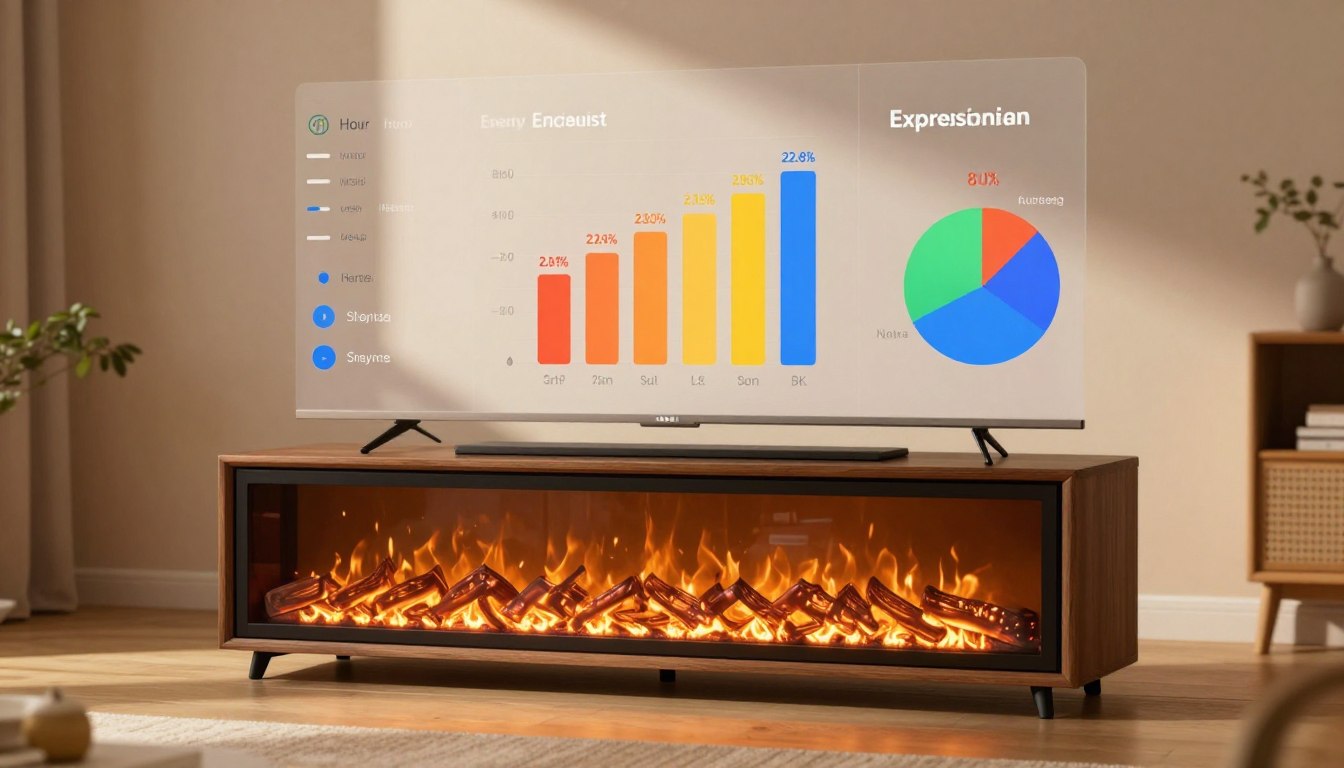
Do Fireplace TV Stands Use a Lot of Electricity?
Affiliate links — we may earn a commission
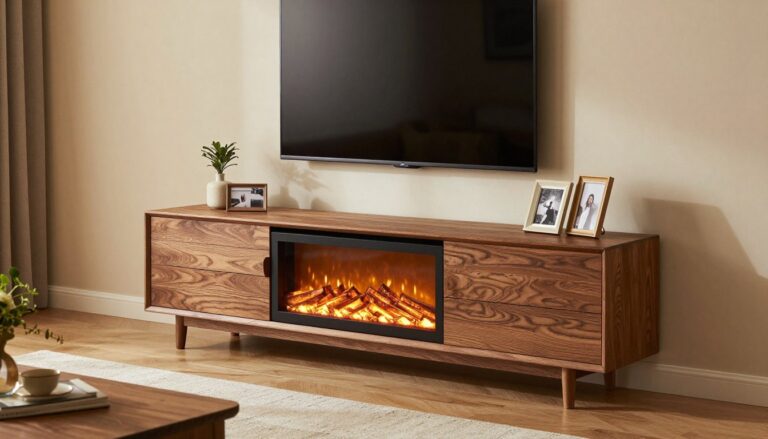
I remember the exact moment my electric bill arrived last January. My heart sank. I had just bought a gorgeous fireplace TV stand from Dimplex, and I was convinced it was draining my wallet faster then a teenager at a mall. Turns out, I was dead wrong — and my panic was completley unnecessary.
The question “do fireplace TV stands use a lot of electricity” kept me up at night. I pictured my meter spinning like a roulette wheel every time I flipped that cozy flame on. But when I sat down and crunched the real numbers, I almost laughed at myself.
Here’s what surprised me most about electric fireplace TV stand energy consumption. The flame effect alone — that warm, flickering glow I love — uses about 40 to 100 watts per hour. That’s roughly what a table lamp pulls. Running just the flames costs less than $2 a month. Not exactly the budget disaster I imagined.
The heating function is a different story, drawing 750 to 1,500 watts per hour. At 1,500 watts for about three hours a day, you’re looking at roughly $16 a month based on the national average rate of $0.12 per kWh. This is far less than cranking up your central HVAC system to heat your entire house.
These units plug right into a standard wall outlet. No venting. No gas lines. No emissions. Just instant warmth in one room — what experts call zone heating. I wish someone had told me all this before I spent a week stressing over my power bill.
Key Takeaways
- Flame-only mode uses just 40 to 100 watts, costing under $2 per month.
- The heating function draws 750 to 1,500 watts per hour depending on your setting.
- Running the heater at full power for 3 hours daily costs around $16 monthly.
- Electric fireplace TV stand energy consumption is far lower than whole-home central heating.
- No venting, gas lines, or harmful emissions are required — just a standard outlet.
- Zone heating lets you warm one room instead of your entire house, saving real money.
Understanding Electric Fireplace TV Stand Power Consumption
Let’s explore what’s inside these smart pieces of furniture. To find out how much electricity a fireplace TV stand uses, we need to look at its technology. Many parts work together, each using different amounts of power.
How Electric Components Work Together
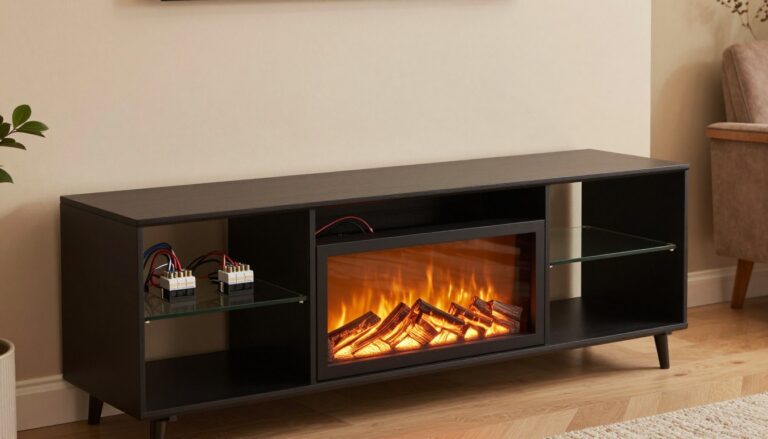
Inside your fireplace TV stand, LED lights create a flame look through special technology. Heating elements, like copper or aluminum wire, warm the air. Some models use infrared to heat people and furniture directly.
High-end units even mix water vapor with LEDs for amazing 3D flames.
The best part? Almost all electricity turns into heat. There’s no chimney, so all the energy stays in your home.
Typical Wattage Ranges for Different Models
Fireplace TV stand power usage is pretty consistent. Most models use between 1,000 and 1,500 watts when heating. This is similar to a portable space heater. Here’s a quick overview:
| Mode | Wattage Range | Comparable To |
|---|---|---|
| Flame Effect Only | 20–40 watts | Less than a standard light bulb |
| Low Heat Setting | 750–1,000 watts | Small space heater |
| High Heat Setting | 1,000–1,500 watts | Full-size space heater |
Flame Effect vs. Heating Function Energy Draw
The flame-only mode is super efficient, using just 20 to 40 watts. That’s less than your nightstand lamp. The heating function uses more power, depending on the technology:
- Fan-forced convection — quickly moves warm air
- Radiant ceramic heating — warms objects and surfaces
- Infrared technology — targets people and furniture
So, how much electricity does a fireplace TV stand use? It depends on whether you’re using it for looks or warmth. This affects your monthly bill, which I’ll discuss next.
Do Fireplace TV Stands Use a Lot of Electricity?
I get this question all the time, and the answer might surprise you. The cost to run an electric fireplace TV stand is much less than many think. Let’s look at the numbers to see for yourself.
Breaking Down the Numbers: Real Usage Data
At full power, 1,500 watts for 6 hours a day, you use about 270 kWh a month. That seems a lot until you compare it. Running just the flame mode cuts that to 54 kWh monthly. Using the 750W setting lowers it to 135 kWh a month.
| Usage Mode | Wattage | Daily Use (6 hrs) | Monthly kWh |
|---|---|---|---|
| Full Heat | 1,500W | 9 kWh | 270 kWh |
| Medium Heat | 750W | 4.5 kWh | 135 kWh |
| Flame Only | 50W | 0.3 kWh | 54 kWh |
Comparing LED Flame Technology to Traditional Heating
LED flame technology uses very little electricity. It’s less than a standard light bulb. This makes TV stands with fireplaces much more energy-efficient than old heating methods.
“The most efficient energy is the energy you never use.” — Amory Lovins, Rocky Mountain Institute
Zone Heating Benefits vs. Central HVAC Systems
Central HVAC systems heat every room, even empty ones. Fireplace TV stands only warm the room you’re in. This is called zone heating and it’s very effective.
- Portable AC units pull around 2,000W
- Washing machines draw about 2,200W per cycle
- Electric fireplace TV stands max out at 1,500W
Modern models have smart thermostats that turn heat on and off. This is better than old space heaters that run all the time. The cost to run an electric fireplace TV stand is low when you only heat the room you’re in.
Monthly Electric Bill Impact of Fireplace TV Stands
I was worried my electric fireplace console would raise my power bill. But it didn’t. The impact on your bill depends on simple math and how much you use it.
In the U.S., the average power rate is $0.17 per kWh (EIA, 2024). A 1,500W unit costs about $0.26 per hour. Running it four hours a day is $1.04, or $31.20 a month. That’s not too much.
For just a warm glow, the flame-only mode uses under 20 watts. That’s less than a penny an hour. So, it costs under $0.50 for a month. That’s cheaper than my morning coffee.
Let’s compare costs with other fireplaces:
| Fireplace Type | Estimated Monthly Cost | Maintenance Required |
|---|---|---|
| Electric Fireplace TV Stand (4 hrs/day) | $15–$31 | Minimal |
| Gas Fireplace | $40–$60 | Annual inspection |
| Wood-Burning Fireplace | $50+ | Chimney sweeping, wood supply |
Seasons affect how much you pay. In winter, I use it daily and see a big increase. In summer, I use flame-only mode, and my bill barely changes.
If you only use it on weekends, your bill will be much lower. Expect to pay about $7–$9 a month. That’s a great deal for weekend warmth.
Calculating Your Fireplace Media Console Electricity Costs
I love math when it saves me money. Figuring out your electricity costs is easy. Knowing the wattage of your electric fireplace TV console helps you guess your bill. The formula is simple: divide watts by 1,000, then multiply by hours used and your local rate per kWh.
Cost Per Hour at Different Settings
At $0.17/kWh, costs are easy to figure out. A 1,500W unit costs about $0.26 per hour. Lower it to 750W, and it’s $0.13 per hour. Flame-only mode? That’s just pennies, around $0.01 per hour with LED tech.
| Setting | Wattage | Cost Per Hour ($0.17/kWh) | Cost for 5 Hours |
|---|---|---|---|
| Flame Only | 50W | $0.01 | $0.04 |
| Low Heat | 750W | $0.13 | $0.64 |
| High Heat | 1,500W | $0.26 | $1.28 |
Seasonal Usage Patterns and Bills
Winter is when costs go up. I run my unit 4–6 hours daily in cold months. This adds $15–$45 monthly, depending on the setting. In summer, using flame-only mode keeps costs under $2 monthly. So, electric fireplace TV stands aren’t expensive all year.
Regional Electricity Rate Variations
Your zip code affects costs a lot. Rates range from $0.11/kWh in Idaho to over $0.30/kWh in Connecticut and Hawaii. A 1,500W unit at full blast costs $0.17/hour in the Midwest but $0.45/hour in New England.
- Rooms up to 400 sq ft heat efficiently with minimal energy waste
- Rooms between 400–600 sq ft consume moderate energy, comparable to zone heating
- Rooms over 600 sq ft benefit from using the fireplace as a supplemental heat source
Choosing the right unit for your room size keeps costs steady. This makes your space cozy without surprise costs.
Energy Efficiency Features in Modern Electric Fireplace Entertainment Centers
Do fireplace TV stands use a lot of electricity? Not if you choose one with the latest tech. Today’s units have energy-saving features that keep electricity use low. Let’s explore the key features.
Smart Thermostats and Timer Functions
Smart thermostats in modern units control the heat for you. They turn the heater on and off to keep your room at the right temperature. This saves energy.
Brands like Belleze also have timers that let you set the unit to turn off after 1–8 hours. No more worrying about leaving it on all night.
LED Technology Advantages
LED flame effects are a game-changer. They use only 40–100 watts, much less than old bulbs. Plus, they last a long time and don’t get hot.
This means you get a beautiful flame effect without using a lot of energy. It’s a big reason why electric fireplaces are energy-efficient.
Adjustable Heat Settings for Optimal Control
Quality models usually have two heat settings: 750W and 1,500W. Here’s how they compare:
| Feature | Low Setting (750W) | High Setting (1,500W) |
|---|---|---|
| Best Room Size | Up to 200 sq ft | Up to 400 sq ft |
| Hourly Cost (at $0.16/kWh) | $0.12 | $0.24 |
| Overheat Protection | Yes | Yes |
I adjust the heat based on the room size. A small room doesn’t need 1,500W. Remote controls from brands like Ameriwood and Walker Edison let me adjust everything from my couch. Precision without effort.
The best watt is the one you never waste.
These features help lower your monthly energy costs. We’ll look at how to save even more in the next section.
Comparing Fireplace TV Stand Power Usage to Other Heating Options
I love comparing things head-to-head, and this matchup is intense. People often wonder how much electricity a fireplace TV stand uses compared to other heaters. Let’s look at these options side by side to understand better.
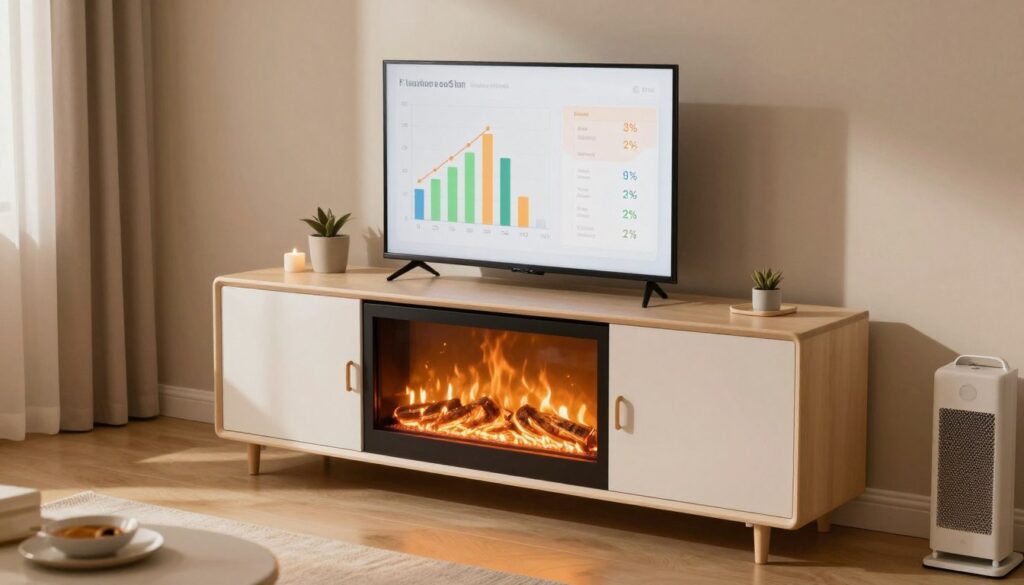
Electric fireplace TV stands use between 1,000 and 1,500 watts when they’re on the heat setting. This is similar to a standard space heater. The big difference is how they use that energy. Electric models turn almost all of the electricity into heat. None of it goes out through a chimney or flue.
Gas and wood-burning heaters can’t say the same. They lose some of their heat.
| Heating Option | Thermal Efficiency | Estimated Monthly Cost | Installation Complexity | Maintenance Needs |
|---|---|---|---|---|
| Electric Fireplace TV Stand | ~100% | $15–$35 | Plug into outlet | Simple dusting |
| Gas Fireplace | 70–90% | $40–$60 | Gas line installation | Annual gas line inspection |
| Wood-Burning Fireplace | 30–50% | $50+ | Chimney construction | Chimney sweeping, ash removal |
| Central HVAC System | 80–95% | $100–$200+ | Full ductwork required | Filter changes, professional tune-ups |
Fireplace TV stand power usage is even better when you think about installation. I just plugged mine into a wall outlet and it was ready. No need for a contractor, permits, or gas lines. Wood-burning fireplaces lose up to 70% of their heat straight up the chimney. That’s like throwing money away.
Using an electric unit for zone heating is smart. It warms only the room you’re in, not the whole house. This can cut your heating bill by 10–15%, the U.S. Department of Energy says. Modern electric fireplace stands have thermostats and timers, giving you control that wood can’t.
The Real Cost to Run an Electric Fireplace TV Console
I love a good reality check, and the electric fireplace entertainment center cost to run is far less scary than most people expect. Let me break down the actual numbers so you can stop guessing and start enjoying your cozy setup guilt-free.
Daily Operating Expenses Breakdown
At full 1500W power for about 4 hours a day, I’m looking at roughly $1.04 in daily costs (based on the U.S. average of $0.17/kWh). That’s less than my morning latte. A 12-hour binge session doubles that figure, while trimming use to 3 hours cuts it nearly in half. The truth? Most of us aren’t running these units nonstop, which makes real-world costs much lower than worst-case math suggests.
Flame-Only Mode vs. Full Heat Operation
This is where TV stand with fireplace energy efficiency really shines. Running just the LED flame effect costs under $0.02 per day — practically free ambiance. Full heat mode at 1500W runs about $0.26 per hour. Flame visuals alone? Under a penny per hour. That’s the beauty of having two modes: pick the vibe without the bill.
- Flame-only mode: under $0.01/hour
- Full heat at 1500W: approximately $0.26/hour
- Combined 4-hour daily use: about $1.04/day
Weekend vs. Daily Use Cost Differences
My weekend-only friends spend roughly $2.08 per week (8 total hours at full heat). Daily users clocking 4 hours each night see about $7.28 weekly. That gap is significant over a full heating season.
| Usage Pattern | Weekly Hours | Weekly Cost (1500W) | Monthly Estimate |
|---|---|---|---|
| Weekend only (Sat & Sun) | 8 hours | $2.08 | $8.32 |
| Daily (4 hrs/night) | 28 hours | $7.28 | $29.12 |
| Light daily (2 hrs/night) | 14 hours | $3.64 | $14.56 |
| Flame-only daily (4 hrs) | 28 hours | $0.14 | $0.56 |
As you can see, the electric fireplace entertainment center cost to run stays remarkably manageable — even with TV stand with fireplace energy efficiency features like adjustable heat settings, which I’ll dig into in the next section.
Wattage Specifications of Popular Electric Fireplace TV Stands
I’ve spent a lot of time looking at specs, and electric fireplace TV console wattage is pretty consistent. Most models use between 1,000 and 1,500 watts on a standard 120V outlet. This 1,500W range gives off about 5,000 BTUs, enough to warm a 400-square-foot room easily.
So, are electric fireplace TV stands expensive to run? It really depends on the model you choose. Here’s what I found from popular brands:
| Brand/Model | Wattage Range | Key Feature | BTU Output |
|---|---|---|---|
| Povison Modern Light Luxury | 100–1,500W | LED effects with minimal power draw | Up to 5,000 BTUs |
| Avenue Long TV Stand | 1,000–1,500W | Colorful LED crystals for ambiance | Up to 5,000 BTUs |
| RealCozy Adjustable | 1,000–1,500W | Adjustable thermostat + flame-only mode | 4,600–5,000 BTUs |
| Belleze 23-Inch Insert | 1,000–1,500W | 1–8 hour timer controls | Up to 5,000 BTUs |
| Infrared Premium Models | 1,000–1,500W | Infrared tech heats larger spaces with remote | 5,000–5,200 BTUs |
Flame-only modes on units like the RealCozy use as little as 10–20 watts. That’s less than a standard light bulb. The real energy use starts when the heater turns on.
High-end infrared models are worth noting. They turn electricity into radiant heat more efficiently. This means you warm up faster and use less energy over time.
Knowing your unit’s exact wattage is the first step to calculating real operating costs — something I’ll explore in the energy-saving strategies coming up next.
Smart Ways to Reduce Your Fireplace TV Stand Energy Consumption
I’ve worked hard to keep my electric bill down. A few smart moves can cut your energy use without losing that warm feel. Here are my top tips.
Optimal Room Placement Strategies
Where you put your unit is key. Place it against an interior wall, not an exterior one. Exterior walls lose heat outside your home. Stay away from windows and drafty doors too.
These spots let warm air escape. Add weatherstripping and you’ll see a big drop in your electricity costs.
- Place the unit against an interior wall to prevent heat loss
- Avoid spots near windows, doors, or drafty areas
- Use a ceiling fan on low to circulate warm air throughout the room
- Clean vents and fans regularly to maintain peak heat transfer
Using Timers and Thermostats Effectively
I set my thermostat to a target temperature. This lets the unit turn on and off as needed. It prevents overheating and keeps my bill steady. Timers are great — they turn off the unit when I’m asleep.
A programmable timer can cut your annual operating costs by up to 20%, according to the U.S. Department of Energy’s recommendations for supplemental heating devices.
Choosing the Right Size for Your Space
Don’t get a big unit for a small room. It’s like using a firehose on a houseplant. Choose a size that matches your room’s size to save on electricity.
| Room Size | Recommended Wattage | Best Mode for Savings |
|---|---|---|
| Up to 200 sq ft | 750W (low setting) | Low heat + flame effect |
| 200–400 sq ft | 1,000W (medium setting) | Thermostat-controlled cycling |
| 400+ sq ft | 1,500W (high setting) | Zone heating specific areas |
Pro tip: In mild weather, use the flame-only mode. It gives you warmth without using much electricity.
Are Electric Fireplace TV Stands Expensive to Operate Year-Round?
I often get asked if electric fireplace TV stands cost a lot to run all year. The answer is quite surprising. The difference in costs between seasons is huge. They don’t use much electricity at all.
Summer vs. Winter Usage Patterns
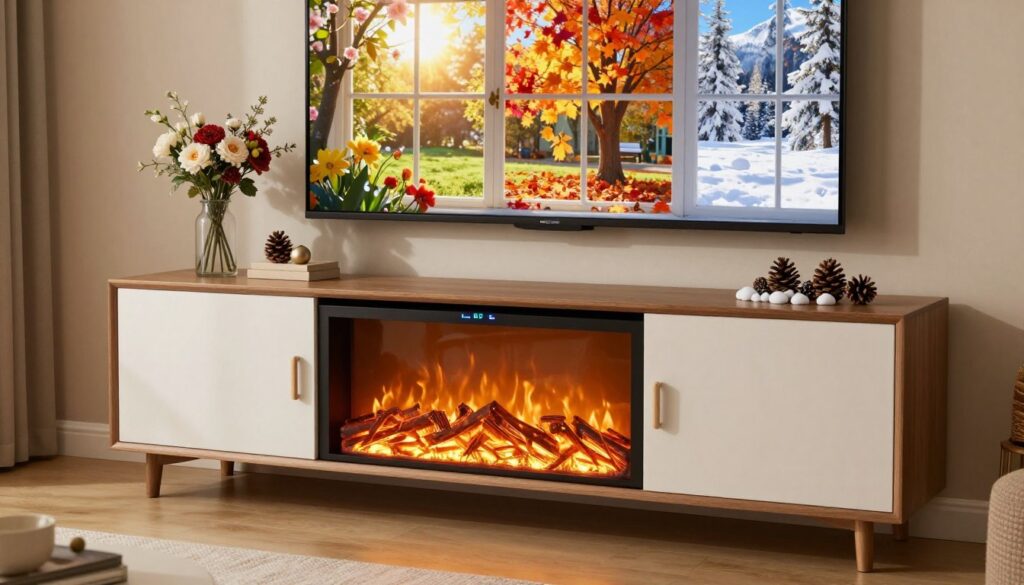
In winter, electric fireplace TV stands use more electricity. I use mine 4-6 hours a day to keep warm. This costs me about $25-$30 a month. But in summer, I just use the flame for looks, spending less than a dollar a month.
Where you live affects how much you pay. People in colder places like Minnesota pay more than those in warmer places like Georgia. It’s all about using the right mode for the weather.
| Season | Daily Usage | Wattage Used | Estimated Monthly Cost |
|---|---|---|---|
| Winter (Heat Mode) | 4-6 hours | 1,500 watts | $25-$30 |
| Spring/Fall (Mixed Use) | 2-3 hours | 750-1,500 watts | $8-$15 |
| Summer (Flame Only) | 1-2 hours | 20-40 watts | $0.50-$0.90 |
Ambient Lighting Without Heat Function
Using the LED flame effect is my top tip. It only uses 20-40 watts, less than a regular light bulb. I turn it on in summer to create a cozy feel without heating up the room.
Using the flame effect in summer means you don’t worry about electricity costs. It’s a way to add warmth without heat, saving money. Smart users switch it up with the seasons, getting the most out of their investment.
Choosing Energy-Efficient TV Stands with Fireplace Features
Shopping for an energy-efficient fireplace TV stand is like dating. You want it to look good, but it must have substance. Before looking at how much electricity it uses, I check its features first.
- LED-based flame effects (they sip power instead of guzzling it)
- Built-in timer functions and programmable thermostats
- Adjustable heat settings with a low-power flame-only mode
- Overheat protection for safe, worry-free operation
- Accurate thermostat sensors for automated shut-off
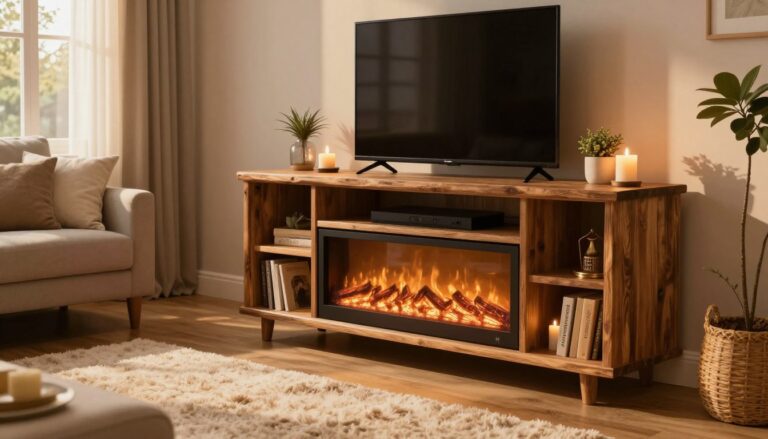
I’ve been looking at brands that offer both style and efficiency. Povison’s 78.74″ Modern Fireplace TV Stand is a great example. It has bold geometry and subtle flame effects. Plus, it comes fully assembled, which is a big plus for my back.
Brands like RealCozy and Belleze are known for their durable, efficient designs. You can find them at Lowe’s, Amazon, and Home Depot. This makes it easy to compare prices. Fireplace TV stand power usage varies, so I always compare wattage specs.
| Feature | Energy-Efficient Pick | Standard Model |
|---|---|---|
| Flame Technology | LED | Halogen/Incandescent |
| Flame-Only Wattage | 10–20W | 50–100W |
| Timer Function | Yes (programmable) | Manual only |
| Adjustable Heat Levels | 3–5 settings | 1–2 settings |
| Thermostat Accuracy | ±1°F | ±3°F |
Pick the right features now, and you’ll thank yourself every month when the electric bill arrives.
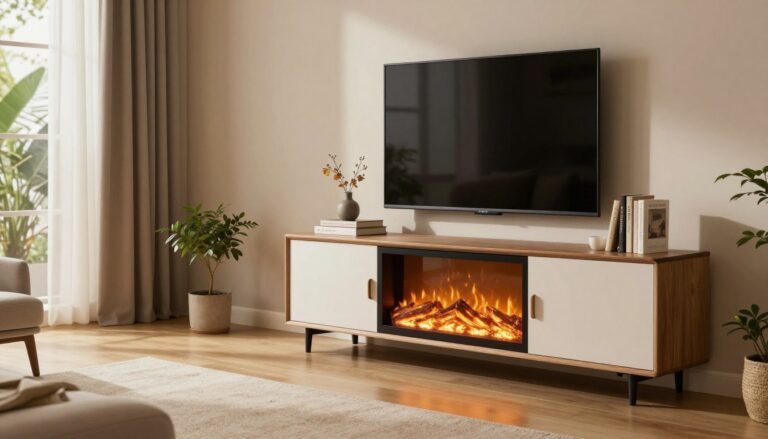
Dual functionality is the real win here. You get storage for your entertainment center and zone heating in one piece. This combo keeps your living room and wallet comfortable all year.
Conclusion
Do electric fireplace TV stands use a lot of electricity? Absolutely not. They cost between $15 and $31 a month to run, depending on how often you use them. That’s just a dollar a day for warmth and a nice look in your living room.
What really impresses me is how energy-efficient these stands are. They turn almost all electricity into heat. This is way better than wood-burning fireplaces, which are only 30-50% efficient. Or gas fireplaces, which are 70-90% efficient.
They come with built-in thermostats and timers. You can adjust the heat to exactly what you need. This means you only heat the room you’re in, saving energy.
Want a cozy feel without the heat? Use the flame-only mode. It costs less than a dollar a month. You get stylish storage, efficient heating, and beautiful looks without the hassle of gas lines or chimney cleaning.
In my opinion, an electric fireplace TV stand is a smart choice. It looks good, heats well, and doesn’t break the bank. That’s a win for every season.
FAQ
Do fireplace TV stands use a lot of electricity?
FAQ
Do fireplace TV stands use a lot of electricity?
Not as much as I thought. A typical electric fireplace TV stand uses 1,000–1,500 watts when heating. This is similar to a standard space heater. But, it has smart controls that turn on and off, not running all the time.
The flame-only mode uses only 20–40 watts. This is less than a light bulb. At
FAQ
Do fireplace TV stands use a lot of electricity?
Not as much as I thought. A typical electric fireplace TV stand uses 1,000–1,500 watts when heating. This is similar to a standard space heater. But, it has smart controls that turn on and off, not running all the time.
The flame-only mode uses only 20–40 watts. This is less than a light bulb. At $0.17/kWh, heating costs about $15–31 monthly. For just ambiance, it’s under $1 monthly.
Compared to gas or wood-burning fireplaces, electric ones are very cheap. They cost less than $40 monthly for gas or over $50 for wood.
How much does it cost per hour to run an electric fireplace TV console?
The cost is simple to calculate. At 1,500W and $0.17/kWh, it’s about $0.26 per hour. At 750W, it’s $0.13 per hour. And for just the flame effect, it’s under $0.01 per hour.
For 4 hours daily at full power, it’s about $1.04 daily. I think this is a great deal for heat and a beautiful look.
What’s the monthly electric bill impact of a fireplace TV stand?
The impact depends on how you use it. Running a 1,500W unit for 4 hours daily adds about $31.20 monthly. If used 8 hours weekly, it’s about $8.32 monthly.
The real secret is the flame-only mode. Running this all month costs under $0.50. Seasonal use also affects the bill. Winter use is higher, but summer is very low.
Are electric fireplace TV stands expensive to operate year-round?
No, they’re not expensive at all. Winter heating costs about $30 monthly. But summer ambiance costs under $1 monthly.
The LED flame technology uses only 20–40 watts, no matter the season. This makes it very cheap to use all year. Even in cold climates, the yearly cost is much lower than gas or wood-burning fireplaces.
How does electric fireplace TV stand energy consumption compare to other heating options?
Electric models are a clear winner. They convert almost all electricity to heat with no losses. This is unlike wood-burning fireplaces, which lose up to 70% of heat.
Gas fireplaces are better, but they cost $40–60 monthly. Electric units use less power than many appliances. They also cost less to install than gas or wood-burning setups.
What wattage do popular electric fireplace TV stands use?
Most use 1,000–1,500 watts on 120V outlets. The 1,500W setting heats rooms up to 400 square feet well. Some models have LED effects for stunning visuals.
Other models have adjustable thermostats and timer controls for efficiency. Some even use infrared technology for better heating. There are also higher-end models for larger spaces.
How can I reduce my fireplace TV stand energy consumption?
There are a few ways to cut down on energy use. Place it on an interior wall to keep heat in. Avoid areas near windows and doors.
Use a thermostat to keep temperatures steady. This helps the heater work more efficiently. Timer functions can also save energy by turning it off when not needed.
Match the unit’s power to your room size. Running ceiling fans on low can also help circulate warm air. And, use flame-only mode for ambiance at a very low cost.
Does the flame-only mode on an electric fireplace TV stand use much electricity?
Flame-only mode is very energy-efficient. It uses 20–40 watts, which is less than a light bulb. This means it costs under $0.01 per hour and under $0.50 monthly.
The LED technology used for the flame visuals is also very efficient. It lasts longer and uses less energy than traditional bulbs. This makes it free to run all year.
What should I look for in an energy-efficient fireplace TV stand?
Look for models with timer functions and smart thermostats. Also, check for overheat protection and adjustable flame colors. Make sure the energy efficiency specs are clear.
Multiple heat settings let you adjust to your room’s needs. LED-based flame effects use less energy than older technologies. Look for durable designs from brands like RealCozy and Belleze.
Check the BTU output to match your room size. This ensures you’re not wasting energy on a unit that’s too big.
How does zone heating with a fireplace TV stand save money on electricity?
Zone heating is a smart strategy. Instead of heating the whole house, focus on the room you’re in. This saves a lot of energy.
For medium rooms, it’s as efficient as zoned central heating. For larger rooms, use it as supplemental heat. This way, you’re not wasting energy on empty spaces.
FAQ
Do fireplace TV stands use a lot of electricity?
Not as much as I thought. A typical electric fireplace TV stand uses 1,000–1,500 watts when heating. This is similar to a standard space heater. But, it has smart controls that turn on and off, not running all the time.
The flame-only mode uses only 20–40 watts. This is less than a light bulb. At
FAQ
Do fireplace TV stands use a lot of electricity?
Not as much as I thought. A typical electric fireplace TV stand uses 1,000–1,500 watts when heating. This is similar to a standard space heater. But, it has smart controls that turn on and off, not running all the time.
The flame-only mode uses only 20–40 watts. This is less than a light bulb. At $0.17/kWh, heating costs about $15–31 monthly. For just ambiance, it’s under $1 monthly.
Compared to gas or wood-burning fireplaces, electric ones are very cheap. They cost less than $40 monthly for gas or over $50 for wood.
How much does it cost per hour to run an electric fireplace TV console?
The cost is simple to calculate. At 1,500W and $0.17/kWh, it’s about $0.26 per hour. At 750W, it’s $0.13 per hour. And for just the flame effect, it’s under $0.01 per hour.
For 4 hours daily at full power, it’s about $1.04 daily. I think this is a great deal for heat and a beautiful look.
What’s the monthly electric bill impact of a fireplace TV stand?
The impact depends on how you use it. Running a 1,500W unit for 4 hours daily adds about $31.20 monthly. If used 8 hours weekly, it’s about $8.32 monthly.
The real secret is the flame-only mode. Running this all month costs under $0.50. Seasonal use also affects the bill. Winter use is higher, but summer is very low.
Are electric fireplace TV stands expensive to operate year-round?
No, they’re not expensive at all. Winter heating costs about $30 monthly. But summer ambiance costs under $1 monthly.
The LED flame technology uses only 20–40 watts, no matter the season. This makes it very cheap to use all year. Even in cold climates, the yearly cost is much lower than gas or wood-burning fireplaces.
How does electric fireplace TV stand energy consumption compare to other heating options?
Electric models are a clear winner. They convert almost all electricity to heat with no losses. This is unlike wood-burning fireplaces, which lose up to 70% of heat.
Gas fireplaces are better, but they cost $40–60 monthly. Electric units use less power than many appliances. They also cost less to install than gas or wood-burning setups.
What wattage do popular electric fireplace TV stands use?
Most use 1,000–1,500 watts on 120V outlets. The 1,500W setting heats rooms up to 400 square feet well. Some models have LED effects for stunning visuals.
Other models have adjustable thermostats and timer controls for efficiency. Some even use infrared technology for better heating. There are also higher-end models for larger spaces.
How can I reduce my fireplace TV stand energy consumption?
There are a few ways to cut down on energy use. Place it on an interior wall to keep heat in. Avoid areas near windows and doors.
Use a thermostat to keep temperatures steady. This helps the heater work more efficiently. Timer functions can also save energy by turning it off when not needed.
Match the unit’s power to your room size. Running ceiling fans on low can also help circulate warm air. And, use flame-only mode for ambiance at a very low cost.
Does the flame-only mode on an electric fireplace TV stand use much electricity?
Flame-only mode is very energy-efficient. It uses 20–40 watts, which is less than a light bulb. This means it costs under $0.01 per hour and under $0.50 monthly.
The LED technology used for the flame visuals is also very efficient. It lasts longer and uses less energy than traditional bulbs. This makes it free to run all year.
What should I look for in an energy-efficient fireplace TV stand?
Look for models with timer functions and smart thermostats. Also, check for overheat protection and adjustable flame colors. Make sure the energy efficiency specs are clear.
Multiple heat settings let you adjust to your room’s needs. LED-based flame effects use less energy than older technologies. Look for durable designs from brands like RealCozy and Belleze.
Check the BTU output to match your room size. This ensures you’re not wasting energy on a unit that’s too big.
How does zone heating with a fireplace TV stand save money on electricity?
Zone heating is a smart strategy. Instead of heating the whole house, focus on the room you’re in. This saves a lot of energy.
For medium rooms, it’s as efficient as zoned central heating. For larger rooms, use it as supplemental heat. This way, you’re not wasting energy on empty spaces.
FAQ
Do fireplace TV stands use a lot of electricity?
Not as much as I thought. A typical electric fireplace TV stand uses 1,000–1,500 watts when heating. This is similar to a standard space heater. But, it has smart controls that turn on and off, not running all the time.
The flame-only mode uses only 20–40 watts. This is less than a light bulb. At
FAQ
Do fireplace TV stands use a lot of electricity?
Not as much as I thought. A typical electric fireplace TV stand uses 1,000–1,500 watts when heating. This is similar to a standard space heater. But, it has smart controls that turn on and off, not running all the time.
The flame-only mode uses only 20–40 watts. This is less than a light bulb. At $0.17/kWh, heating costs about $15–31 monthly. For just ambiance, it’s under $1 monthly.
Compared to gas or wood-burning fireplaces, electric ones are very cheap. They cost less than $40 monthly for gas or over $50 for wood.
How much does it cost per hour to run an electric fireplace TV console?
The cost is simple to calculate. At 1,500W and $0.17/kWh, it’s about $0.26 per hour. At 750W, it’s $0.13 per hour. And for just the flame effect, it’s under $0.01 per hour.
For 4 hours daily at full power, it’s about $1.04 daily. I think this is a great deal for heat and a beautiful look.
What’s the monthly electric bill impact of a fireplace TV stand?
The impact depends on how you use it. Running a 1,500W unit for 4 hours daily adds about $31.20 monthly. If used 8 hours weekly, it’s about $8.32 monthly.
The real secret is the flame-only mode. Running this all month costs under $0.50. Seasonal use also affects the bill. Winter use is higher, but summer is very low.
Are electric fireplace TV stands expensive to operate year-round?
No, they’re not expensive at all. Winter heating costs about $30 monthly. But summer ambiance costs under $1 monthly.
The LED flame technology uses only 20–40 watts, no matter the season. This makes it very cheap to use all year. Even in cold climates, the yearly cost is much lower than gas or wood-burning fireplaces.
How does electric fireplace TV stand energy consumption compare to other heating options?
Electric models are a clear winner. They convert almost all electricity to heat with no losses. This is unlike wood-burning fireplaces, which lose up to 70% of heat.
Gas fireplaces are better, but they cost $40–60 monthly. Electric units use less power than many appliances. They also cost less to install than gas or wood-burning setups.
What wattage do popular electric fireplace TV stands use?
Most use 1,000–1,500 watts on 120V outlets. The 1,500W setting heats rooms up to 400 square feet well. Some models have LED effects for stunning visuals.
Other models have adjustable thermostats and timer controls for efficiency. Some even use infrared technology for better heating. There are also higher-end models for larger spaces.
How can I reduce my fireplace TV stand energy consumption?
There are a few ways to cut down on energy use. Place it on an interior wall to keep heat in. Avoid areas near windows and doors.
Use a thermostat to keep temperatures steady. This helps the heater work more efficiently. Timer functions can also save energy by turning it off when not needed.
Match the unit’s power to your room size. Running ceiling fans on low can also help circulate warm air. And, use flame-only mode for ambiance at a very low cost.
Does the flame-only mode on an electric fireplace TV stand use much electricity?
Flame-only mode is very energy-efficient. It uses 20–40 watts, which is less than a light bulb. This means it costs under $0.01 per hour and under $0.50 monthly.
The LED technology used for the flame visuals is also very efficient. It lasts longer and uses less energy than traditional bulbs. This makes it free to run all year.
What should I look for in an energy-efficient fireplace TV stand?
Look for models with timer functions and smart thermostats. Also, check for overheat protection and adjustable flame colors. Make sure the energy efficiency specs are clear.
Multiple heat settings let you adjust to your room’s needs. LED-based flame effects use less energy than older technologies. Look for durable designs from brands like RealCozy and Belleze.
Check the BTU output to match your room size. This ensures you’re not wasting energy on a unit that’s too big.
How does zone heating with a fireplace TV stand save money on electricity?
Zone heating is a smart strategy. Instead of heating the whole house, focus on the room you’re in. This saves a lot of energy.
For medium rooms, it’s as efficient as zoned central heating. For larger rooms, use it as supplemental heat. This way, you’re not wasting energy on empty spaces.
FAQ
Do fireplace TV stands use a lot of electricity?
Not as much as I thought. A typical electric fireplace TV stand uses 1,000–1,500 watts when heating. This is similar to a standard space heater. But, it has smart controls that turn on and off, not running all the time.
The flame-only mode uses only 20–40 watts. This is less than a light bulb. At
FAQ
Do fireplace TV stands use a lot of electricity?
Not as much as I thought. A typical electric fireplace TV stand uses 1,000–1,500 watts when heating. This is similar to a standard space heater. But, it has smart controls that turn on and off, not running all the time.
The flame-only mode uses only 20–40 watts. This is less than a light bulb. At $0.17/kWh, heating costs about $15–31 monthly. For just ambiance, it’s under $1 monthly.
Compared to gas or wood-burning fireplaces, electric ones are very cheap. They cost less than $40 monthly for gas or over $50 for wood.
How much does it cost per hour to run an electric fireplace TV console?
The cost is simple to calculate. At 1,500W and $0.17/kWh, it’s about $0.26 per hour. At 750W, it’s $0.13 per hour. And for just the flame effect, it’s under $0.01 per hour.
For 4 hours daily at full power, it’s about $1.04 daily. I think this is a great deal for heat and a beautiful look.
What’s the monthly electric bill impact of a fireplace TV stand?
The impact depends on how you use it. Running a 1,500W unit for 4 hours daily adds about $31.20 monthly. If used 8 hours weekly, it’s about $8.32 monthly.
The real secret is the flame-only mode. Running this all month costs under $0.50. Seasonal use also affects the bill. Winter use is higher, but summer is very low.
Are electric fireplace TV stands expensive to operate year-round?
No, they’re not expensive at all. Winter heating costs about $30 monthly. But summer ambiance costs under $1 monthly.
The LED flame technology uses only 20–40 watts, no matter the season. This makes it very cheap to use all year. Even in cold climates, the yearly cost is much lower than gas or wood-burning fireplaces.
How does electric fireplace TV stand energy consumption compare to other heating options?
Electric models are a clear winner. They convert almost all electricity to heat with no losses. This is unlike wood-burning fireplaces, which lose up to 70% of heat.
Gas fireplaces are better, but they cost $40–60 monthly. Electric units use less power than many appliances. They also cost less to install than gas or wood-burning setups.
What wattage do popular electric fireplace TV stands use?
Most use 1,000–1,500 watts on 120V outlets. The 1,500W setting heats rooms up to 400 square feet well. Some models have LED effects for stunning visuals.
Other models have adjustable thermostats and timer controls for efficiency. Some even use infrared technology for better heating. There are also higher-end models for larger spaces.
How can I reduce my fireplace TV stand energy consumption?
There are a few ways to cut down on energy use. Place it on an interior wall to keep heat in. Avoid areas near windows and doors.
Use a thermostat to keep temperatures steady. This helps the heater work more efficiently. Timer functions can also save energy by turning it off when not needed.
Match the unit’s power to your room size. Running ceiling fans on low can also help circulate warm air. And, use flame-only mode for ambiance at a very low cost.
Does the flame-only mode on an electric fireplace TV stand use much electricity?
Flame-only mode is very energy-efficient. It uses 20–40 watts, which is less than a light bulb. This means it costs under $0.01 per hour and under $0.50 monthly.
The LED technology used for the flame visuals is also very efficient. It lasts longer and uses less energy than traditional bulbs. This makes it free to run all year.
What should I look for in an energy-efficient fireplace TV stand?
Look for models with timer functions and smart thermostats. Also, check for overheat protection and adjustable flame colors. Make sure the energy efficiency specs are clear.
Multiple heat settings let you adjust to your room’s needs. LED-based flame effects use less energy than older technologies. Look for durable designs from brands like RealCozy and Belleze.
Check the BTU output to match your room size. This ensures you’re not wasting energy on a unit that’s too big.
How does zone heating with a fireplace TV stand save money on electricity?
Zone heating is a smart strategy. Instead of heating the whole house, focus on the room you’re in. This saves a lot of energy.
For medium rooms, it’s as efficient as zoned central heating. For larger rooms, use it as supplemental heat. This way, you’re not wasting energy on empty spaces.
FAQ
Do fireplace TV stands use a lot of electricity?
Not as much as I thought. A typical electric fireplace TV stand uses 1,000–1,500 watts when heating. This is similar to a standard space heater. But, it has smart controls that turn on and off, not running all the time.
The flame-only mode uses only 20–40 watts. This is less than a light bulb. At
FAQ
Do fireplace TV stands use a lot of electricity?
Not as much as I thought. A typical electric fireplace TV stand uses 1,000–1,500 watts when heating. This is similar to a standard space heater. But, it has smart controls that turn on and off, not running all the time.
The flame-only mode uses only 20–40 watts. This is less than a light bulb. At $0.17/kWh, heating costs about $15–31 monthly. For just ambiance, it’s under $1 monthly.
Compared to gas or wood-burning fireplaces, electric ones are very cheap. They cost less than $40 monthly for gas or over $50 for wood.
How much does it cost per hour to run an electric fireplace TV console?
The cost is simple to calculate. At 1,500W and $0.17/kWh, it’s about $0.26 per hour. At 750W, it’s $0.13 per hour. And for just the flame effect, it’s under $0.01 per hour.
For 4 hours daily at full power, it’s about $1.04 daily. I think this is a great deal for heat and a beautiful look.
What’s the monthly electric bill impact of a fireplace TV stand?
The impact depends on how you use it. Running a 1,500W unit for 4 hours daily adds about $31.20 monthly. If used 8 hours weekly, it’s about $8.32 monthly.
The real secret is the flame-only mode. Running this all month costs under $0.50. Seasonal use also affects the bill. Winter use is higher, but summer is very low.
Are electric fireplace TV stands expensive to operate year-round?
No, they’re not expensive at all. Winter heating costs about $30 monthly. But summer ambiance costs under $1 monthly.
The LED flame technology uses only 20–40 watts, no matter the season. This makes it very cheap to use all year. Even in cold climates, the yearly cost is much lower than gas or wood-burning fireplaces.
How does electric fireplace TV stand energy consumption compare to other heating options?
Electric models are a clear winner. They convert almost all electricity to heat with no losses. This is unlike wood-burning fireplaces, which lose up to 70% of heat.
Gas fireplaces are better, but they cost $40–60 monthly. Electric units use less power than many appliances. They also cost less to install than gas or wood-burning setups.
What wattage do popular electric fireplace TV stands use?
Most use 1,000–1,500 watts on 120V outlets. The 1,500W setting heats rooms up to 400 square feet well. Some models have LED effects for stunning visuals.
Other models have adjustable thermostats and timer controls for efficiency. Some even use infrared technology for better heating. There are also higher-end models for larger spaces.
How can I reduce my fireplace TV stand energy consumption?
There are a few ways to cut down on energy use. Place it on an interior wall to keep heat in. Avoid areas near windows and doors.
Use a thermostat to keep temperatures steady. This helps the heater work more efficiently. Timer functions can also save energy by turning it off when not needed.
Match the unit’s power to your room size. Running ceiling fans on low can also help circulate warm air. And, use flame-only mode for ambiance at a very low cost.
Does the flame-only mode on an electric fireplace TV stand use much electricity?
Flame-only mode is very energy-efficient. It uses 20–40 watts, which is less than a light bulb. This means it costs under $0.01 per hour and under $0.50 monthly.
The LED technology used for the flame visuals is also very efficient. It lasts longer and uses less energy than traditional bulbs. This makes it free to run all year.
What should I look for in an energy-efficient fireplace TV stand?
Look for models with timer functions and smart thermostats. Also, check for overheat protection and adjustable flame colors. Make sure the energy efficiency specs are clear.
Multiple heat settings let you adjust to your room’s needs. LED-based flame effects use less energy than older technologies. Look for durable designs from brands like RealCozy and Belleze.
Check the BTU output to match your room size. This ensures you’re not wasting energy on a unit that’s too big.
How does zone heating with a fireplace TV stand save money on electricity?
Zone heating is a smart strategy. Instead of heating the whole house, focus on the room you’re in. This saves a lot of energy.
For medium rooms, it’s as efficient as zoned central heating. For larger rooms, use it as supplemental heat. This way, you’re not wasting energy on empty spaces.
FAQ
Do fireplace TV stands use a lot of electricity?
Not as much as I thought. A typical electric fireplace TV stand uses 1,000–1,500 watts when heating. This is similar to a standard space heater. But, it has smart controls that turn on and off, not running all the time.
The flame-only mode uses only 20–40 watts. This is less than a light bulb. At
FAQ
Do fireplace TV stands use a lot of electricity?
Not as much as I thought. A typical electric fireplace TV stand uses 1,000–1,500 watts when heating. This is similar to a standard space heater. But, it has smart controls that turn on and off, not running all the time.
The flame-only mode uses only 20–40 watts. This is less than a light bulb. At $0.17/kWh, heating costs about $15–31 monthly. For just ambiance, it’s under $1 monthly.
Compared to gas or wood-burning fireplaces, electric ones are very cheap. They cost less than $40 monthly for gas or over $50 for wood.
How much does it cost per hour to run an electric fireplace TV console?
The cost is simple to calculate. At 1,500W and $0.17/kWh, it’s about $0.26 per hour. At 750W, it’s $0.13 per hour. And for just the flame effect, it’s under $0.01 per hour.
For 4 hours daily at full power, it’s about $1.04 daily. I think this is a great deal for heat and a beautiful look.
What’s the monthly electric bill impact of a fireplace TV stand?
The impact depends on how you use it. Running a 1,500W unit for 4 hours daily adds about $31.20 monthly. If used 8 hours weekly, it’s about $8.32 monthly.
The real secret is the flame-only mode. Running this all month costs under $0.50. Seasonal use also affects the bill. Winter use is higher, but summer is very low.
Are electric fireplace TV stands expensive to operate year-round?
No, they’re not expensive at all. Winter heating costs about $30 monthly. But summer ambiance costs under $1 monthly.
The LED flame technology uses only 20–40 watts, no matter the season. This makes it very cheap to use all year. Even in cold climates, the yearly cost is much lower than gas or wood-burning fireplaces.
How does electric fireplace TV stand energy consumption compare to other heating options?
Electric models are a clear winner. They convert almost all electricity to heat with no losses. This is unlike wood-burning fireplaces, which lose up to 70% of heat.
Gas fireplaces are better, but they cost $40–60 monthly. Electric units use less power than many appliances. They also cost less to install than gas or wood-burning setups.
What wattage do popular electric fireplace TV stands use?
Most use 1,000–1,500 watts on 120V outlets. The 1,500W setting heats rooms up to 400 square feet well. Some models have LED effects for stunning visuals.
Other models have adjustable thermostats and timer controls for efficiency. Some even use infrared technology for better heating. There are also higher-end models for larger spaces.
How can I reduce my fireplace TV stand energy consumption?
There are a few ways to cut down on energy use. Place it on an interior wall to keep heat in. Avoid areas near windows and doors.
Use a thermostat to keep temperatures steady. This helps the heater work more efficiently. Timer functions can also save energy by turning it off when not needed.
Match the unit’s power to your room size. Running ceiling fans on low can also help circulate warm air. And, use flame-only mode for ambiance at a very low cost.
Does the flame-only mode on an electric fireplace TV stand use much electricity?
Flame-only mode is very energy-efficient. It uses 20–40 watts, which is less than a light bulb. This means it costs under $0.01 per hour and under $0.50 monthly.
The LED technology used for the flame visuals is also very efficient. It lasts longer and uses less energy than traditional bulbs. This makes it free to run all year.
What should I look for in an energy-efficient fireplace TV stand?
Look for models with timer functions and smart thermostats. Also, check for overheat protection and adjustable flame colors. Make sure the energy efficiency specs are clear.
Multiple heat settings let you adjust to your room’s needs. LED-based flame effects use less energy than older technologies. Look for durable designs from brands like RealCozy and Belleze.
Check the BTU output to match your room size. This ensures you’re not wasting energy on a unit that’s too big.
How does zone heating with a fireplace TV stand save money on electricity?
Zone heating is a smart strategy. Instead of heating the whole house, focus on the room you’re in. This saves a lot of energy.
For medium rooms, it’s as efficient as zoned central heating. For larger rooms, use it as supplemental heat. This way, you’re not wasting energy on empty spaces.
FAQ
Do fireplace TV stands use a lot of electricity?
Not as much as I thought. A typical electric fireplace TV stand uses 1,000–1,500 watts when heating. This is similar to a standard space heater. But, it has smart controls that turn on and off, not running all the time.
The flame-only mode uses only 20–40 watts. This is less than a light bulb. At
FAQ
Do fireplace TV stands use a lot of electricity?
Not as much as I thought. A typical electric fireplace TV stand uses 1,000–1,500 watts when heating. This is similar to a standard space heater. But, it has smart controls that turn on and off, not running all the time.
The flame-only mode uses only 20–40 watts. This is less than a light bulb. At $0.17/kWh, heating costs about $15–31 monthly. For just ambiance, it’s under $1 monthly.
Compared to gas or wood-burning fireplaces, electric ones are very cheap. They cost less than $40 monthly for gas or over $50 for wood.
How much does it cost per hour to run an electric fireplace TV console?
The cost is simple to calculate. At 1,500W and $0.17/kWh, it’s about $0.26 per hour. At 750W, it’s $0.13 per hour. And for just the flame effect, it’s under $0.01 per hour.
For 4 hours daily at full power, it’s about $1.04 daily. I think this is a great deal for heat and a beautiful look.
What’s the monthly electric bill impact of a fireplace TV stand?
The impact depends on how you use it. Running a 1,500W unit for 4 hours daily adds about $31.20 monthly. If used 8 hours weekly, it’s about $8.32 monthly.
The real secret is the flame-only mode. Running this all month costs under $0.50. Seasonal use also affects the bill. Winter use is higher, but summer is very low.
Are electric fireplace TV stands expensive to operate year-round?
No, they’re not expensive at all. Winter heating costs about $30 monthly. But summer ambiance costs under $1 monthly.
The LED flame technology uses only 20–40 watts, no matter the season. This makes it very cheap to use all year. Even in cold climates, the yearly cost is much lower than gas or wood-burning fireplaces.
How does electric fireplace TV stand energy consumption compare to other heating options?
Electric models are a clear winner. They convert almost all electricity to heat with no losses. This is unlike wood-burning fireplaces, which lose up to 70% of heat.
Gas fireplaces are better, but they cost $40–60 monthly. Electric units use less power than many appliances. They also cost less to install than gas or wood-burning setups.
What wattage do popular electric fireplace TV stands use?
Most use 1,000–1,500 watts on 120V outlets. The 1,500W setting heats rooms up to 400 square feet well. Some models have LED effects for stunning visuals.
Other models have adjustable thermostats and timer controls for efficiency. Some even use infrared technology for better heating. There are also higher-end models for larger spaces.
How can I reduce my fireplace TV stand energy consumption?
There are a few ways to cut down on energy use. Place it on an interior wall to keep heat in. Avoid areas near windows and doors.
Use a thermostat to keep temperatures steady. This helps the heater work more efficiently. Timer functions can also save energy by turning it off when not needed.
Match the unit’s power to your room size. Running ceiling fans on low can also help circulate warm air. And, use flame-only mode for ambiance at a very low cost.
Does the flame-only mode on an electric fireplace TV stand use much electricity?
Flame-only mode is very energy-efficient. It uses 20–40 watts, which is less than a light bulb. This means it costs under $0.01 per hour and under $0.50 monthly.
The LED technology used for the flame visuals is also very efficient. It lasts longer and uses less energy than traditional bulbs. This makes it free to run all year.
What should I look for in an energy-efficient fireplace TV stand?
Look for models with timer functions and smart thermostats. Also, check for overheat protection and adjustable flame colors. Make sure the energy efficiency specs are clear.
Multiple heat settings let you adjust to your room’s needs. LED-based flame effects use less energy than older technologies. Look for durable designs from brands like RealCozy and Belleze.
Check the BTU output to match your room size. This ensures you’re not wasting energy on a unit that’s too big.
How does zone heating with a fireplace TV stand save money on electricity?
Zone heating is a smart strategy. Instead of heating the whole house, focus on the room you’re in. This saves a lot of energy.
For medium rooms, it’s as efficient as zoned central heating. For larger rooms, use it as supplemental heat. This way, you’re not wasting energy on empty spaces.
FAQ
Do fireplace TV stands use a lot of electricity?
Not as much as I thought. A typical electric fireplace TV stand uses 1,000–1,500 watts when heating. This is similar to a standard space heater. But, it has smart controls that turn on and off, not running all the time.
The flame-only mode uses only 20–40 watts. This is less than a light bulb. At
FAQ
Do fireplace TV stands use a lot of electricity?
Not as much as I thought. A typical electric fireplace TV stand uses 1,000–1,500 watts when heating. This is similar to a standard space heater. But, it has smart controls that turn on and off, not running all the time.
The flame-only mode uses only 20–40 watts. This is less than a light bulb. At $0.17/kWh, heating costs about $15–31 monthly. For just ambiance, it’s under $1 monthly.
Compared to gas or wood-burning fireplaces, electric ones are very cheap. They cost less than $40 monthly for gas or over $50 for wood.
How much does it cost per hour to run an electric fireplace TV console?
The cost is simple to calculate. At 1,500W and $0.17/kWh, it’s about $0.26 per hour. At 750W, it’s $0.13 per hour. And for just the flame effect, it’s under $0.01 per hour.
For 4 hours daily at full power, it’s about $1.04 daily. I think this is a great deal for heat and a beautiful look.
What’s the monthly electric bill impact of a fireplace TV stand?
The impact depends on how you use it. Running a 1,500W unit for 4 hours daily adds about $31.20 monthly. If used 8 hours weekly, it’s about $8.32 monthly.
The real secret is the flame-only mode. Running this all month costs under $0.50. Seasonal use also affects the bill. Winter use is higher, but summer is very low.
Are electric fireplace TV stands expensive to operate year-round?
No, they’re not expensive at all. Winter heating costs about $30 monthly. But summer ambiance costs under $1 monthly.
The LED flame technology uses only 20–40 watts, no matter the season. This makes it very cheap to use all year. Even in cold climates, the yearly cost is much lower than gas or wood-burning fireplaces.
How does electric fireplace TV stand energy consumption compare to other heating options?
Electric models are a clear winner. They convert almost all electricity to heat with no losses. This is unlike wood-burning fireplaces, which lose up to 70% of heat.
Gas fireplaces are better, but they cost $40–60 monthly. Electric units use less power than many appliances. They also cost less to install than gas or wood-burning setups.
What wattage do popular electric fireplace TV stands use?
Most use 1,000–1,500 watts on 120V outlets. The 1,500W setting heats rooms up to 400 square feet well. Some models have LED effects for stunning visuals.
Other models have adjustable thermostats and timer controls for efficiency. Some even use infrared technology for better heating. There are also higher-end models for larger spaces.
How can I reduce my fireplace TV stand energy consumption?
There are a few ways to cut down on energy use. Place it on an interior wall to keep heat in. Avoid areas near windows and doors.
Use a thermostat to keep temperatures steady. This helps the heater work more efficiently. Timer functions can also save energy by turning it off when not needed.
Match the unit’s power to your room size. Running ceiling fans on low can also help circulate warm air. And, use flame-only mode for ambiance at a very low cost.
Does the flame-only mode on an electric fireplace TV stand use much electricity?
Flame-only mode is very energy-efficient. It uses 20–40 watts, which is less than a light bulb. This means it costs under $0.01 per hour and under $0.50 monthly.
The LED technology used for the flame visuals is also very efficient. It lasts longer and uses less energy than traditional bulbs. This makes it free to run all year.
What should I look for in an energy-efficient fireplace TV stand?
Look for models with timer functions and smart thermostats. Also, check for overheat protection and adjustable flame colors. Make sure the energy efficiency specs are clear.
Multiple heat settings let you adjust to your room’s needs. LED-based flame effects use less energy than older technologies. Look for durable designs from brands like RealCozy and Belleze.
Check the BTU output to match your room size. This ensures you’re not wasting energy on a unit that’s too big.
How does zone heating with a fireplace TV stand save money on electricity?
Zone heating is a smart strategy. Instead of heating the whole house, focus on the room you’re in. This saves a lot of energy.
For medium rooms, it’s as efficient as zoned central heating. For larger rooms, use it as supplemental heat. This way, you’re not wasting energy on empty spaces.
FAQ
Do fireplace TV stands use a lot of electricity?
Not as much as I thought. A typical electric fireplace TV stand uses 1,000–1,500 watts when heating. This is similar to a standard space heater. But, it has smart controls that turn on and off, not running all the time.
The flame-only mode uses only 20–40 watts. This is less than a light bulb. At
FAQ
Do fireplace TV stands use a lot of electricity?
Not as much as I thought. A typical electric fireplace TV stand uses 1,000–1,500 watts when heating. This is similar to a standard space heater. But, it has smart controls that turn on and off, not running all the time.
The flame-only mode uses only 20–40 watts. This is less than a light bulb. At $0.17/kWh, heating costs about $15–31 monthly. For just ambiance, it’s under $1 monthly.
Compared to gas or wood-burning fireplaces, electric ones are very cheap. They cost less than $40 monthly for gas or over $50 for wood.
How much does it cost per hour to run an electric fireplace TV console?
The cost is simple to calculate. At 1,500W and $0.17/kWh, it’s about $0.26 per hour. At 750W, it’s $0.13 per hour. And for just the flame effect, it’s under $0.01 per hour.
For 4 hours daily at full power, it’s about $1.04 daily. I think this is a great deal for heat and a beautiful look.
What’s the monthly electric bill impact of a fireplace TV stand?
The impact depends on how you use it. Running a 1,500W unit for 4 hours daily adds about $31.20 monthly. If used 8 hours weekly, it’s about $8.32 monthly.
The real secret is the flame-only mode. Running this all month costs under $0.50. Seasonal use also affects the bill. Winter use is higher, but summer is very low.
Are electric fireplace TV stands expensive to operate year-round?
No, they’re not expensive at all. Winter heating costs about $30 monthly. But summer ambiance costs under $1 monthly.
The LED flame technology uses only 20–40 watts, no matter the season. This makes it very cheap to use all year. Even in cold climates, the yearly cost is much lower than gas or wood-burning fireplaces.
How does electric fireplace TV stand energy consumption compare to other heating options?
Electric models are a clear winner. They convert almost all electricity to heat with no losses. This is unlike wood-burning fireplaces, which lose up to 70% of heat.
Gas fireplaces are better, but they cost $40–60 monthly. Electric units use less power than many appliances. They also cost less to install than gas or wood-burning setups.
What wattage do popular electric fireplace TV stands use?
Most use 1,000–1,500 watts on 120V outlets. The 1,500W setting heats rooms up to 400 square feet well. Some models have LED effects for stunning visuals.
Other models have adjustable thermostats and timer controls for efficiency. Some even use infrared technology for better heating. There are also higher-end models for larger spaces.
How can I reduce my fireplace TV stand energy consumption?
There are a few ways to cut down on energy use. Place it on an interior wall to keep heat in. Avoid areas near windows and doors.
Use a thermostat to keep temperatures steady. This helps the heater work more efficiently. Timer functions can also save energy by turning it off when not needed.
Match the unit’s power to your room size. Running ceiling fans on low can also help circulate warm air. And, use flame-only mode for ambiance at a very low cost.
Does the flame-only mode on an electric fireplace TV stand use much electricity?
Flame-only mode is very energy-efficient. It uses 20–40 watts, which is less than a light bulb. This means it costs under $0.01 per hour and under $0.50 monthly.
The LED technology used for the flame visuals is also very efficient. It lasts longer and uses less energy than traditional bulbs. This makes it free to run all year.
What should I look for in an energy-efficient fireplace TV stand?
Look for models with timer functions and smart thermostats. Also, check for overheat protection and adjustable flame colors. Make sure the energy efficiency specs are clear.
Multiple heat settings let you adjust to your room’s needs. LED-based flame effects use less energy than older technologies. Look for durable designs from brands like RealCozy and Belleze.
Check the BTU output to match your room size. This ensures you’re not wasting energy on a unit that’s too big.
How does zone heating with a fireplace TV stand save money on electricity?
Zone heating is a smart strategy. Instead of heating the whole house, focus on the room you’re in. This saves a lot of energy.
For medium rooms, it’s as efficient as zoned central heating. For larger rooms, use it as supplemental heat. This way, you’re not wasting energy on empty spaces.
FAQ
Do fireplace TV stands use a lot of electricity?
Not as much as I thought. A typical electric fireplace TV stand uses 1,000–1,500 watts when heating. This is similar to a standard space heater. But, it has smart controls that turn on and off, not running all the time.
The flame-only mode uses only 20–40 watts. This is less than a light bulb. At
FAQ
Do fireplace TV stands use a lot of electricity?
Not as much as I thought. A typical electric fireplace TV stand uses 1,000–1,500 watts when heating. This is similar to a standard space heater. But, it has smart controls that turn on and off, not running all the time.
The flame-only mode uses only 20–40 watts. This is less than a light bulb. At $0.17/kWh, heating costs about $15–31 monthly. For just ambiance, it’s under $1 monthly.
Compared to gas or wood-burning fireplaces, electric ones are very cheap. They cost less than $40 monthly for gas or over $50 for wood.
How much does it cost per hour to run an electric fireplace TV console?
The cost is simple to calculate. At 1,500W and $0.17/kWh, it’s about $0.26 per hour. At 750W, it’s $0.13 per hour. And for just the flame effect, it’s under $0.01 per hour.
For 4 hours daily at full power, it’s about $1.04 daily. I think this is a great deal for heat and a beautiful look.
What’s the monthly electric bill impact of a fireplace TV stand?
The impact depends on how you use it. Running a 1,500W unit for 4 hours daily adds about $31.20 monthly. If used 8 hours weekly, it’s about $8.32 monthly.
The real secret is the flame-only mode. Running this all month costs under $0.50. Seasonal use also affects the bill. Winter use is higher, but summer is very low.
Are electric fireplace TV stands expensive to operate year-round?
No, they’re not expensive at all. Winter heating costs about $30 monthly. But summer ambiance costs under $1 monthly.
The LED flame technology uses only 20–40 watts, no matter the season. This makes it very cheap to use all year. Even in cold climates, the yearly cost is much lower than gas or wood-burning fireplaces.
How does electric fireplace TV stand energy consumption compare to other heating options?
Electric models are a clear winner. They convert almost all electricity to heat with no losses. This is unlike wood-burning fireplaces, which lose up to 70% of heat.
Gas fireplaces are better, but they cost $40–60 monthly. Electric units use less power than many appliances. They also cost less to install than gas or wood-burning setups.
What wattage do popular electric fireplace TV stands use?
Most use 1,000–1,500 watts on 120V outlets. The 1,500W setting heats rooms up to 400 square feet well. Some models have LED effects for stunning visuals.
Other models have adjustable thermostats and timer controls for efficiency. Some even use infrared technology for better heating. There are also higher-end models for larger spaces.
How can I reduce my fireplace TV stand energy consumption?
There are a few ways to cut down on energy use. Place it on an interior wall to keep heat in. Avoid areas near windows and doors.
Use a thermostat to keep temperatures steady. This helps the heater work more efficiently. Timer functions can also save energy by turning it off when not needed.
Match the unit’s power to your room size. Running ceiling fans on low can also help circulate warm air. And, use flame-only mode for ambiance at a very low cost.
Does the flame-only mode on an electric fireplace TV stand use much electricity?
Flame-only mode is very energy-efficient. It uses 20–40 watts, which is less than a light bulb. This means it costs under $0.01 per hour and under $0.50 monthly.
The LED technology used for the flame visuals is also very efficient. It lasts longer and uses less energy than traditional bulbs. This makes it free to run all year.
What should I look for in an energy-efficient fireplace TV stand?
Look for models with timer functions and smart thermostats. Also, check for overheat protection and adjustable flame colors. Make sure the energy efficiency specs are clear.
Multiple heat settings let you adjust to your room’s needs. LED-based flame effects use less energy than older technologies. Look for durable designs from brands like RealCozy and Belleze.
Check the BTU output to match your room size. This ensures you’re not wasting energy on a unit that’s too big.
How does zone heating with a fireplace TV stand save money on electricity?
Zone heating is a smart strategy. Instead of heating the whole house, focus on the room you’re in. This saves a lot of energy.
For medium rooms, it’s as efficient as zoned central heating. For larger rooms, use it as supplemental heat. This way, you’re not wasting energy on empty spaces.
FAQ
Do fireplace TV stands use a lot of electricity?
Not as much as I thought. A typical electric fireplace TV stand uses 1,000–1,500 watts when heating. This is similar to a standard space heater. But, it has smart controls that turn on and off, not running all the time.
The flame-only mode uses only 20–40 watts. This is less than a light bulb. At
FAQ
Do fireplace TV stands use a lot of electricity?
Not as much as I thought. A typical electric fireplace TV stand uses 1,000–1,500 watts when heating. This is similar to a standard space heater. But, it has smart controls that turn on and off, not running all the time.
The flame-only mode uses only 20–40 watts. This is less than a light bulb. At $0.17/kWh, heating costs about $15–31 monthly. For just ambiance, it’s under $1 monthly.
Compared to gas or wood-burning fireplaces, electric ones are very cheap. They cost less than $40 monthly for gas or over $50 for wood.
How much does it cost per hour to run an electric fireplace TV console?
The cost is simple to calculate. At 1,500W and $0.17/kWh, it’s about $0.26 per hour. At 750W, it’s $0.13 per hour. And for just the flame effect, it’s under $0.01 per hour.
For 4 hours daily at full power, it’s about $1.04 daily. I think this is a great deal for heat and a beautiful look.
What’s the monthly electric bill impact of a fireplace TV stand?
The impact depends on how you use it. Running a 1,500W unit for 4 hours daily adds about $31.20 monthly. If used 8 hours weekly, it’s about $8.32 monthly.
The real secret is the flame-only mode. Running this all month costs under $0.50. Seasonal use also affects the bill. Winter use is higher, but summer is very low.
Are electric fireplace TV stands expensive to operate year-round?
No, they’re not expensive at all. Winter heating costs about $30 monthly. But summer ambiance costs under $1 monthly.
The LED flame technology uses only 20–40 watts, no matter the season. This makes it very cheap to use all year. Even in cold climates, the yearly cost is much lower than gas or wood-burning fireplaces.
How does electric fireplace TV stand energy consumption compare to other heating options?
Electric models are a clear winner. They convert almost all electricity to heat with no losses. This is unlike wood-burning fireplaces, which lose up to 70% of heat.
Gas fireplaces are better, but they cost $40–60 monthly. Electric units use less power than many appliances. They also cost less to install than gas or wood-burning setups.
What wattage do popular electric fireplace TV stands use?
Most use 1,000–1,500 watts on 120V outlets. The 1,500W setting heats rooms up to 400 square feet well. Some models have LED effects for stunning visuals.
Other models have adjustable thermostats and timer controls for efficiency. Some even use infrared technology for better heating. There are also higher-end models for larger spaces.
How can I reduce my fireplace TV stand energy consumption?
There are a few ways to cut down on energy use. Place it on an interior wall to keep heat in. Avoid areas near windows and doors.
Use a thermostat to keep temperatures steady. This helps the heater work more efficiently. Timer functions can also save energy by turning it off when not needed.
Match the unit’s power to your room size. Running ceiling fans on low can also help circulate warm air. And, use flame-only mode for ambiance at a very low cost.
Does the flame-only mode on an electric fireplace TV stand use much electricity?
Flame-only mode is very energy-efficient. It uses 20–40 watts, which is less than a light bulb. This means it costs under $0.01 per hour and under $0.50 monthly.
The LED technology used for the flame visuals is also very efficient. It lasts longer and uses less energy than traditional bulbs. This makes it free to run all year.
What should I look for in an energy-efficient fireplace TV stand?
Look for models with timer functions and smart thermostats. Also, check for overheat protection and adjustable flame colors. Make sure the energy efficiency specs are clear.
Multiple heat settings let you adjust to your room’s needs. LED-based flame effects use less energy than older technologies. Look for durable designs from brands like RealCozy and Belleze.
Check the BTU output to match your room size. This ensures you’re not wasting energy on a unit that’s too big.
How does zone heating with a fireplace TV stand save money on electricity?
Zone heating is a smart strategy. Instead of heating the whole house, focus on the room you’re in. This saves a lot of energy.
For medium rooms, it’s as efficient as zoned central heating. For larger rooms, use it as supplemental heat. This way, you’re not wasting energy on empty spaces.
.17/kWh, heating costs about –31 monthly. For just ambiance, it’s under
FAQ
Do fireplace TV stands use a lot of electricity?
Not as much as I thought. A typical electric fireplace TV stand uses 1,000–1,500 watts when heating. This is similar to a standard space heater. But, it has smart controls that turn on and off, not running all the time.
The flame-only mode uses only 20–40 watts. This is less than a light bulb. At $0.17/kWh, heating costs about $15–31 monthly. For just ambiance, it’s under $1 monthly.
Compared to gas or wood-burning fireplaces, electric ones are very cheap. They cost less than $40 monthly for gas or over $50 for wood.
How much does it cost per hour to run an electric fireplace TV console?
The cost is simple to calculate. At 1,500W and $0.17/kWh, it’s about $0.26 per hour. At 750W, it’s $0.13 per hour. And for just the flame effect, it’s under $0.01 per hour.
For 4 hours daily at full power, it’s about $1.04 daily. I think this is a great deal for heat and a beautiful look.
What’s the monthly electric bill impact of a fireplace TV stand?
The impact depends on how you use it. Running a 1,500W unit for 4 hours daily adds about $31.20 monthly. If used 8 hours weekly, it’s about $8.32 monthly.
The real secret is the flame-only mode. Running this all month costs under $0.50. Seasonal use also affects the bill. Winter use is higher, but summer is very low.
Are electric fireplace TV stands expensive to operate year-round?
No, they’re not expensive at all. Winter heating costs about $30 monthly. But summer ambiance costs under $1 monthly.
The LED flame technology uses only 20–40 watts, no matter the season. This makes it very cheap to use all year. Even in cold climates, the yearly cost is much lower than gas or wood-burning fireplaces.
How does electric fireplace TV stand energy consumption compare to other heating options?
Electric models are a clear winner. They convert almost all electricity to heat with no losses. This is unlike wood-burning fireplaces, which lose up to 70% of heat.
Gas fireplaces are better, but they cost $40–60 monthly. Electric units use less power than many appliances. They also cost less to install than gas or wood-burning setups.
What wattage do popular electric fireplace TV stands use?
Most use 1,000–1,500 watts on 120V outlets. The 1,500W setting heats rooms up to 400 square feet well. Some models have LED effects for stunning visuals.
Other models have adjustable thermostats and timer controls for efficiency. Some even use infrared technology for better heating. There are also higher-end models for larger spaces.
How can I reduce my fireplace TV stand energy consumption?
There are a few ways to cut down on energy use. Place it on an interior wall to keep heat in. Avoid areas near windows and doors.
Use a thermostat to keep temperatures steady. This helps the heater work more efficiently. Timer functions can also save energy by turning it off when not needed.
Match the unit’s power to your room size. Running ceiling fans on low can also help circulate warm air. And, use flame-only mode for ambiance at a very low cost.
Does the flame-only mode on an electric fireplace TV stand use much electricity?
Flame-only mode is very energy-efficient. It uses 20–40 watts, which is less than a light bulb. This means it costs under $0.01 per hour and under $0.50 monthly.
The LED technology used for the flame visuals is also very efficient. It lasts longer and uses less energy than traditional bulbs. This makes it free to run all year.
What should I look for in an energy-efficient fireplace TV stand?
Look for models with timer functions and smart thermostats. Also, check for overheat protection and adjustable flame colors. Make sure the energy efficiency specs are clear.
Multiple heat settings let you adjust to your room’s needs. LED-based flame effects use less energy than older technologies. Look for durable designs from brands like RealCozy and Belleze.
Check the BTU output to match your room size. This ensures you’re not wasting energy on a unit that’s too big.
How does zone heating with a fireplace TV stand save money on electricity?
Zone heating is a smart strategy. Instead of heating the whole house, focus on the room you’re in. This saves a lot of energy.
For medium rooms, it’s as efficient as zoned central heating. For larger rooms, use it as supplemental heat. This way, you’re not wasting energy on empty spaces.
monthly.
Compared to gas or wood-burning fireplaces, electric ones are very cheap. They cost less than monthly for gas or over for wood.
How much does it cost per hour to run an electric fireplace TV console?
The cost is simple to calculate. At 1,500W and
FAQ
Do fireplace TV stands use a lot of electricity?
Not as much as I thought. A typical electric fireplace TV stand uses 1,000–1,500 watts when heating. This is similar to a standard space heater. But, it has smart controls that turn on and off, not running all the time.
The flame-only mode uses only 20–40 watts. This is less than a light bulb. At $0.17/kWh, heating costs about $15–31 monthly. For just ambiance, it’s under $1 monthly.
Compared to gas or wood-burning fireplaces, electric ones are very cheap. They cost less than $40 monthly for gas or over $50 for wood.
How much does it cost per hour to run an electric fireplace TV console?
The cost is simple to calculate. At 1,500W and $0.17/kWh, it’s about $0.26 per hour. At 750W, it’s $0.13 per hour. And for just the flame effect, it’s under $0.01 per hour.
For 4 hours daily at full power, it’s about $1.04 daily. I think this is a great deal for heat and a beautiful look.
What’s the monthly electric bill impact of a fireplace TV stand?
The impact depends on how you use it. Running a 1,500W unit for 4 hours daily adds about $31.20 monthly. If used 8 hours weekly, it’s about $8.32 monthly.
The real secret is the flame-only mode. Running this all month costs under $0.50. Seasonal use also affects the bill. Winter use is higher, but summer is very low.
Are electric fireplace TV stands expensive to operate year-round?
No, they’re not expensive at all. Winter heating costs about $30 monthly. But summer ambiance costs under $1 monthly.
The LED flame technology uses only 20–40 watts, no matter the season. This makes it very cheap to use all year. Even in cold climates, the yearly cost is much lower than gas or wood-burning fireplaces.
How does electric fireplace TV stand energy consumption compare to other heating options?
Electric models are a clear winner. They convert almost all electricity to heat with no losses. This is unlike wood-burning fireplaces, which lose up to 70% of heat.
Gas fireplaces are better, but they cost $40–60 monthly. Electric units use less power than many appliances. They also cost less to install than gas or wood-burning setups.
What wattage do popular electric fireplace TV stands use?
Most use 1,000–1,500 watts on 120V outlets. The 1,500W setting heats rooms up to 400 square feet well. Some models have LED effects for stunning visuals.
Other models have adjustable thermostats and timer controls for efficiency. Some even use infrared technology for better heating. There are also higher-end models for larger spaces.
How can I reduce my fireplace TV stand energy consumption?
There are a few ways to cut down on energy use. Place it on an interior wall to keep heat in. Avoid areas near windows and doors.
Use a thermostat to keep temperatures steady. This helps the heater work more efficiently. Timer functions can also save energy by turning it off when not needed.
Match the unit’s power to your room size. Running ceiling fans on low can also help circulate warm air. And, use flame-only mode for ambiance at a very low cost.
Does the flame-only mode on an electric fireplace TV stand use much electricity?
Flame-only mode is very energy-efficient. It uses 20–40 watts, which is less than a light bulb. This means it costs under $0.01 per hour and under $0.50 monthly.
The LED technology used for the flame visuals is also very efficient. It lasts longer and uses less energy than traditional bulbs. This makes it free to run all year.
What should I look for in an energy-efficient fireplace TV stand?
Look for models with timer functions and smart thermostats. Also, check for overheat protection and adjustable flame colors. Make sure the energy efficiency specs are clear.
Multiple heat settings let you adjust to your room’s needs. LED-based flame effects use less energy than older technologies. Look for durable designs from brands like RealCozy and Belleze.
Check the BTU output to match your room size. This ensures you’re not wasting energy on a unit that’s too big.
How does zone heating with a fireplace TV stand save money on electricity?
Zone heating is a smart strategy. Instead of heating the whole house, focus on the room you’re in. This saves a lot of energy.
For medium rooms, it’s as efficient as zoned central heating. For larger rooms, use it as supplemental heat. This way, you’re not wasting energy on empty spaces.
.17/kWh, it’s about
FAQ
Do fireplace TV stands use a lot of electricity?
Not as much as I thought. A typical electric fireplace TV stand uses 1,000–1,500 watts when heating. This is similar to a standard space heater. But, it has smart controls that turn on and off, not running all the time.
The flame-only mode uses only 20–40 watts. This is less than a light bulb. At $0.17/kWh, heating costs about $15–31 monthly. For just ambiance, it’s under $1 monthly.
Compared to gas or wood-burning fireplaces, electric ones are very cheap. They cost less than $40 monthly for gas or over $50 for wood.
How much does it cost per hour to run an electric fireplace TV console?
The cost is simple to calculate. At 1,500W and $0.17/kWh, it’s about $0.26 per hour. At 750W, it’s $0.13 per hour. And for just the flame effect, it’s under $0.01 per hour.
For 4 hours daily at full power, it’s about $1.04 daily. I think this is a great deal for heat and a beautiful look.
What’s the monthly electric bill impact of a fireplace TV stand?
The impact depends on how you use it. Running a 1,500W unit for 4 hours daily adds about $31.20 monthly. If used 8 hours weekly, it’s about $8.32 monthly.
The real secret is the flame-only mode. Running this all month costs under $0.50. Seasonal use also affects the bill. Winter use is higher, but summer is very low.
Are electric fireplace TV stands expensive to operate year-round?
No, they’re not expensive at all. Winter heating costs about $30 monthly. But summer ambiance costs under $1 monthly.
The LED flame technology uses only 20–40 watts, no matter the season. This makes it very cheap to use all year. Even in cold climates, the yearly cost is much lower than gas or wood-burning fireplaces.
How does electric fireplace TV stand energy consumption compare to other heating options?
Electric models are a clear winner. They convert almost all electricity to heat with no losses. This is unlike wood-burning fireplaces, which lose up to 70% of heat.
Gas fireplaces are better, but they cost $40–60 monthly. Electric units use less power than many appliances. They also cost less to install than gas or wood-burning setups.
What wattage do popular electric fireplace TV stands use?
Most use 1,000–1,500 watts on 120V outlets. The 1,500W setting heats rooms up to 400 square feet well. Some models have LED effects for stunning visuals.
Other models have adjustable thermostats and timer controls for efficiency. Some even use infrared technology for better heating. There are also higher-end models for larger spaces.
How can I reduce my fireplace TV stand energy consumption?
There are a few ways to cut down on energy use. Place it on an interior wall to keep heat in. Avoid areas near windows and doors.
Use a thermostat to keep temperatures steady. This helps the heater work more efficiently. Timer functions can also save energy by turning it off when not needed.
Match the unit’s power to your room size. Running ceiling fans on low can also help circulate warm air. And, use flame-only mode for ambiance at a very low cost.
Does the flame-only mode on an electric fireplace TV stand use much electricity?
Flame-only mode is very energy-efficient. It uses 20–40 watts, which is less than a light bulb. This means it costs under $0.01 per hour and under $0.50 monthly.
The LED technology used for the flame visuals is also very efficient. It lasts longer and uses less energy than traditional bulbs. This makes it free to run all year.
What should I look for in an energy-efficient fireplace TV stand?
Look for models with timer functions and smart thermostats. Also, check for overheat protection and adjustable flame colors. Make sure the energy efficiency specs are clear.
Multiple heat settings let you adjust to your room’s needs. LED-based flame effects use less energy than older technologies. Look for durable designs from brands like RealCozy and Belleze.
Check the BTU output to match your room size. This ensures you’re not wasting energy on a unit that’s too big.
How does zone heating with a fireplace TV stand save money on electricity?
Zone heating is a smart strategy. Instead of heating the whole house, focus on the room you’re in. This saves a lot of energy.
For medium rooms, it’s as efficient as zoned central heating. For larger rooms, use it as supplemental heat. This way, you’re not wasting energy on empty spaces.
.26 per hour. At 750W, it’s
FAQ
Do fireplace TV stands use a lot of electricity?
Not as much as I thought. A typical electric fireplace TV stand uses 1,000–1,500 watts when heating. This is similar to a standard space heater. But, it has smart controls that turn on and off, not running all the time.
The flame-only mode uses only 20–40 watts. This is less than a light bulb. At $0.17/kWh, heating costs about $15–31 monthly. For just ambiance, it’s under $1 monthly.
Compared to gas or wood-burning fireplaces, electric ones are very cheap. They cost less than $40 monthly for gas or over $50 for wood.
How much does it cost per hour to run an electric fireplace TV console?
The cost is simple to calculate. At 1,500W and $0.17/kWh, it’s about $0.26 per hour. At 750W, it’s $0.13 per hour. And for just the flame effect, it’s under $0.01 per hour.
For 4 hours daily at full power, it’s about $1.04 daily. I think this is a great deal for heat and a beautiful look.
What’s the monthly electric bill impact of a fireplace TV stand?
The impact depends on how you use it. Running a 1,500W unit for 4 hours daily adds about $31.20 monthly. If used 8 hours weekly, it’s about $8.32 monthly.
The real secret is the flame-only mode. Running this all month costs under $0.50. Seasonal use also affects the bill. Winter use is higher, but summer is very low.
Are electric fireplace TV stands expensive to operate year-round?
No, they’re not expensive at all. Winter heating costs about $30 monthly. But summer ambiance costs under $1 monthly.
The LED flame technology uses only 20–40 watts, no matter the season. This makes it very cheap to use all year. Even in cold climates, the yearly cost is much lower than gas or wood-burning fireplaces.
How does electric fireplace TV stand energy consumption compare to other heating options?
Electric models are a clear winner. They convert almost all electricity to heat with no losses. This is unlike wood-burning fireplaces, which lose up to 70% of heat.
Gas fireplaces are better, but they cost $40–60 monthly. Electric units use less power than many appliances. They also cost less to install than gas or wood-burning setups.
What wattage do popular electric fireplace TV stands use?
Most use 1,000–1,500 watts on 120V outlets. The 1,500W setting heats rooms up to 400 square feet well. Some models have LED effects for stunning visuals.
Other models have adjustable thermostats and timer controls for efficiency. Some even use infrared technology for better heating. There are also higher-end models for larger spaces.
How can I reduce my fireplace TV stand energy consumption?
There are a few ways to cut down on energy use. Place it on an interior wall to keep heat in. Avoid areas near windows and doors.
Use a thermostat to keep temperatures steady. This helps the heater work more efficiently. Timer functions can also save energy by turning it off when not needed.
Match the unit’s power to your room size. Running ceiling fans on low can also help circulate warm air. And, use flame-only mode for ambiance at a very low cost.
Does the flame-only mode on an electric fireplace TV stand use much electricity?
Flame-only mode is very energy-efficient. It uses 20–40 watts, which is less than a light bulb. This means it costs under $0.01 per hour and under $0.50 monthly.
The LED technology used for the flame visuals is also very efficient. It lasts longer and uses less energy than traditional bulbs. This makes it free to run all year.
What should I look for in an energy-efficient fireplace TV stand?
Look for models with timer functions and smart thermostats. Also, check for overheat protection and adjustable flame colors. Make sure the energy efficiency specs are clear.
Multiple heat settings let you adjust to your room’s needs. LED-based flame effects use less energy than older technologies. Look for durable designs from brands like RealCozy and Belleze.
Check the BTU output to match your room size. This ensures you’re not wasting energy on a unit that’s too big.
How does zone heating with a fireplace TV stand save money on electricity?
Zone heating is a smart strategy. Instead of heating the whole house, focus on the room you’re in. This saves a lot of energy.
For medium rooms, it’s as efficient as zoned central heating. For larger rooms, use it as supplemental heat. This way, you’re not wasting energy on empty spaces.
.13 per hour. And for just the flame effect, it’s under
FAQ
Do fireplace TV stands use a lot of electricity?
Not as much as I thought. A typical electric fireplace TV stand uses 1,000–1,500 watts when heating. This is similar to a standard space heater. But, it has smart controls that turn on and off, not running all the time.
The flame-only mode uses only 20–40 watts. This is less than a light bulb. At $0.17/kWh, heating costs about $15–31 monthly. For just ambiance, it’s under $1 monthly.
Compared to gas or wood-burning fireplaces, electric ones are very cheap. They cost less than $40 monthly for gas or over $50 for wood.
How much does it cost per hour to run an electric fireplace TV console?
The cost is simple to calculate. At 1,500W and $0.17/kWh, it’s about $0.26 per hour. At 750W, it’s $0.13 per hour. And for just the flame effect, it’s under $0.01 per hour.
For 4 hours daily at full power, it’s about $1.04 daily. I think this is a great deal for heat and a beautiful look.
What’s the monthly electric bill impact of a fireplace TV stand?
The impact depends on how you use it. Running a 1,500W unit for 4 hours daily adds about $31.20 monthly. If used 8 hours weekly, it’s about $8.32 monthly.
The real secret is the flame-only mode. Running this all month costs under $0.50. Seasonal use also affects the bill. Winter use is higher, but summer is very low.
Are electric fireplace TV stands expensive to operate year-round?
No, they’re not expensive at all. Winter heating costs about $30 monthly. But summer ambiance costs under $1 monthly.
The LED flame technology uses only 20–40 watts, no matter the season. This makes it very cheap to use all year. Even in cold climates, the yearly cost is much lower than gas or wood-burning fireplaces.
How does electric fireplace TV stand energy consumption compare to other heating options?
Electric models are a clear winner. They convert almost all electricity to heat with no losses. This is unlike wood-burning fireplaces, which lose up to 70% of heat.
Gas fireplaces are better, but they cost $40–60 monthly. Electric units use less power than many appliances. They also cost less to install than gas or wood-burning setups.
What wattage do popular electric fireplace TV stands use?
Most use 1,000–1,500 watts on 120V outlets. The 1,500W setting heats rooms up to 400 square feet well. Some models have LED effects for stunning visuals.
Other models have adjustable thermostats and timer controls for efficiency. Some even use infrared technology for better heating. There are also higher-end models for larger spaces.
How can I reduce my fireplace TV stand energy consumption?
There are a few ways to cut down on energy use. Place it on an interior wall to keep heat in. Avoid areas near windows and doors.
Use a thermostat to keep temperatures steady. This helps the heater work more efficiently. Timer functions can also save energy by turning it off when not needed.
Match the unit’s power to your room size. Running ceiling fans on low can also help circulate warm air. And, use flame-only mode for ambiance at a very low cost.
Does the flame-only mode on an electric fireplace TV stand use much electricity?
Flame-only mode is very energy-efficient. It uses 20–40 watts, which is less than a light bulb. This means it costs under $0.01 per hour and under $0.50 monthly.
The LED technology used for the flame visuals is also very efficient. It lasts longer and uses less energy than traditional bulbs. This makes it free to run all year.
What should I look for in an energy-efficient fireplace TV stand?
Look for models with timer functions and smart thermostats. Also, check for overheat protection and adjustable flame colors. Make sure the energy efficiency specs are clear.
Multiple heat settings let you adjust to your room’s needs. LED-based flame effects use less energy than older technologies. Look for durable designs from brands like RealCozy and Belleze.
Check the BTU output to match your room size. This ensures you’re not wasting energy on a unit that’s too big.
How does zone heating with a fireplace TV stand save money on electricity?
Zone heating is a smart strategy. Instead of heating the whole house, focus on the room you’re in. This saves a lot of energy.
For medium rooms, it’s as efficient as zoned central heating. For larger rooms, use it as supplemental heat. This way, you’re not wasting energy on empty spaces.
.01 per hour.
For 4 hours daily at full power, it’s about
FAQ
Do fireplace TV stands use a lot of electricity?
Not as much as I thought. A typical electric fireplace TV stand uses 1,000–1,500 watts when heating. This is similar to a standard space heater. But, it has smart controls that turn on and off, not running all the time.
The flame-only mode uses only 20–40 watts. This is less than a light bulb. At $0.17/kWh, heating costs about $15–31 monthly. For just ambiance, it’s under $1 monthly.
Compared to gas or wood-burning fireplaces, electric ones are very cheap. They cost less than $40 monthly for gas or over $50 for wood.
How much does it cost per hour to run an electric fireplace TV console?
The cost is simple to calculate. At 1,500W and $0.17/kWh, it’s about $0.26 per hour. At 750W, it’s $0.13 per hour. And for just the flame effect, it’s under $0.01 per hour.
For 4 hours daily at full power, it’s about $1.04 daily. I think this is a great deal for heat and a beautiful look.
What’s the monthly electric bill impact of a fireplace TV stand?
The impact depends on how you use it. Running a 1,500W unit for 4 hours daily adds about $31.20 monthly. If used 8 hours weekly, it’s about $8.32 monthly.
The real secret is the flame-only mode. Running this all month costs under $0.50. Seasonal use also affects the bill. Winter use is higher, but summer is very low.
Are electric fireplace TV stands expensive to operate year-round?
No, they’re not expensive at all. Winter heating costs about $30 monthly. But summer ambiance costs under $1 monthly.
The LED flame technology uses only 20–40 watts, no matter the season. This makes it very cheap to use all year. Even in cold climates, the yearly cost is much lower than gas or wood-burning fireplaces.
How does electric fireplace TV stand energy consumption compare to other heating options?
Electric models are a clear winner. They convert almost all electricity to heat with no losses. This is unlike wood-burning fireplaces, which lose up to 70% of heat.
Gas fireplaces are better, but they cost $40–60 monthly. Electric units use less power than many appliances. They also cost less to install than gas or wood-burning setups.
What wattage do popular electric fireplace TV stands use?
Most use 1,000–1,500 watts on 120V outlets. The 1,500W setting heats rooms up to 400 square feet well. Some models have LED effects for stunning visuals.
Other models have adjustable thermostats and timer controls for efficiency. Some even use infrared technology for better heating. There are also higher-end models for larger spaces.
How can I reduce my fireplace TV stand energy consumption?
There are a few ways to cut down on energy use. Place it on an interior wall to keep heat in. Avoid areas near windows and doors.
Use a thermostat to keep temperatures steady. This helps the heater work more efficiently. Timer functions can also save energy by turning it off when not needed.
Match the unit’s power to your room size. Running ceiling fans on low can also help circulate warm air. And, use flame-only mode for ambiance at a very low cost.
Does the flame-only mode on an electric fireplace TV stand use much electricity?
Flame-only mode is very energy-efficient. It uses 20–40 watts, which is less than a light bulb. This means it costs under $0.01 per hour and under $0.50 monthly.
The LED technology used for the flame visuals is also very efficient. It lasts longer and uses less energy than traditional bulbs. This makes it free to run all year.
What should I look for in an energy-efficient fireplace TV stand?
Look for models with timer functions and smart thermostats. Also, check for overheat protection and adjustable flame colors. Make sure the energy efficiency specs are clear.
Multiple heat settings let you adjust to your room’s needs. LED-based flame effects use less energy than older technologies. Look for durable designs from brands like RealCozy and Belleze.
Check the BTU output to match your room size. This ensures you’re not wasting energy on a unit that’s too big.
How does zone heating with a fireplace TV stand save money on electricity?
Zone heating is a smart strategy. Instead of heating the whole house, focus on the room you’re in. This saves a lot of energy.
For medium rooms, it’s as efficient as zoned central heating. For larger rooms, use it as supplemental heat. This way, you’re not wasting energy on empty spaces.
.04 daily. I think this is a great deal for heat and a beautiful look.
What’s the monthly electric bill impact of a fireplace TV stand?
The impact depends on how you use it. Running a 1,500W unit for 4 hours daily adds about .20 monthly. If used 8 hours weekly, it’s about .32 monthly.
The real secret is the flame-only mode. Running this all month costs under
FAQ
Do fireplace TV stands use a lot of electricity?
Not as much as I thought. A typical electric fireplace TV stand uses 1,000–1,500 watts when heating. This is similar to a standard space heater. But, it has smart controls that turn on and off, not running all the time.
The flame-only mode uses only 20–40 watts. This is less than a light bulb. At $0.17/kWh, heating costs about $15–31 monthly. For just ambiance, it’s under $1 monthly.
Compared to gas or wood-burning fireplaces, electric ones are very cheap. They cost less than $40 monthly for gas or over $50 for wood.
How much does it cost per hour to run an electric fireplace TV console?
The cost is simple to calculate. At 1,500W and $0.17/kWh, it’s about $0.26 per hour. At 750W, it’s $0.13 per hour. And for just the flame effect, it’s under $0.01 per hour.
For 4 hours daily at full power, it’s about $1.04 daily. I think this is a great deal for heat and a beautiful look.
What’s the monthly electric bill impact of a fireplace TV stand?
The impact depends on how you use it. Running a 1,500W unit for 4 hours daily adds about $31.20 monthly. If used 8 hours weekly, it’s about $8.32 monthly.
The real secret is the flame-only mode. Running this all month costs under $0.50. Seasonal use also affects the bill. Winter use is higher, but summer is very low.
Are electric fireplace TV stands expensive to operate year-round?
No, they’re not expensive at all. Winter heating costs about $30 monthly. But summer ambiance costs under $1 monthly.
The LED flame technology uses only 20–40 watts, no matter the season. This makes it very cheap to use all year. Even in cold climates, the yearly cost is much lower than gas or wood-burning fireplaces.
How does electric fireplace TV stand energy consumption compare to other heating options?
Electric models are a clear winner. They convert almost all electricity to heat with no losses. This is unlike wood-burning fireplaces, which lose up to 70% of heat.
Gas fireplaces are better, but they cost $40–60 monthly. Electric units use less power than many appliances. They also cost less to install than gas or wood-burning setups.
What wattage do popular electric fireplace TV stands use?
Most use 1,000–1,500 watts on 120V outlets. The 1,500W setting heats rooms up to 400 square feet well. Some models have LED effects for stunning visuals.
Other models have adjustable thermostats and timer controls for efficiency. Some even use infrared technology for better heating. There are also higher-end models for larger spaces.
How can I reduce my fireplace TV stand energy consumption?
There are a few ways to cut down on energy use. Place it on an interior wall to keep heat in. Avoid areas near windows and doors.
Use a thermostat to keep temperatures steady. This helps the heater work more efficiently. Timer functions can also save energy by turning it off when not needed.
Match the unit’s power to your room size. Running ceiling fans on low can also help circulate warm air. And, use flame-only mode for ambiance at a very low cost.
Does the flame-only mode on an electric fireplace TV stand use much electricity?
Flame-only mode is very energy-efficient. It uses 20–40 watts, which is less than a light bulb. This means it costs under $0.01 per hour and under $0.50 monthly.
The LED technology used for the flame visuals is also very efficient. It lasts longer and uses less energy than traditional bulbs. This makes it free to run all year.
What should I look for in an energy-efficient fireplace TV stand?
Look for models with timer functions and smart thermostats. Also, check for overheat protection and adjustable flame colors. Make sure the energy efficiency specs are clear.
Multiple heat settings let you adjust to your room’s needs. LED-based flame effects use less energy than older technologies. Look for durable designs from brands like RealCozy and Belleze.
Check the BTU output to match your room size. This ensures you’re not wasting energy on a unit that’s too big.
How does zone heating with a fireplace TV stand save money on electricity?
Zone heating is a smart strategy. Instead of heating the whole house, focus on the room you’re in. This saves a lot of energy.
For medium rooms, it’s as efficient as zoned central heating. For larger rooms, use it as supplemental heat. This way, you’re not wasting energy on empty spaces.
.50. Seasonal use also affects the bill. Winter use is higher, but summer is very low.
Are electric fireplace TV stands expensive to operate year-round?
No, they’re not expensive at all. Winter heating costs about monthly. But summer ambiance costs under
FAQ
Do fireplace TV stands use a lot of electricity?
Not as much as I thought. A typical electric fireplace TV stand uses 1,000–1,500 watts when heating. This is similar to a standard space heater. But, it has smart controls that turn on and off, not running all the time.
The flame-only mode uses only 20–40 watts. This is less than a light bulb. At $0.17/kWh, heating costs about $15–31 monthly. For just ambiance, it’s under $1 monthly.
Compared to gas or wood-burning fireplaces, electric ones are very cheap. They cost less than $40 monthly for gas or over $50 for wood.
How much does it cost per hour to run an electric fireplace TV console?
The cost is simple to calculate. At 1,500W and $0.17/kWh, it’s about $0.26 per hour. At 750W, it’s $0.13 per hour. And for just the flame effect, it’s under $0.01 per hour.
For 4 hours daily at full power, it’s about $1.04 daily. I think this is a great deal for heat and a beautiful look.
What’s the monthly electric bill impact of a fireplace TV stand?
The impact depends on how you use it. Running a 1,500W unit for 4 hours daily adds about $31.20 monthly. If used 8 hours weekly, it’s about $8.32 monthly.
The real secret is the flame-only mode. Running this all month costs under $0.50. Seasonal use also affects the bill. Winter use is higher, but summer is very low.
Are electric fireplace TV stands expensive to operate year-round?
No, they’re not expensive at all. Winter heating costs about $30 monthly. But summer ambiance costs under $1 monthly.
The LED flame technology uses only 20–40 watts, no matter the season. This makes it very cheap to use all year. Even in cold climates, the yearly cost is much lower than gas or wood-burning fireplaces.
How does electric fireplace TV stand energy consumption compare to other heating options?
Electric models are a clear winner. They convert almost all electricity to heat with no losses. This is unlike wood-burning fireplaces, which lose up to 70% of heat.
Gas fireplaces are better, but they cost $40–60 monthly. Electric units use less power than many appliances. They also cost less to install than gas or wood-burning setups.
What wattage do popular electric fireplace TV stands use?
Most use 1,000–1,500 watts on 120V outlets. The 1,500W setting heats rooms up to 400 square feet well. Some models have LED effects for stunning visuals.
Other models have adjustable thermostats and timer controls for efficiency. Some even use infrared technology for better heating. There are also higher-end models for larger spaces.
How can I reduce my fireplace TV stand energy consumption?
There are a few ways to cut down on energy use. Place it on an interior wall to keep heat in. Avoid areas near windows and doors.
Use a thermostat to keep temperatures steady. This helps the heater work more efficiently. Timer functions can also save energy by turning it off when not needed.
Match the unit’s power to your room size. Running ceiling fans on low can also help circulate warm air. And, use flame-only mode for ambiance at a very low cost.
Does the flame-only mode on an electric fireplace TV stand use much electricity?
Flame-only mode is very energy-efficient. It uses 20–40 watts, which is less than a light bulb. This means it costs under $0.01 per hour and under $0.50 monthly.
The LED technology used for the flame visuals is also very efficient. It lasts longer and uses less energy than traditional bulbs. This makes it free to run all year.
What should I look for in an energy-efficient fireplace TV stand?
Look for models with timer functions and smart thermostats. Also, check for overheat protection and adjustable flame colors. Make sure the energy efficiency specs are clear.
Multiple heat settings let you adjust to your room’s needs. LED-based flame effects use less energy than older technologies. Look for durable designs from brands like RealCozy and Belleze.
Check the BTU output to match your room size. This ensures you’re not wasting energy on a unit that’s too big.
How does zone heating with a fireplace TV stand save money on electricity?
Zone heating is a smart strategy. Instead of heating the whole house, focus on the room you’re in. This saves a lot of energy.
For medium rooms, it’s as efficient as zoned central heating. For larger rooms, use it as supplemental heat. This way, you’re not wasting energy on empty spaces.
monthly.
The LED flame technology uses only 20–40 watts, no matter the season. This makes it very cheap to use all year. Even in cold climates, the yearly cost is much lower than gas or wood-burning fireplaces.
How does electric fireplace TV stand energy consumption compare to other heating options?
Electric models are a clear winner. They convert almost all electricity to heat with no losses. This is unlike wood-burning fireplaces, which lose up to 70% of heat.
Gas fireplaces are better, but they cost –60 monthly. Electric units use less power than many appliances. They also cost less to install than gas or wood-burning setups.
What wattage do popular electric fireplace TV stands use?
Most use 1,000–1,500 watts on 120V outlets. The 1,500W setting heats rooms up to 400 square feet well. Some models have LED effects for stunning visuals.
Other models have adjustable thermostats and timer controls for efficiency. Some even use infrared technology for better heating. There are also higher-end models for larger spaces.
How can I reduce my fireplace TV stand energy consumption?
There are a few ways to cut down on energy use. Place it on an interior wall to keep heat in. Avoid areas near windows and doors.
Use a thermostat to keep temperatures steady. This helps the heater work more efficiently. Timer functions can also save energy by turning it off when not needed.
Match the unit’s power to your room size. Running ceiling fans on low can also help circulate warm air. And, use flame-only mode for ambiance at a very low cost.
Does the flame-only mode on an electric fireplace TV stand use much electricity?
Flame-only mode is very energy-efficient. It uses 20–40 watts, which is less than a light bulb. This means it costs under
FAQ
Do fireplace TV stands use a lot of electricity?
Not as much as I thought. A typical electric fireplace TV stand uses 1,000–1,500 watts when heating. This is similar to a standard space heater. But, it has smart controls that turn on and off, not running all the time.
The flame-only mode uses only 20–40 watts. This is less than a light bulb. At $0.17/kWh, heating costs about $15–31 monthly. For just ambiance, it’s under $1 monthly.
Compared to gas or wood-burning fireplaces, electric ones are very cheap. They cost less than $40 monthly for gas or over $50 for wood.
How much does it cost per hour to run an electric fireplace TV console?
The cost is simple to calculate. At 1,500W and $0.17/kWh, it’s about $0.26 per hour. At 750W, it’s $0.13 per hour. And for just the flame effect, it’s under $0.01 per hour.
For 4 hours daily at full power, it’s about $1.04 daily. I think this is a great deal for heat and a beautiful look.
What’s the monthly electric bill impact of a fireplace TV stand?
The impact depends on how you use it. Running a 1,500W unit for 4 hours daily adds about $31.20 monthly. If used 8 hours weekly, it’s about $8.32 monthly.
The real secret is the flame-only mode. Running this all month costs under $0.50. Seasonal use also affects the bill. Winter use is higher, but summer is very low.
Are electric fireplace TV stands expensive to operate year-round?
No, they’re not expensive at all. Winter heating costs about $30 monthly. But summer ambiance costs under $1 monthly.
The LED flame technology uses only 20–40 watts, no matter the season. This makes it very cheap to use all year. Even in cold climates, the yearly cost is much lower than gas or wood-burning fireplaces.
How does electric fireplace TV stand energy consumption compare to other heating options?
Electric models are a clear winner. They convert almost all electricity to heat with no losses. This is unlike wood-burning fireplaces, which lose up to 70% of heat.
Gas fireplaces are better, but they cost $40–60 monthly. Electric units use less power than many appliances. They also cost less to install than gas or wood-burning setups.
What wattage do popular electric fireplace TV stands use?
Most use 1,000–1,500 watts on 120V outlets. The 1,500W setting heats rooms up to 400 square feet well. Some models have LED effects for stunning visuals.
Other models have adjustable thermostats and timer controls for efficiency. Some even use infrared technology for better heating. There are also higher-end models for larger spaces.
How can I reduce my fireplace TV stand energy consumption?
There are a few ways to cut down on energy use. Place it on an interior wall to keep heat in. Avoid areas near windows and doors.
Use a thermostat to keep temperatures steady. This helps the heater work more efficiently. Timer functions can also save energy by turning it off when not needed.
Match the unit’s power to your room size. Running ceiling fans on low can also help circulate warm air. And, use flame-only mode for ambiance at a very low cost.
Does the flame-only mode on an electric fireplace TV stand use much electricity?
Flame-only mode is very energy-efficient. It uses 20–40 watts, which is less than a light bulb. This means it costs under $0.01 per hour and under $0.50 monthly.
The LED technology used for the flame visuals is also very efficient. It lasts longer and uses less energy than traditional bulbs. This makes it free to run all year.
What should I look for in an energy-efficient fireplace TV stand?
Look for models with timer functions and smart thermostats. Also, check for overheat protection and adjustable flame colors. Make sure the energy efficiency specs are clear.
Multiple heat settings let you adjust to your room’s needs. LED-based flame effects use less energy than older technologies. Look for durable designs from brands like RealCozy and Belleze.
Check the BTU output to match your room size. This ensures you’re not wasting energy on a unit that’s too big.
How does zone heating with a fireplace TV stand save money on electricity?
Zone heating is a smart strategy. Instead of heating the whole house, focus on the room you’re in. This saves a lot of energy.
For medium rooms, it’s as efficient as zoned central heating. For larger rooms, use it as supplemental heat. This way, you’re not wasting energy on empty spaces.
.01 per hour and under
FAQ
Do fireplace TV stands use a lot of electricity?
Not as much as I thought. A typical electric fireplace TV stand uses 1,000–1,500 watts when heating. This is similar to a standard space heater. But, it has smart controls that turn on and off, not running all the time.
The flame-only mode uses only 20–40 watts. This is less than a light bulb. At $0.17/kWh, heating costs about $15–31 monthly. For just ambiance, it’s under $1 monthly.
Compared to gas or wood-burning fireplaces, electric ones are very cheap. They cost less than $40 monthly for gas or over $50 for wood.
How much does it cost per hour to run an electric fireplace TV console?
The cost is simple to calculate. At 1,500W and $0.17/kWh, it’s about $0.26 per hour. At 750W, it’s $0.13 per hour. And for just the flame effect, it’s under $0.01 per hour.
For 4 hours daily at full power, it’s about $1.04 daily. I think this is a great deal for heat and a beautiful look.
What’s the monthly electric bill impact of a fireplace TV stand?
The impact depends on how you use it. Running a 1,500W unit for 4 hours daily adds about $31.20 monthly. If used 8 hours weekly, it’s about $8.32 monthly.
The real secret is the flame-only mode. Running this all month costs under $0.50. Seasonal use also affects the bill. Winter use is higher, but summer is very low.
Are electric fireplace TV stands expensive to operate year-round?
No, they’re not expensive at all. Winter heating costs about $30 monthly. But summer ambiance costs under $1 monthly.
The LED flame technology uses only 20–40 watts, no matter the season. This makes it very cheap to use all year. Even in cold climates, the yearly cost is much lower than gas or wood-burning fireplaces.
How does electric fireplace TV stand energy consumption compare to other heating options?
Electric models are a clear winner. They convert almost all electricity to heat with no losses. This is unlike wood-burning fireplaces, which lose up to 70% of heat.
Gas fireplaces are better, but they cost $40–60 monthly. Electric units use less power than many appliances. They also cost less to install than gas or wood-burning setups.
What wattage do popular electric fireplace TV stands use?
Most use 1,000–1,500 watts on 120V outlets. The 1,500W setting heats rooms up to 400 square feet well. Some models have LED effects for stunning visuals.
Other models have adjustable thermostats and timer controls for efficiency. Some even use infrared technology for better heating. There are also higher-end models for larger spaces.
How can I reduce my fireplace TV stand energy consumption?
There are a few ways to cut down on energy use. Place it on an interior wall to keep heat in. Avoid areas near windows and doors.
Use a thermostat to keep temperatures steady. This helps the heater work more efficiently. Timer functions can also save energy by turning it off when not needed.
Match the unit’s power to your room size. Running ceiling fans on low can also help circulate warm air. And, use flame-only mode for ambiance at a very low cost.
Does the flame-only mode on an electric fireplace TV stand use much electricity?
Flame-only mode is very energy-efficient. It uses 20–40 watts, which is less than a light bulb. This means it costs under $0.01 per hour and under $0.50 monthly.
The LED technology used for the flame visuals is also very efficient. It lasts longer and uses less energy than traditional bulbs. This makes it free to run all year.
What should I look for in an energy-efficient fireplace TV stand?
Look for models with timer functions and smart thermostats. Also, check for overheat protection and adjustable flame colors. Make sure the energy efficiency specs are clear.
Multiple heat settings let you adjust to your room’s needs. LED-based flame effects use less energy than older technologies. Look for durable designs from brands like RealCozy and Belleze.
Check the BTU output to match your room size. This ensures you’re not wasting energy on a unit that’s too big.
How does zone heating with a fireplace TV stand save money on electricity?
Zone heating is a smart strategy. Instead of heating the whole house, focus on the room you’re in. This saves a lot of energy.
For medium rooms, it’s as efficient as zoned central heating. For larger rooms, use it as supplemental heat. This way, you’re not wasting energy on empty spaces.
.50 monthly.
The LED technology used for the flame visuals is also very efficient. It lasts longer and uses less energy than traditional bulbs. This makes it free to run all year.
What should I look for in an energy-efficient fireplace TV stand?
Look for models with timer functions and smart thermostats. Also, check for overheat protection and adjustable flame colors. Make sure the energy efficiency specs are clear.
Multiple heat settings let you adjust to your room’s needs. LED-based flame effects use less energy than older technologies. Look for durable designs from brands like RealCozy and Belleze.
Check the BTU output to match your room size. This ensures you’re not wasting energy on a unit that’s too big.
How does zone heating with a fireplace TV stand save money on electricity?
Zone heating is a smart strategy. Instead of heating the whole house, focus on the room you’re in. This saves a lot of energy.
For medium rooms, it’s as efficient as zoned central heating. For larger rooms, use it as supplemental heat. This way, you’re not wasting energy on empty spaces.

giveitlegs@live.com
Contributing writer covering Honest reviews & buying help for fireplace TV stands and electric media consoles..
Similar Posts
Are There Fuses in a TV Stand Fireplace? Find Out
Wondering are there fuses in a TV stand fireplace? I checked the details to give you a clear answer before you plug in that cozy setup.
How to Build an Electric Fireplace TV Stand That Wows
Discover how to build an electric fireplace TV stand that wows with style and function, perfect for cozy nights and sleek living rooms alike.
Are TV Stands with Fireplaces Safe What You Need to Know
Wondering are tv stands with fireplaces safe? I break down the facts so you can cozy up without worry. Stay warm and informed!
How to Build a Fireplace TV Stand Step by Step Guide
Discover how to build a fireplace TV stand with my easy, step-by-step guide that turns your living room into a cozy, stylish haven in no time.
Where to Buy Electric Fireplace TV Stand: My Guide
Looking for where to buy electric fireplace tv stand? I’ve got the best spots lined up to help you find style, warmth, and entertainment in one piece.
What Is the Best Fireplace TV Stand for Your Home?
Wondering what is the best fireplace tv stand for your living room? I’ve got the top picks that combine style, function, and that cozy fire vibe you want.