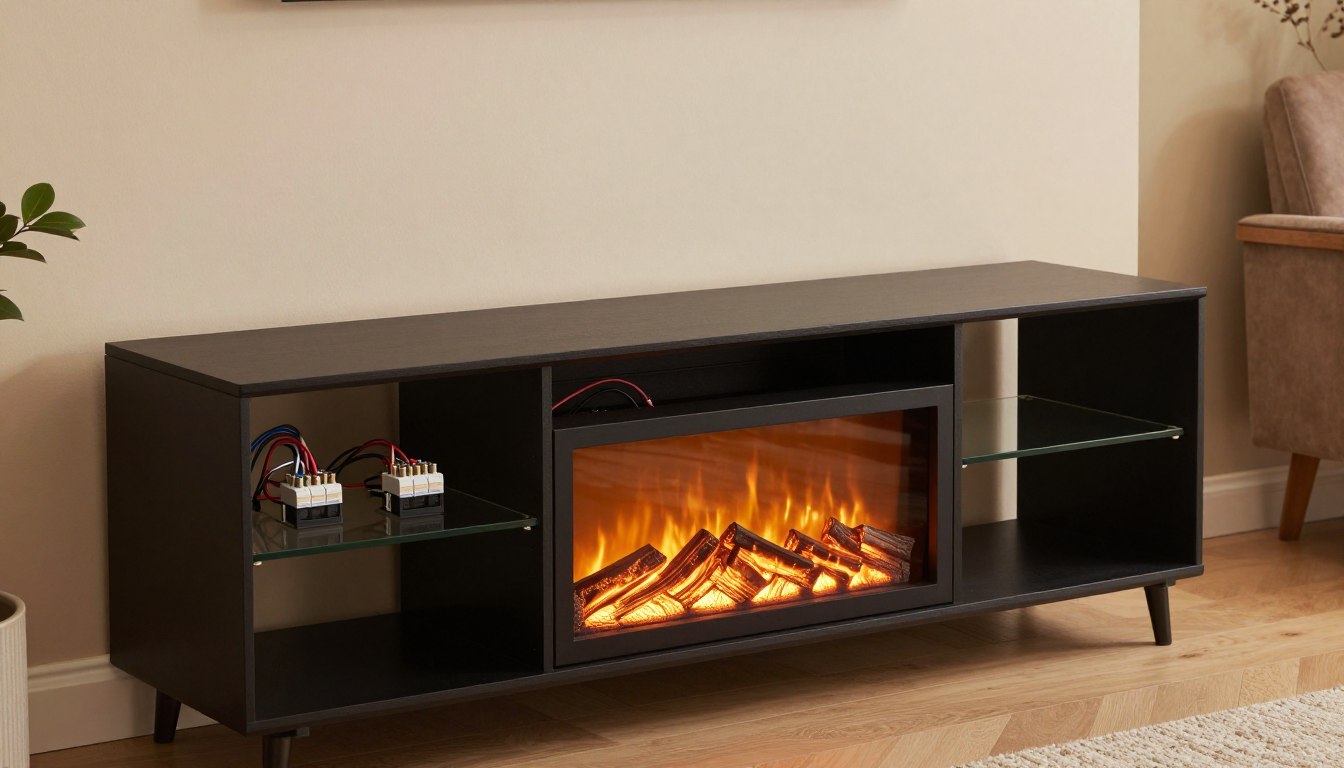
Are There Fuses in a TV Stand Fireplace? Find Out
Affiliate links — we may earn a commission
I remember a cold January night when my living room went chilly. My TV stand fireplace, which I relied on for warmth, suddenly stopped working. No heat, no light. I was left wondering if I’d have to call an electrician or buy a new one.
That night, I searched online, “Are there fuses in a TV stand fireplace?” The answer was yes. Most electric fireplaces have fuses. They protect against electrical issues like overloads and overheating.
These fireplaces are amazing. They offer adjustable heat, realistic flames, storage, and remote control. But, we often overlook the safety features inside until something goes wrong.
Knowing about the electrical parts in your fireplace can save you time and money. A blown fuse doesn’t mean your fireplace is broken. It means it saved your unit from bigger problems.
Let’s explore this together. I’ll share what I learned that cold night. You won’t have to freeze while figuring it out yourself.
Key Takeaways
- Most TV stand fireplaces contain one or more fuses designed to protect internal components from electrical damage.
- Fuses act as a safety mechanism that cuts off electrical current during power surges or overheating events.
- These units require a dedicated 120-volt circuit breaker for safe, reliable operation.
- A blown fuse is often the simplest fix when your electric fireplace stops producing heat.
- Understanding electric fireplace safety features helps you troubleshoot problems quickly without costly service calls.
- Regular maintenance and proper ventilation reduce the risk of blown fuses and extend the life of your unit.
Understanding TV Stand Fireplaces and Their Electrical Components
The first time I opened my TV stand fireplace, I was amazed by the tech inside. These units are more than just furniture. They have electrical safety parts that keep your home warm and safe. Let’s explore what’s behind those flickering flames.
What Makes a TV Stand Fireplace Different
TV stand fireplaces are unique because they store media and heat your home. They have LED flames that look like real fires but without the mess. They use standard outlets and don’t mess with your air conditioning or heating.
Basic Electrical Safety Features
Quality units have built-in safety features. They have sensors, shut-off functions, and fuses to prevent danger. Knowing where your electric fireplace fuse is important for safety.
Common Components Inside Your Unit
Here’s a quick look at what’s inside your fireplace:
| Component | Function | Safety Role |
|---|---|---|
| Heating Element | Generates warmth (up to 5,000 BTUs) | Paired with thermal cutoff switch |
| Thermostat Control | Regulates temperature settings | Prevents overheating cycles |
| Fan System | Distributes heat evenly | Keeps internal temps stable |
| Flame Effect Mechanism | Creates realistic fire visuals via LED filaments | Low-voltage, minimal fire risk |
| Control Panel | Manages all unit operations | Houses fuse and circuit protection |
| Remote Receiver | Accepts wireless commands | Isolated low-power circuit |
Knowing about these safety parts helps when something goes wrong. Next, we’ll see if your unit has fuses and where they are.
Are There Fuses in a TV Stand Fireplace
Yes, and I’m glad they’re there. Most TV stand fireplaces have at least one fuse inside. It acts as a tiny bodyguard against electrical disasters. These small glass or ceramic cylinders are key to keeping your unit safe and working well.
Where Fuses Are Typically Located
Wondering where the fuse is in your fireplace TV stand? I’ve got the answer. Fuses are usually found in two places:
- Inside a lower metal compartment beneath the glass panel of the fireplace insert
- Within the main control panel near the heating element
Some brands, like Duraflame and Twin Star, put fuses on the back of the fireplace insert. You might need a screwdriver to get to them.
Purpose of Fuses in Electric Fireplaces
The fuse in your electric fireplace has one main job: to watch the electrical current. If a power surge or a part breaks, the fuse blows intentionally. This stops the circuit before damage can reach expensive parts like the blower motor or thermostat.
How Fuses Protect Your Investment
Fuses do more than just stop a single surge. They save your investment in many ways:
| Component Protected | Risk Without Fuse | Estimated Replacement Cost |
|---|---|---|
| Blower/Fan Motor | Burnout from power surge | $40–$80 |
| Heating Element | Overheating and failure | $25–$60 |
| Wiring and Insulation | Melting, possible fire hazard | $100+ (professional repair) |
| Control Board | Short circuit damage | $50–$120 |
A new fuse costs about $1 to $3. That’s a great deal compared to the cost of repairs. It’s like the cheapest insurance for your living room.
Electric Fireplace Fuse Location Guide
Finding a tiny fuse in a big TV stand is like a treasure hunt. The “treasure” is a small glass cylinder. I’ve opened many units and found that the fuse’s location changes by brand. Yet, most follow a similar pattern.
In most models, fuses are in a lower metal compartment under the glass front. You’ll need a Phillips-head screwdriver and patience to get to the fuse. After removing the panel, look for a small fuse near the wiring or on the circuit board.
If you’re stuck on a blown tv console fireplace fuse, check your manual first. Each brand puts fuses in different spots. Here’s a quick guide on brands I’ve worked with:
| Brand | Model Example | Fuse Location | Access Method |
|---|---|---|---|
| Twin Star | 28EF023SRA | Main control panel in lower compartment | Remove lower metal panel with screwdriver |
| Dimplex | DFB6016 | Lower metal area near circuit board | Unscrew bottom access panel |
| SimpliFire | SF-ALL series | Lower compartment near wiring | Slide or unscrew lower panel |
| Modern Flames | Redstone series | Rear lower section near power input | Remove rear access cover |
Always unplug the unit before attempting any fuse compartment access — electricity and curiosity make a dangerous pair.
Some units have two fuses: one for the heating and one for the LED flames. Knowing where your fuse is saves time and gets your fireplace working again.
Signs Your TV Stand Fireplace Fuse May Be Blown
Learning that a fireplace tv stand not working can ruin a cozy evening is tough. Spotting blown fuse symptoms early saves time, money, and frustration. Here are the signs I watch for.
Unit Won’t Turn On
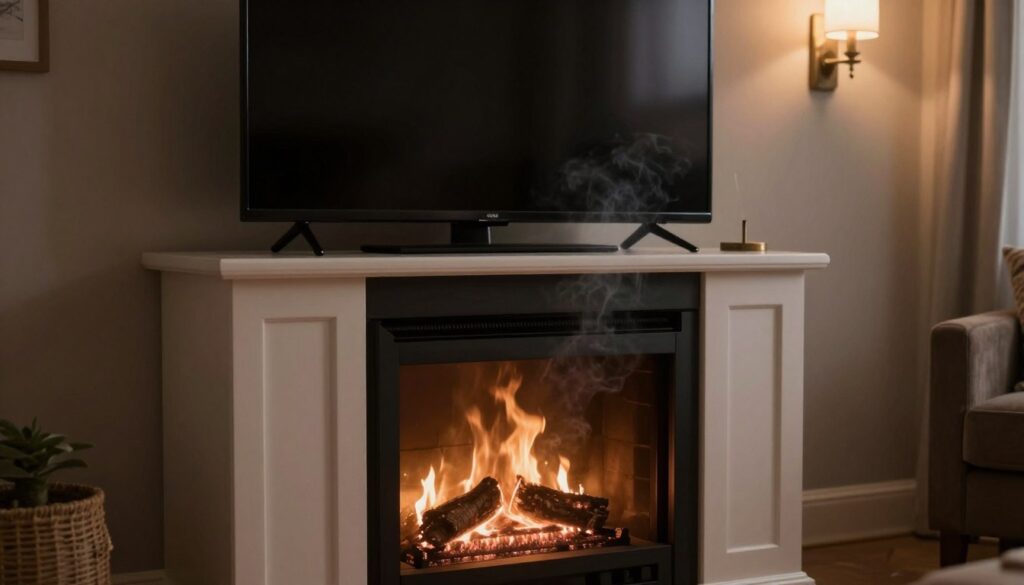
This is the most obvious clue. You press the power button, and nothing happens. No lights, no fan, no flame display — just silence. If your electric fireplace stopped working fuse issues are likely the culprit. Before you panic, make sure the outlet itself works by plugging in another device.
Heating Element Not Working
Your thermostat is cranked up past the room temperature, but the air blowing out feels cold. The heater refuses to kick in. This tells me the fuse protecting the heating circuit has likely given up the ghost. You might notice dimly glowing embers or hear unusual buzzing sounds from components straining to operate.
Circuit Breaker Issues
If your home’s circuit breaker keeps tripping every time you run the fireplace, pay attention. This often means your unit shares a circuit with too many devices. A faulty fuse inside the fireplace can cause repeated tripping as well. I recommend checking whether your unit runs on a dedicated 15-amp or 20-amp circuit.
Flame Effects Working but No Heat
This is the sneaky one. The LED flames dance beautifully, the logs glow — yet zero warmth comes out. That’s because most TV stand fireplaces use separate fuses for the flame effects and the heating element. The heating fuse blew, but the flame circuit stayed intact.
A fireplace that lights up but won’t heat is like a sports car with no engine — it looks great but won’t get the job done.
| Symptom | Likely Cause | Urgency Level |
|---|---|---|
| Unit completely dead | Main fuse blown | High |
| No heat, display works | Heater fuse blown | Medium |
| Breaker keeps tripping | Overloaded circuit or faulty fuse | High |
| Auto shutoff activates | Overheat protection triggered | Medium |
Once you’ve identified these blown fuse symptoms, it’s time to locate and access the fuse compartment — which I’ll walk you through next.
How to Access the Fuse Compartment
Learning to access the fuse compartment safely is simpler than putting together flat-pack furniture. It’s also less stressful. Before you start, let’s go through each step of tv stand fireplace troubleshooting. This way, you can avoid getting shocked or voiding your warranty.
Safety First: Unplugging Your Unit
Remember, always disconnect your fireplace from the 120-volt power outlet before starting work. Make sure it’s unplugged completely — don’t just turn off a switch. Clear the area of any decorations, media, or clutter. You need a safe space with no risk of electrical shock.
Removing the Lower Metal Panel
Removing the electric fireplace panel is easy. Use a Phillips-head screwdriver to find and remove the screws holding the lower metal panel. Store the screws in a small cup or magnetic tray. Losing one screw can mess up your whole day.
After removing the screws, gently slide or pull the panel away. Don’t force it. Some models have clips that need a bit of wiggle to come loose.
Locating the Main Control Panel
With the panel off, you’ll see the wiring and circuit board. Look for a small glass fuse near the wiring or on the control board. Check for dark burns or a broken filament. These signs mean the fuse is blown.
| What to Look For | What It Means | Next Step |
|---|---|---|
| Clear glass fuse, intact filament | Fuse is working | Check other components |
| Dark or cloudy glass fuse | Fuse is blown | Replace with matching fuse |
| Reset button near control board | Minor overload occurred | Press reset, test the unit |
Some models, like Duraflame and Twin Star, have a reset button near the control board. Press it before replacing anything. It might fix the issue without needing a trip to the store.
TV Stand Fireplace Troubleshooting Basics
Before you panic and toss your fireplace out the window, let me guide you. I’ve found that most electric fireplace problems have simple fixes. It’s often easier than you think.
First, check the basics. Is the plug actually secure in the outlet? Many times, a loose connection is the whole issue. Try plugging in a lamp or phone charger to test the outlet.
Next, follow these steps:
- Check your remote control batteries — replace them and make sure they’re inserted correctly with clean contacts.
- Point the remote directly at the receiver on the unit, not at the ceiling like you’re hailing a cab.
- Inspect your home’s circuit breaker panel for a tripped breaker and reset it if needed.
- Verify the thermostat is set above the current room temperature — the heater won’t kick on if it thinks the room is warm enough.
- Look at the vents for dust buildup or blockages restricting airflow.
- Try a hard reset: unplug the unit, wait 30 seconds, and plug it back in.
Many electric fireplace problems are due to poor airflow or dust. A quick vacuum around the vents can fix it in minutes. Also, check for loose wires or damage inside.
A good rule of thumb: if these basic fixes don’t solve the issue, it’s time to check the fuse — which I’ll cover in the next section with a full step-by-step replacement guide.
Good tv stand fireplace troubleshooting saves you time, money, and stress. Patience is key here.
Replace Fuse in Electric Fireplace: Step-by-Step Process
Ready to get your hands a little dirty? Replacing the fuse is easier than setting up your TV stand. Just grab your user manual, needle-nose pliers, and a new fuse. Let’s get your fireplace working again.
Identifying the Correct Fuse Type
Before you start, make sure you have the right fuse type. Most electric fireplaces use small glass tube fuses for 120-volt circuits. Check your manual for the correct amperage rating. Using the wrong fuse can cause problems.
| Fuse Specification | Common Rating |
|---|---|
| Voltage | 120V or 250V |
| Amperage | 10A, 15A, or 20A |
| Size | 20mm or 1.25-inch glass tube |
Removing the Old Fuse Safely
First, unplug your unit. Then, find the fuse holder inside. Use needle-nose pliers to remove the blown fuse. Look for signs of failure like a blackened interior or broken wire. Never yank or twist aggressively.
Installing the New Fuse
Replacing the fuse is easy. Just slide the new fuse into the empty slot until it clicks. Make sure it’s seated properly. Then, put back the access panel and tighten the screws.
“A properly seated fuse is a safe fuse — if it wobbles, it’s trouble.” — National Electrical Manufacturers Association guidelines
Testing Your Fireplace
Plug your unit into a dedicated circuit breaker outlet. Test each function:
- Power on/off
- Heating element at low and high settings
- LED flame effects
- Remote control responsiveness
If everything works, you did it! If not, don’t worry. I have troubleshooting tips in the next section.
When Your Fireplace TV Stand Not Working Despite Fuse Replacement
So, you replaced the fuse and did a little dance. But, nothing worked. It feels like a joke. But, don’t worry, there are other reasons it might not work.
Checking Other Electrical Components
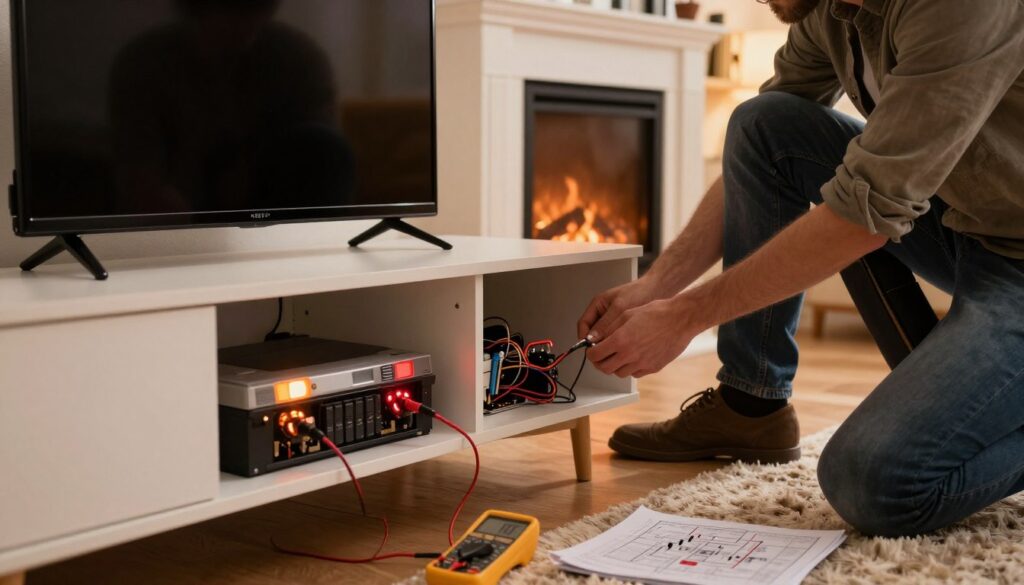
After replacing the fuse, check other parts. Make sure your outlet has 120 volts on a dedicated circuit. Too many devices on one circuit can cause problems.
Look inside the lower part and check the wiring. Loose or frayed wires can cause issues. Also, check the heating elements for damage. A spinning fan that makes noise means it’s mechanical trouble.
Some fireplaces, like the Dimplex DFB6016, need both bulbs to work right.
Remote Control Battery Issues
Dead batteries in the remote can trick you. It’s simple but often overlooked. Try new batteries and follow the manual for pairing.
Thermostat Settings and Controls
Maybe your thermostat is too high. Try lowering it. Also, check if your surge protector is working. A tripped protector can make it seem like your unit is dead.
| Issue | Quick Check | Likely Fix |
|---|---|---|
| No power at all | Test outlet with another device | Try a different outlet or dedicated circuit |
| Loose internal wiring | Visual inspection of lower panel | Reconnect or call a technician |
| Remote not responding | Replace batteries | Re-pair remote per manual |
| Heat won’t engage | Check thermostat setting | Lower thermostat below room temp |
| Surge protector tripped | Press reset button on strip | Plug directly into wall outlet |
Popular Models and Their Specific Fuse Locations
I’ve spent way too much time looking for tiny fuses inside fireplace TV stands. Each brand puts its fuses in different spots. Knowing where the fuse is for your exact unit is key.
The Twin Star 28EF023SRA has its fuses inside the main control panel. You can reach them by opening a lower metal compartment. Dimplex owners, like those with the DFB6016 and Ignitexl 74 Linear, find fuses in lower compartments just below the glass front. Accessing fuses on these units is straightforward.
The SimpliFire Scion 55 Built-in Linear has a simple lower compartment design. I find this design easy to use. The Modern Flames Orion Slim 60 Virtual has fuse placement and safety switches that prevent overheating. Remii Electric Fireplaces have plug-in setups with easy-to-access fuse compartments.
Here’s a quick breakdown for brand-specific troubleshooting across these popular units:
| Brand & Model | Fuse Location | Access Method | Safety Feature |
|---|---|---|---|
| Twin Star 28EF023SRA | Main control panel | Lower metal compartment removal | Standard fuse protection |
| Dimplex DFB6016 | Lower compartment below glass | Front panel removal | Thermal cutoff switch |
| Dimplex Ignitexl 74 Linear | Lower compartment below glass | Bottom access panel | Thermal cutoff switch |
| SimpliFire Scion 55 | Lower compartment | Direct panel access | Built-in circuit protection |
| Modern Flames Orion Slim 60 | Integrated control area | Lower access panel | Overheat prevention switch |
| Remii Electric Fireplaces | Near plug-in connection | Rear or bottom panel | Inline fuse holder |
Always check your model-specific manual before opening any compartment. The right fuse type and exact placement can vary, even between units from the same brand.
Choosing the right fuse for your specific unit is important. Using the wrong amp rating can be dangerous. Always double-check your owner’s manual before making any changes.
Preventive Maintenance to Avoid Blown Fuses
Electric fireplace maintenance is like cheap insurance. A few minutes each month can stop blown fuses. This keeps your living room warm on chilly nights. Here’s my simple routine.
Regular Cleaning and Dust Removal
Dust is a silent enemy of electric fireplaces. I clean mine once a month, focusing on fans, vents, and the control panel. Dust makes components work harder, leading to extra heat and fuse strain. A can of compressed air and a soft brush clean it all in under ten minutes.
Proper Ventilation Requirements
Your fireplace needs to breathe. I’ve seen people cover their TV stands or block vents with pillows. This causes overheating and trips safety mechanisms. Make sure there’s at least three inches of space around all vents and the log cavity.
Using Dedicated Circuits
Knowing about dedicated circuits is smart. Plug your fireplace into its own 120-volt circuit breaker. Don’t share it with space heaters, microwaves, or hair dryers. Sharing circuits with high-amp appliances quickly blows a fuse.
| Maintenance Task | Frequency | Why It Matters |
|---|---|---|
| Dust fans and vents | Monthly | Prevents overheating |
| Check wire connections | Every 6 months | Catches wear before failure |
| Verify level placement | Seasonally | Ensures structural stability |
| Inspect dedicated circuit load | Annually | Avoids circuit overloading |
Avoiding Overloading
Don’t go over the weight limit in your owner’s manual. Too much weight can cause structural issues and loosen wiring. Use adjustable feet or shims to keep it level on uneven floors. A stable unit is a safe unit, and it keeps its fuses intact.
Professional Help vs. DIY Repairs
Being handy is great, but there’s a limit. Swapping a fuse is okay for a weekend project. But, rewiring a control panel is a job for the pros.
Knowing when to DIY and when to call a pro can save you money. It might even save your fireplace TV stand.
When to Call a Technician
If your fuse keeps blowing, something deeper is going on. Electrical faults, short-circuited wires, or failing parts need a pro. A certified tech has the tools to find problems you can’t.
“The cheapest repair is the one you only have to do once.”
Warranty Considerations
Opening your unit too much can void your warranty. Most makers, like Duraflame and Twin Star International, need authorized service for anything more than fuse swaps. Keep records of maintenance, including receipts and photos. Your warranty depends on the proof you have.
Cost-Benefit Analysis
Let’s look at the costs:
| Repair Type | DIY Cost | Professional Cost | Risk Level |
|---|---|---|---|
| Fuse Replacement | $2–$5 | $75–$150 | Low |
| Control Panel Repair | $20–$50 (parts) | $100–$250 | High |
| Wiring/Short Circuit Fix | Not Recommended | $150–$300 | Very High |
DIY is fine for simple fuse swaps. But, for wiring, circuit boards, or heating elements, get a pro. A bad DIY job can cost you a lot more.
Conclusion
Yes, your TV stand fireplace has fuses. They work hard to keep your unit safe from electrical issues and overheating. Think of them as tiny bodyguards for your living room.
When a fuse blows, knowing how to find and replace it saves a lot of trouble. It’s a small task that can make a big difference.
For easy maintenance, clean dust off monthly, use a dedicated circuit, and keep vents open. These steps help prevent fuse issues and make your fireplace last longer. Replacing an electric fireplace fuse is simple with a screwdriver and patience.
But, if you’re unsure or it’s more complicated, call a certified technician. They can avoid warranty issues and save you money. Brands like Duraflame and Twin Star International have customer support lines for help.
Take good care of your TV stand fireplace, and it will keep you warm and entertained for years. A little effort now can save you from expensive repairs later.
Are there fuses in a TV stand fireplace?
Where is the electric fireplace fuse location in most models?
How do I know if my TV stand fireplace fuse is blown?
How do I replace a fuse in an electric fireplace?
Why does my electric fireplace keep blowing fuses?
What should I do when my fireplace TV stand is not working even after fuse replacement?
Can I use any fuse to replace the one in my TV stand fireplace?
How often should I inspect the fuse in my electric fireplace?
Should I repair my electric fireplace myself or call a professional?
Do specific electric fireplace brands have different fuse locations?
What is the purpose of a reset button on my electric fireplace, and is it related to the fuse?

giveitlegs@live.com
Contributing writer covering Honest reviews & buying help for fireplace TV stands and electric media consoles..